


The US has sharpened its assault on China’s technology industry with a flurry of export bans and stifling restrictions on companies, an escalation that leaves Beijing with few options for retaliation.
Washington’s moves are part of a strategy to prevent China from dominating the industries of the future and arming its military with advanced weaponry, while also securing its tech supply chain by enticing chipmakers to set up shop in the US.
US President Joe Biden’s administration this week escalated those efforts, blacklisting dozens of Chinese tech firms, while signs emerged Japan and the Netherlands are aligning with US restrictions on selling crucial chipmaking equipment to China, a major blow to Beijing’s ambitions to produce advanced semiconductors.
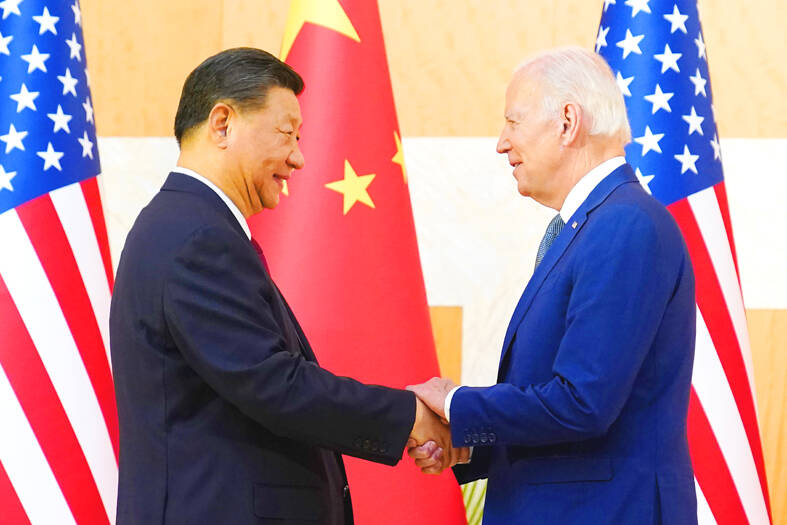
Photo: AP
China has accused the US of protectionism, lodged a complaint with the WTO and courted chipmaking powerhouse South Korea, a key US ally. Beijing is also reportedly preparing a multibillion-dollar aid package for its semiconductor industry, a crucial sector for the global economy.
However, China does not have many options, or incentives, to go further. Any moves to block US investment threatens an economy already reeling from China’s zero-tolerance COVID-19 policies, which are being rolled back.
“China’s lack of good options is precisely why the US is striking hard and fast now with export controls,” said Rhodium Group director Reva Goujon, who advises corporate clients on US-China relations and industrial policies.
Beijing’s response to the recent US moves on semiconductors has been “very reserved,” said Wang Huiyao (王輝耀), founder of the Center for China and Globalization, a policy research group in Beijing.
The new actions unveiled this week — which follow export controls announced in October aimed at preventing China’s access to machines and knowhow to make high-end chips — placed a number of Chinese companies on a so-called Entity List, requiring suppliers to get difficult-to-obtain US government licenses.
Among the most notable firms on that list is emerging chip equipment-maker Shanghai Micro Electronics Equipment Group Co (SMEE, 上海微電子), which could stifle Beijing’s efforts to create next-generation semiconductors. The machines that make the chips are among the most complicated devices produced by humans, and defy reverse engineering, making it difficult for China to develop its own domestic capabilities if it cannot get the equipment elsewhere.
“Having SMEE on the Entity List is a major blow for China’s chip sector,” said former CIA analyst Martijn Rasser, now a senior fellow at the Center for a New American Security.
“It’s the one company that Beijing saw as having potential to produce advanced chipmaking machines, which is essential for China to be a competitive force in the global semiconductor ecosystem,” he said. “Those hopes are now greatly diminished, if not dashed altogether.”
Even if China wins the WTO case, the US can veto any ruling by bringing it to the trade organization’s appellate body.
China’s best option might be to pour money into developing its own high-tech chips. Beijing is preparing to unleash a US$143 billion aid package for its chip industry, but it is not clear how much impact this might have.
“They can invest more, but the issues right now are not really a lack of resources,” Council on Foreign Relations technology analyst Adam Segal said. “It’s these technological chokepoints they are still vulnerable to.”
There is a risk that unilateral actions could alienate key US partners, Carnegie Endowment for International Peace senior fellow Jon Bateman said.
Beijing has not shown a willingness to leverage its dominance of rare earth minerals or its role as a manufacturing hub because it “has more to lose than to gain,” Bateman said.
“China has a lot of capability to retaliate, but very limited willingness to do so thus far,” he added.

CREDIT-GRABBER: China said its coast guard rescued the crew of a fishing vessel that caught fire, who were actually rescued by a nearby Taiwanese boat and the CGA Maritime search and rescue operations do not have borders, and China should not use a shipwreck to infringe upon Taiwanese sovereignty, the Coast Guard Administration (CGA) said yesterday. The coast guard made the statement in response to the China Coast Guard (CCG) saying it saved a Taiwanese fishing boat. The Chuan Yu No. 6 (全漁6號), a fishing vessel registered in Keelung, on Thursday caught fire and sank in waters northeast of Diaoyutai Islands (釣魚台). The vessel left Keelung’s Badouzih Fishing Harbor (八斗子漁港) at 3:35pm on Sunday last week, with seven people on board — a 62-year-old Taiwanese captain surnamed Chang (張) and six
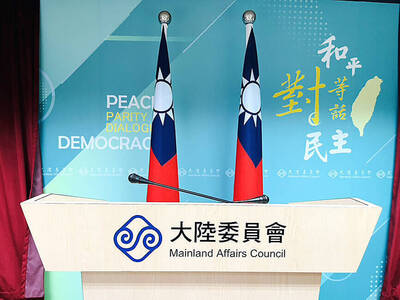
RISKY BUSINESS: The ‘incentives’ include initiatives that get suspended for no reason, creating uncertainty and resulting in considerable losses for Taiwanese, the MAC said China’s “incentives” failed to sway sentiment in Taiwan, as willingness to work in China hit a record low of 1.6 percent, a Ministry of Labor survey showed. The Directorate-General of Budget, Accounting and Statistics (DGBAS) also reported that the number of Taiwanese workers in China has nearly halved from a peak of 430,000 in 2012 to an estimated 231,000 in 2024. That marked a new low in the proportion of Taiwanese going abroad to work. The ministry’s annual survey on “Labor Life and Employment Status” includes questions respondents’ willingness to seek employment overseas. Willingness to work in China has steadily declined from

The number of pet cats in Taiwan surpassed that of pet dogs for the first time last year, reaching 1,742,033, a 32.8 percent increase from 2023, the Ministry of Agriculture said yesterday, citing a survey. By contrast, the number of pet dogs declined slightly by 1.2 percent over the same period to 1,462,528, the ministry said. Despite the shift, households with dogs still slightly outnumber those with cats by 1.2 percent. However, while the number of households with multiple dogs has remained relatively stable, households keeping more than two cats have increased, contributing to the overall rise in the feline population. The trend

The Legislative Yuan’s Finance Committee yesterday approved proposed amendments to the Amusement Tax Act (娛樂稅法) that would abolish taxes on films, cultural activities and competitive sporting events, retaining the fee only for dance halls and golf courses. The proposed changes would set the maximum tax rate for dance halls and golf courses at 50 and 20 percent respectively, with local governments authorized to suspend the levies. Article 2 of the act says that “amusement tax shall be levied on tickets sold or fees charged by amusement places, facilities or activities” in six categories: “Cinema; professional singing, story-telling, dancing, circus, magic show, acrobatics


 RSS
RSS