


The army yesterday introduced changes to military physical fitness standards across the armed forces to take effect next year.
The fitness evaluations include planking, slow push-ups, dumbbell lifting, crunching, sit-and-reach, back-scratch and a 10km march, army officers told a news conference at the Ministry of National Defense headquarters.
These tests are to complement current fitness trials — which include sit-ups, push-ups and a 3km run — and are to take effect on Dec. 1 next year, they said.
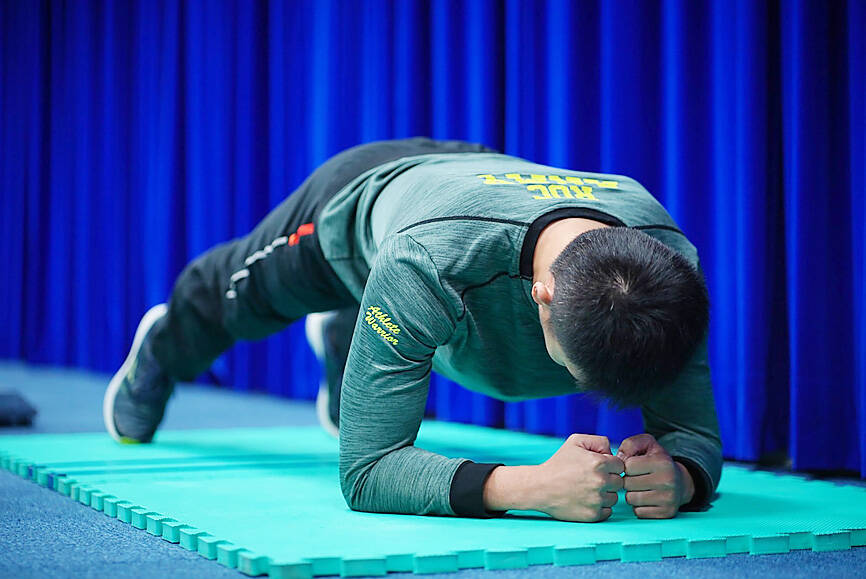
Photo: CNA
The new tests were created by the Army Infantry Training Command in consultation with the National Sports Training Center to modernize fitness training in the military, said Major General Liu Shen-mo (劉慎謨), director of the Military Training Division’s Office of the Deputy Chief of the General Staff for Training.
The fitness assessments are based on US Army standards, he added.
Tank loaders need arm strength to load shells into their vehicles, while cardiovascular fitness and core conditioning are required for infantry tasks such as shooting and changing posture, he said.
The army’s fitness reform also introduces exercises that reduce injuries and incorporates advances in civilian sport science, National Sports Center sports science division head Wu Po-han (吳柏翰) said.
The US Army has adopted planking as a substitute for sit-ups, while the US Navy has incorporated aerobic test options including running, rowing and swimming, he said, adding that Taiwan’s military is to follow the US in utilizing these activities in fitness programs.
The military has over the past two years certified more than 3,400 service members as instructors in physical training, sports science, swimming and martial arts in an effort to improve soldier training, said Colonel Hsiao Chia-ming (蕭嘉銘) of the Army Infantry Training Command’s sports science promotion center.
Separately, the ministry’s plans to lengthen conscription are not ready to be publicly released, ministry spokesman Sun Li-fang (孫立方) said, citing the need for officials to calibrate the policy to meet requirements for the nation’s defense and laws.
Additional reporting by Aaron Tu
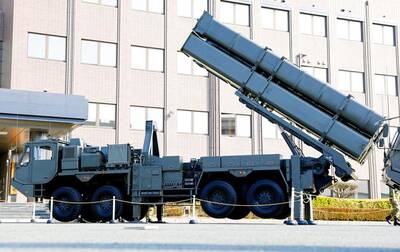
Japan has deployed long-range missiles in a southwestern region near China, the Japanese defense minister said yesterday, at a time when ties with Beijing are at their lowest in recent years. The missiles were installed in Kumamoto in the southern region of Kyushu, as Japan is attempting to shore up its military capacity as China steps up naval activity in the East China Sea. “Standoff defense capabilities enable us to counter the threat of enemy forces attempting to invade our country ... while ensuring the safety of our personnel,” Japanese Minister of Defense Shinjiro Koizumi said. “This is an extremely important initiative for
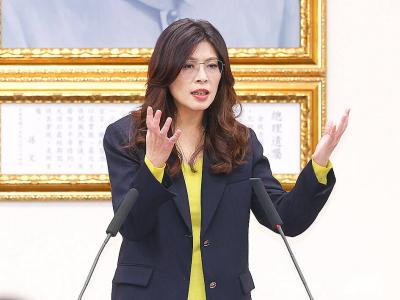
Chinese Nationalist Party (KMT) Chairwoman Cheng Li-wun (鄭麗文) today accepted an invitation from Chinese President Xi Jinping (習近平) to lead a delegation to China next month, saying she hopes to promote the peaceful development of cross-strait relations and bring stability to the Taiwan Strait. “I am grateful and happy to accept this invitation,” Cheng said in a statement from the KMT chairperson’s office. Cheng said she hopes both sides can work together to promote the peaceful development of cross-strait relations, enhance exchange and cooperation, bring stability to the Taiwan Strait and improve people’s livelihoods. At today's news conference, Cheng said any efforts to
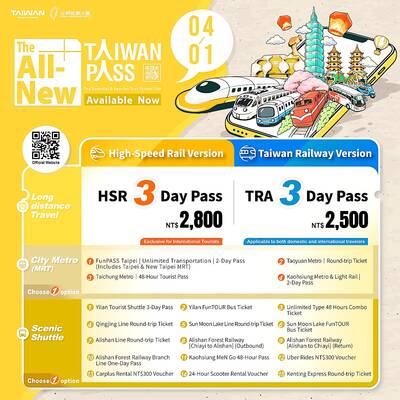
MORE POPULAR: Taiwan Pass sales increased by 59 percent during the first quarter compared with the same period last year, the Tourism Administration said The Tourism Administration yesterday said that it has streamlined the Taiwan Pass, with two versions available for purchase beginning today. The tourism agency has made the pass available to international tourists since 2024, allowing them to access the high-speed rail, Taiwan Railway Corp services, four MRT systems and four Taiwan Tourist Shuttles. Previously, five types of Taiwan Pass were available, but some tourists have said that the offerings were too complicated. The agency said only two types of Taiwan Pass would be available, starting from a three-day pass with the high-speed rail and a three-day pass with Taiwan Railway Corp. The former costs NT$2,800

The nation’s fastest supercomputer, Nano 4 (晶創26), is scheduled to be launched in the third quarter, and would be used to train large language models in finance and national defense sectors, the National Center for High-Performance Computing (NCHC) said. The supercomputer, which would operate at about 86.05 petaflops, is being tested at a new cloud computing center in the Southern Taiwan Science Park in Tainan. The exterior of the server cabinet features chip circuitry patterns overlaid with a map of Taiwan, highlighting the nation’s central position in the semiconductor industry. The center also houses Taiwania 2, Taiwania 3, Forerunner 1 and


 RSS
RSS