


Ukraine yesterday welcomed a US$60 price cap on Russian oil agreed by the EU, G7 and Australia, saying it would “destroy” Russia’s economy.
The price cap, previously negotiated on a political level between G7 nations and the EU, is to come into effect with an EU embargo on Russian crude oil from tomorrow.
Poland had refused to back the price cap plan over concerns the ceiling was too high, before its ambassador to the EU confirmed Warsaw’s agreement on Friday evening.

Photo: EPA-EFE
The embargo would prevent shipments of Russian crude by tanker vessel to the EU, which account for two-thirds of imports, potentially depriving Russia’s war chest of billions of euros.
“We always achieve our goal and Russia’s economy will be destroyed, and it will pay and be responsible for all its crimes,” Ukrainian Presidential Office head Andriy Yermak wrote on Telegram yesterday.
However, a cap of “US$30 would have destroyed it more quickly,” he added.
The G7 said it was delivering on its vow “to prevent Russia from profiting from its war of aggression against Ukraine, to support stability in global energy markets and to minimize negative economic spillovers of Russia’s war of aggression.”
The White House described the deal as “welcome news,” saying a price cap would help limit Russian President Vladimir Putin’s ability to fund the Kremlin’s “war machine.”
After humiliating defeats during what has become the largest armed conflict in Europe since World War II, Russia began targeting Ukrainian energy infrastructure in October, causing sweeping blackouts.
Putin said Russian strikes on Ukrainian infrastructure were “inevitable,” in his first conversation with German Chancellor Olaf Scholz since mid-September.
“Such measures have become a forced and inevitable response to Kyiv’s provocative attacks on Russia’s civilian infrastructure,” Putin told Scholz, a Kremlin readout of the telephone talks showed.
During the hour-long call, Scholz “urged the Russian president to come as quickly as possible to a diplomatic solution, including the withdrawal of Russian troops,” the German leader’s spokesman said.
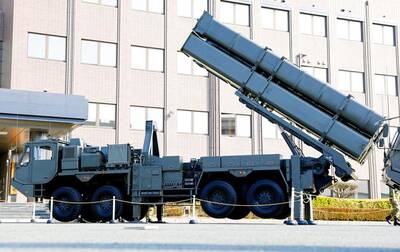
Japan has deployed long-range missiles in a southwestern region near China, the Japanese defense minister said yesterday, at a time when ties with Beijing are at their lowest in recent years. The missiles were installed in Kumamoto in the southern region of Kyushu, as Japan is attempting to shore up its military capacity as China steps up naval activity in the East China Sea. “Standoff defense capabilities enable us to counter the threat of enemy forces attempting to invade our country ... while ensuring the safety of our personnel,” Japanese Minister of Defense Shinjiro Koizumi said. “This is an extremely important initiative for

Chinese Nationalist Party (KMT) Chairwoman Cheng Li-wun (鄭麗文) today accepted an invitation from Chinese President Xi Jinping (習近平) to lead a delegation to China next month, saying she hopes to promote the peaceful development of cross-strait relations and bring stability to the Taiwan Strait. “I am grateful and happy to accept this invitation,” Cheng said in a statement from the KMT chairperson’s office. Cheng said she hopes both sides can work together to promote the peaceful development of cross-strait relations, enhance exchange and cooperation, bring stability to the Taiwan Strait and improve people’s livelihoods. At today's news conference, Cheng said any efforts to

MORE POPULAR: Taiwan Pass sales increased by 59 percent during the first quarter compared with the same period last year, the Tourism Administration said The Tourism Administration yesterday said that it has streamlined the Taiwan Pass, with two versions available for purchase beginning today. The tourism agency has made the pass available to international tourists since 2024, allowing them to access the high-speed rail, Taiwan Railway Corp services, four MRT systems and four Taiwan Tourist Shuttles. Previously, five types of Taiwan Pass were available, but some tourists have said that the offerings were too complicated. The agency said only two types of Taiwan Pass would be available, starting from a three-day pass with the high-speed rail and a three-day pass with Taiwan Railway Corp. The former costs NT$2,800

The nation’s fastest supercomputer, Nano 4 (晶創26), is scheduled to be launched in the third quarter, and would be used to train large language models in finance and national defense sectors, the National Center for High-Performance Computing (NCHC) said. The supercomputer, which would operate at about 86.05 petaflops, is being tested at a new cloud computing center in the Southern Taiwan Science Park in Tainan. The exterior of the server cabinet features chip circuitry patterns overlaid with a map of Taiwan, highlighting the nation’s central position in the semiconductor industry. The center also houses Taiwania 2, Taiwania 3, Forerunner 1 and


 RSS
RSS