


A pledge to defend Taiwan and never surrender has garnered 263 signatures among candidates in Saturday’s local elections, independence advocates said yesterday.
All 21 of the Democratic Progressive Party’s (DPP) county commissioner and mayoral candidates signed the pledge, but no candidates from the Chinese Nationalist Party (KMT) or Taiwan People’s Party (TPP) signed it, they said.
China’s “hardline” approach to Taiwan has intensified since the Chinese Communist Party’s (CCP) 20th National Congress, at which Chinese President Xi Jinping (習近平) refused to renounce the use of force against Taiwan, World United Formosans for Independence chairman Chen Nan-tien (陳南天) said.
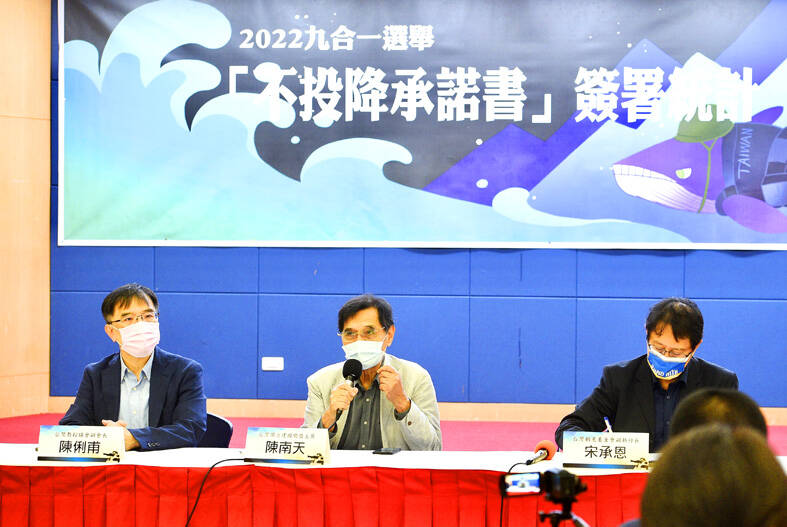
Photo: Lo Pei-der, Taipei Times
The decision of the DPP mayoral candidates in the six special municipalities to sign the pledge was in stark contrast with the inaction of the KMT and TPP candidates, Chen said, adding that the results “make it clear who is friend, foe and traitor.”
There were 37 signatories among candidates for city council seats in Kaohsiung, 24 in Taipei, 22 in New Taipei City, 11 in Taoyuan, 32 in Taichung and 20 in Tainan, the organizers of the pledge said.
In other city and county councils, 24 Taiwan Statebuilding Party members signed the pledge, while there were 15 from the Taiwan Obasang Political Equality Party and 26 from the DPP’s Taiwan Forward faction, the organizers said.
Two TPP councilor candidates from outside the six special municipalities signed, one in Tainan and one in Kaohsiung, they said.
Freedom of speech allows people to express pro-unification views, but voters should reject such candidates, as Taiwan must resist China’s ambitions to annex the nation, Taiwan New Constitution Foundation deputy director Sung Cheng-en (宋承恩) said.
Taiwanese should harbor no illusions about China, which is the nation’s main adversary, Sung said, adding that the KMT’s absence from the pledge undermines its lip service to defend the Republic of China.
Taiwan Association of University Professors deputy chairman Chen Li-fu (陳俐甫) urged voters to reject politicians who might collude with the enemy.
Although the DPP’s mayoral and county commissioner candidates supported the pledge, some of the party’s candidates running for local posts did not sign it, Presbyterian Church in Taiwan representative Lin Wei-lien (林偉聯) said, before asking members of churches represented by his organization to not vote for such candidates.
China has long meddled in Taiwan’s elections and its operatives are waiting to see what will happen on Saturday, Taiwan Statebuilding Party Secretary-General Wang Hsing-huan (王興煥) said.
The local elections will affect the perception of Taiwan internationally and has ramifications for the 2024 presidential election, Wang said.

The National Chungshan Institute of Science and Technology yesterday showcased its locally developed variants of the Vision 60 robotic patrol dog, which it plans to deploy on the nation’s outlying territories in the South China Sea. The variants were produced under the Joint Lab project — created by the institute and domestic companies — and assembled with domestically produced motors, lenses and artificial intelligence (AI) systems alongside licensed tech from the US, Missile and Rocket Systems Research Division deputy director Jen Kuo-kang (任國光) told the media event at a military base in Taipei’s Dazhi (大直) area. Taiwan has built up its strengths

RIGHT DIRECTION: Taiwan’s efforts to prevent forced labor include a proposal to ‘fully prohibit’ employers from withholding workers’ documents, an official said Taiwan is to establish a mechanism to restrict imports of goods linked to forced labor, the Executive Yuan said yesterday, after the US proposed imposing additional tariffs on Taiwanese goods over labor concerns. “The Ministry of Labor and the Ministry of Economic Affairs are to establish an interministerial review procedure,” Executive Yuan spokesperson Michelle Lee (李慧芝) said at a news briefing in Taipei. “The government is to use the Foreign Trade Act [貿易法] as the legal basis to restrict imports of goods produced with forced labor” and bring its supply chain governance more in line with international standards on human rights, resilience

NOT IMMEDIATE: Taiwan has a chance to appeal the proposed 10 percent tariff before it starts, while other countries face a 12.5 percent tariff from the trade office Taiwan is among 60 economies determined by the US to have failed to impose or enforce a ban on the importation of goods produced with forced labor, according to a notice released on Tuesday by the Office of the US Trade Representative (USTR), which proposed imposing an additional 10 percent or more tariff on them. The USTR in a statement said that following an investigation, it had determined under Section 301 of the Trade Act of 1974 that the failure of the 60 economies to impose and effectively enforce a prohibition on the importation of goods produced with forced labor is

TIT-FOR-TAT: The US allegedly revoked the visa of a Chinese national working at Xinhua News Agency in the US in response to Beijing’s expulsion of Vivian Wang The Presidential Office yesterday condemned China for expelling a New York Times correspondent from Beijing following the newspaper’s interview with President William Lai (賴清德), saying the move highlighted Beijing’s suppression of press freedom and its threat to international news media. Taiwan has noted a series of recent incidents in which Beijing used similar tactics to “threaten and pressure international media outlets and journalists,” Presidential Office spokeswoman Karen Kuo (郭雅慧) said in a statement. “This concerns not only press freedom and freedom of expression, but also the safety of journalists, and Taiwan and relevant partners are paying close attention to the situation,” she


 RSS
RSS