


The owners of Kaohsiung news outlet China VTV Co (中華微視公司) are being investigated for having alleged financial connections with China, and for allegedly conducting a disinformation campaign to create social division and mistrust in Taiwan’s government.
Tsai Yue-ting (蔡岳廷) and his ex-wife, Chang Chiao-lin (張巧琳), were questioned by judicial investigators after evidence reportedly showed that the couple had received 3 million yuan (US$421,354) from its parent company’s offices in Beijing and Hong Kong.
The outlet provides news programming on social media sites including YouTube and Facebook.

Photo courtesy of the Ministry of Justice Investigation Bureau
Authorities determined that China VTV was attempting to induce public alarm in a posting titled “Japan readying evacuation of its citizens from Taiwan due to an emergency in the Taiwan Strait.”
Tsai was found to have signed a partnership agreement with China VTV Holding Co chairman Song Tijin (宋體金), who has been linked to the Chinese People’s Liberation Army, the Ministry of Justice Investigation Bureau said on Friday.
“The agreement called for the company’s entities in China and Hong Kong to provide 3 million yuan for Song’s representative companies to obtain 67 percent shares in Taiwan-registered China VTV Co, the bureau said.
Computers and communication records were seized, and nine people were summoned for questioning, including Tsai and Chang, who reside in New Taipei City.
Tsai was released on NT$90,000 bail and Chang on NT$50,000 bail.
Bureau officials said the two face charges of illegal company registration, illegal funding by a Chinese entity and tax evasion under the Company Act (公司法) and the Business Entity Accounting Act (商業會計法), and of contravening legal statutes governing relations between Taiwan and China.
After looking through computer and phone records, investigators alleged Tsai and Chang were taking instruction from executives in China to establish and operate programming for social media produced by outlets in Beijing and Hong Kong in what the bureau called “propaganda efforts."

CREDIT-GRABBER: China said its coast guard rescued the crew of a fishing vessel that caught fire, who were actually rescued by a nearby Taiwanese boat and the CGA Maritime search and rescue operations do not have borders, and China should not use a shipwreck to infringe upon Taiwanese sovereignty, the Coast Guard Administration (CGA) said yesterday. The coast guard made the statement in response to the China Coast Guard (CCG) saying it saved a Taiwanese fishing boat. The Chuan Yu No. 6 (全漁6號), a fishing vessel registered in Keelung, on Thursday caught fire and sank in waters northeast of Diaoyutai Islands (釣魚台). The vessel left Keelung’s Badouzih Fishing Harbor (八斗子漁港) at 3:35pm on Sunday last week, with seven people on board — a 62-year-old Taiwanese captain surnamed Chang (張) and six

RISKY BUSINESS: The ‘incentives’ include initiatives that get suspended for no reason, creating uncertainty and resulting in considerable losses for Taiwanese, the MAC said China’s “incentives” failed to sway sentiment in Taiwan, as willingness to work in China hit a record low of 1.6 percent, a Ministry of Labor survey showed. The Directorate-General of Budget, Accounting and Statistics (DGBAS) also reported that the number of Taiwanese workers in China has nearly halved from a peak of 430,000 in 2012 to an estimated 231,000 in 2024. That marked a new low in the proportion of Taiwanese going abroad to work. The ministry’s annual survey on “Labor Life and Employment Status” includes questions respondents’ willingness to seek employment overseas. Willingness to work in China has steadily declined from
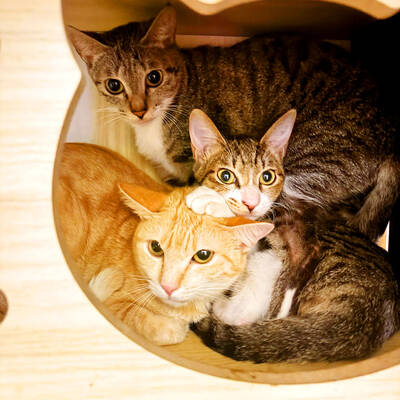
The number of pet cats in Taiwan surpassed that of pet dogs for the first time last year, reaching 1,742,033, a 32.8 percent increase from 2023, the Ministry of Agriculture said yesterday, citing a survey. By contrast, the number of pet dogs declined slightly by 1.2 percent over the same period to 1,462,528, the ministry said. Despite the shift, households with dogs still slightly outnumber those with cats by 1.2 percent. However, while the number of households with multiple dogs has remained relatively stable, households keeping more than two cats have increased, contributing to the overall rise in the feline population. The trend

ESWATINI VISIT: Taipei condemned Beijing’s coercive tactics after Seychelles, Mauritius and Madagascar unexpectedly revoked overflight permits for the president’s aircraft President William Lai (賴清德) has postponed an official trip to Eswatini, after several countries in Africa revoked overflight permits following “intense pressure” from China, a senior aide said yesterday. Lai was due to visit the Kingdom of Eswatini from today to Sunday for the 40th anniversary of King Mswati III’s accession and his 58th birthday. Eswatini is among Taiwan’s 12 remaining diplomatic allies and the only one in Africa. “According to sources, the Seychelles, Mauritius and Madagascar unexpectedly and without prior notice revoked the charter’s overflight permits,” Presidential Office Secretary-General Pan Men-an (潘孟安) told a news conference. “The real reason is that the Chinese


 RSS
RSS