


Leaders from across the Asia-Pacific region called for an end to Russia’s war on Ukraine and pledged to steer the region’s economies toward sustainable growth as they wrapped up summit meetings yesterday.
Host Thailand garnered a diplomatic coup in managing to bridge divisions among the 21 members of the APEC forum by saying that most members had condemned the war. Russia is an APEC member, as is China, which has generally has refrained from criticizing the invasion of Ukraine.
The declaration issued by APEC leaders acknowledged differing views on the war and said the forum, which is devoted largely to trade and economic ties, was not a venue for resolving such conflicts.
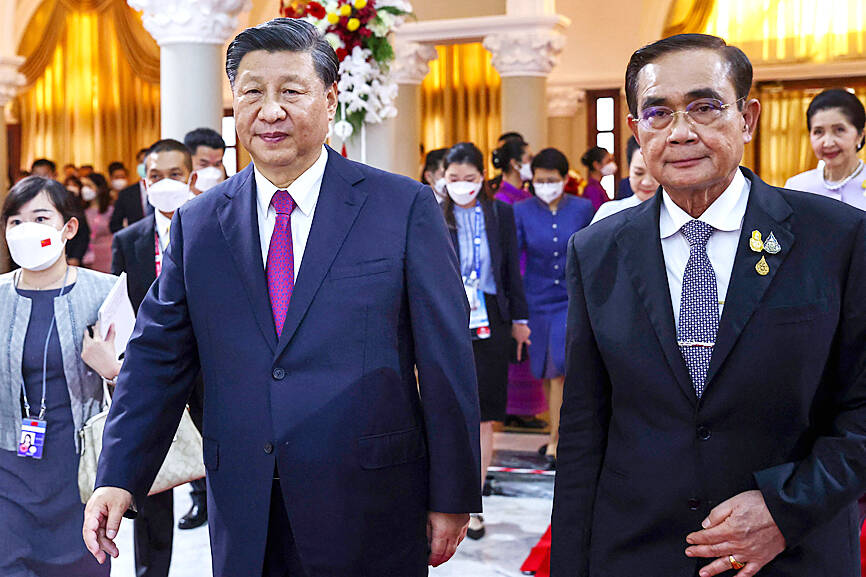
Photo: AFP
However, it noted that the war and other security issues “can have significant consequences for the global economy.”
The leaders’ statement said that the war is causing immense human suffering as well as worsening inflation, supply chain troubles, food insecurity and financial risks.
APEC wrapped up a flurry of meetings in Southeast Asian countries this week, events that gave leaders opportunities for in-person talks that have been rare in the past two years.
US Vice President Kamala Harris met briefly with Chinese President Xi Jinping (習近平) yesterday before the final APEC meeting began.
She reinforced US President Joe Biden’s message that “we must maintain open lines of communication to responsibly manage the competition between our countries,” a US official said on condition of anonymity.
The brief discussion came after the US said it was looking for China to do more to rein in North Korea, which on Friday test-fired a ballistic missile that US and Japanese officials said was capable of hitting the US mainland.
Xi said he viewed a meeting with Biden earlier in the week as a step toward a “next stage” in ties between the two largest economies, a Chinese government summary of the meeting said.
US-China relations have deteriorated in the past few years, but Harris told Xi that the US “does not seek confrontation or conflict with China.”
Harris received a “handover” in the form of a symbolic “chalom” bamboo basket from Thai Prime Minister Prayuth Chan-ocha, the APEC host. The US is to host next year’s summit in San Francisco.
Prayuth opened yesterday’s meeting by urging the leaders to push ahead with APEC’s agenda of promoting free trade in the Indo-Pacific region.
“We have to give priority to turning this plan into action,” he said.
Security risks are not on the formal APEC agenda, but Prayuth said North Korea’s numerous recent missile launches were discussed, and “everybody shares concern on that issue.”
Both at APEC in Thailand and at the G20 meeting in Indonesia, officials appear to have chosen to agree to disagree about the Ukraine war, while voicing anguish over its deepening impact. In Bangkok and Bali, countries that have refused to condemn the invasion refrained from blocking the release of statements harshly criticizing Moscow.
The leaders’ declaration, released yesterday, also called for promoting more use of clean energy and more secure, environmentally sustainable food systems, among an array of goals that also address illegal, unregulated and unauthorized fishing, illegal logging, marine waste, improvements to public health and better access to vaccines.
The summit venue, at Bangkok’s main convention center near a vast parkland, was cordoned off with some streets closed to traffic. Riot police stood guard behind barricades at major intersections to keep protesters far away.
Police in another area of Bangkok on Friday clashed with demonstrators who took the opportunity of the APEC meeting to renew calls for democratic reforms in Thailand and accuse the government of promoting policies to APEC that favor big business over ordinary people.
There were violent confrontations with some protesters who tossed debris and other items at police, who then charged the crowd, shooting rubber bullets. Several people were injured and a number of arrests were made in the standoff, which lasted several hours.
Additional reporting by AFP

A signaling system malfunction disrupted high-speed rail (HSR) services beginning at 8am today, with trains temporarily reduced to three northbound and three southbound trains per hour as authorities conduct inspections. The malfunction occurred on a section of track in Miaoli County during pre-operation checks early this morning, forcing northbound and southbound trains to use a single track, the HSR operator said. The regular schedule has been replaced with three hourly trains offering only nonreserved seating in each direction, stopping at every station, it said, adding that business class cars would still have reserved seating. Departures from terminal stations are scheduled at the top

Taiwan is still in the process of assessing the possibility of recruiting workers from Eswatini, the Ministry of Foreign Affairs said yesterday, adding that its goal is to help Eswatini upgrade its vocational training centers. If there are plans to recruit workers from Eswatini, safeguarding national security, protecting public health and ensuring the employment rights of Taiwanese would be prerequisites, Department of West Asian and African Affairs Director-General Yen Chia-liang (顏嘉良) told a news conference. Key considerations would also include filling labor shortages in specific industries, and fostering bilateral professional and technical exchanges, he said. Yen was asked about the progress of labor

A US uncrewed surface vessel (USV) encountered multiple Chinese warships during an autonomous transit of the Taiwan Strait, US defense company Seasats said in a statement on Wednesday. Seasats announced that a Lightfish USV had completed the first autonomous transit of the Taiwan Strait. Over five days, the USV traversed the entire length of the Strait while constantly monitoring surface vessel traffic, the company said. The Lightfish encountered multiple Chinese warships, one of which was a Chinese People’s Liberation Army Navy (PLAN) Type 056 corvette, it said. The Chinese vessels were operating “well within Taiwan’s exclusive economic zone without transmitting their identity via the

VERBOSE VESSELS: A CGA cutter and a China Coast Guard exchanged verbal barbs for more than a day in Taiwanese-controlled waters before the Chinese vessel left The Taiwanese and Chinese coast guards had a standoff near the strategically located Pratas Islands (Dongsha Islands, 東沙群島) in the north of the South China Sea, the Coast Guard Administration (CGA) said yesterday. The two sides engaged in intense radio exchanges over sovereignty claims during the 33-hour standoff. China Coast Guard vessel 3501 eventually left the restricted waters, 26.6 nautical miles (49.2km) west of the Pratas Islands, at 5pm yesterday, the CGA said. Lying approximately between southern Taiwan and Hong Kong, the Taiwan-controlled Pratas are seen by some security experts as vulnerable to Chinese attack due to their distance — more than


 RSS
RSS