


US President Joe Biden yesterday said he would seek to establish “red lines” in the US’ fraught relations with Beijing when he holds high-stakes talks with Chinese President Xi Jinping (習近平).
Biden said he goes into today’s encounter on the sidelines of a G20 summit in Indonesia in a better position after his Democratic Party’s unexpected success in the midterm elections.
“I feel good and I’m looking forward to the next couple years,” he said. “I know I’m coming in stronger.”
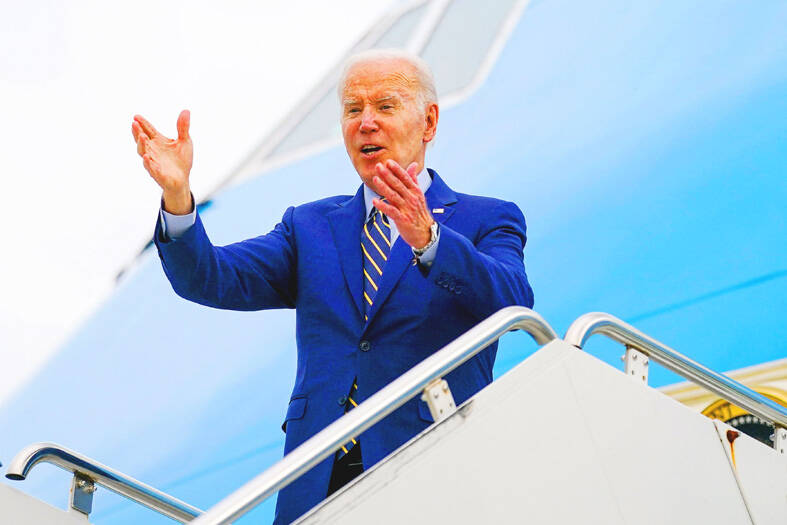
Photo: Reuters
Washington and Beijing are at loggerheads over issues ranging from trade to human rights in China’s Xinjiang region and the status of Taiwan.
Biden said he expected candid talks with Xi.
“I know Xi Jinping, he knows me,” he said, adding that they have always had “straightforward discussions.”
The two men have known each other for more than a decade, since Biden’s time as US vice president, but today will see them meet face-to-face for the first time in their current roles.
“We have very little misunderstanding. We just got to figure out what the red lines are,” Biden said.
White House officials have said Biden would push China to use its influence to rein in North Korea after a record-breaking spate of missile tests sent fears soaring that the reclusive regime would soon carry out its seventh nuclear test.
China is Pyongyang’s main ally and US officials said that, while Biden would not make demands, he would warn Xi that further missile and nuclear build-up would mean the US boosting its military presence in the region — something Beijing bitterly opposes.
“North Korea represents a threat not just to the United States, not just to [South Korea] and Japan, but to peace and stability across the entire region,” US National Security Advisor Jake Sullivan told reporters.
Biden flew to Phnom Penh from the COP27 climate conference as part of US efforts to boost its influence in Southeast Asia as a counter to China.
Biden yesterday told leaders at the ASEAN summit there — including Chinese Premier Li Keqiang (李克強) — that the US would speak out against Beijing’s rights abuses, the White House said in a news release.
A day earlier Biden took a veiled swipe at Beijing.
He said the US would work with ASEAN to “defend against the significant threats to rules-based order and threats to the rule of law.”
While the US president did not refer to China by name, Washington has long criticized what it says are Beijing’s efforts to undermine international norms on everything from intellectual property to human rights.
Despite US-China tensions Biden and Li clinked glasses together in a toast at a gala dinner on Saturday night, where they were seated on either side of the host, Cambodian Prime Minister Hun Sen.
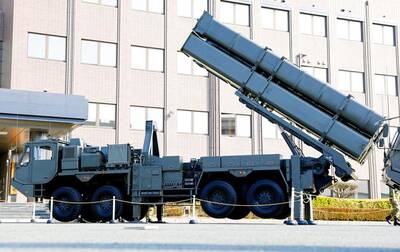
Japan has deployed long-range missiles in a southwestern region near China, the Japanese defense minister said yesterday, at a time when ties with Beijing are at their lowest in recent years. The missiles were installed in Kumamoto in the southern region of Kyushu, as Japan is attempting to shore up its military capacity as China steps up naval activity in the East China Sea. “Standoff defense capabilities enable us to counter the threat of enemy forces attempting to invade our country ... while ensuring the safety of our personnel,” Japanese Minister of Defense Shinjiro Koizumi said. “This is an extremely important initiative for
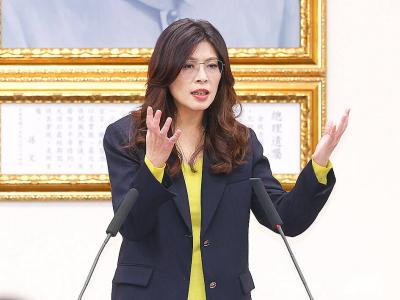
Chinese Nationalist Party (KMT) Chairwoman Cheng Li-wun (鄭麗文) today accepted an invitation from Chinese President Xi Jinping (習近平) to lead a delegation to China next month, saying she hopes to promote the peaceful development of cross-strait relations and bring stability to the Taiwan Strait. “I am grateful and happy to accept this invitation,” Cheng said in a statement from the KMT chairperson’s office. Cheng said she hopes both sides can work together to promote the peaceful development of cross-strait relations, enhance exchange and cooperation, bring stability to the Taiwan Strait and improve people’s livelihoods. At today's news conference, Cheng said any efforts to
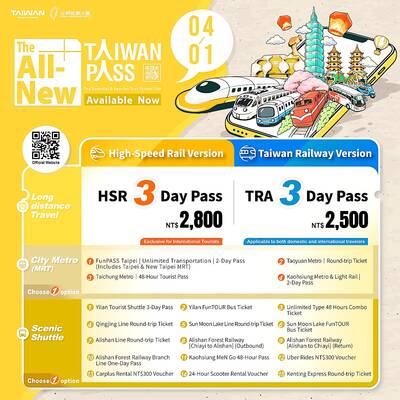
MORE POPULAR: Taiwan Pass sales increased by 59 percent during the first quarter compared with the same period last year, the Tourism Administration said The Tourism Administration yesterday said that it has streamlined the Taiwan Pass, with two versions available for purchase beginning today. The tourism agency has made the pass available to international tourists since 2024, allowing them to access the high-speed rail, Taiwan Railway Corp services, four MRT systems and four Taiwan Tourist Shuttles. Previously, five types of Taiwan Pass were available, but some tourists have said that the offerings were too complicated. The agency said only two types of Taiwan Pass would be available, starting from a three-day pass with the high-speed rail and a three-day pass with Taiwan Railway Corp. The former costs NT$2,800

The nation’s fastest supercomputer, Nano 4 (晶創26), is scheduled to be launched in the third quarter, and would be used to train large language models in finance and national defense sectors, the National Center for High-Performance Computing (NCHC) said. The supercomputer, which would operate at about 86.05 petaflops, is being tested at a new cloud computing center in the Southern Taiwan Science Park in Tainan. The exterior of the server cabinet features chip circuitry patterns overlaid with a map of Taiwan, highlighting the nation’s central position in the semiconductor industry. The center also houses Taiwania 2, Taiwania 3, Forerunner 1 and


 RSS
RSS