


President Tsai Ing-wen (蔡英文) yesterday hailed the Taipei International Travel Fair as symbolic of the nation’s reopening after the lifting of COVID-19 restrictions last month.
Speaking at the opening of the four-day fair at the Taipei Nangang Exhibition Center, Tsai said that this year’s edition has special significance, as it is the first international travel event since the borders reopened for tourist groups on Oct. 13.
Tsai said she is pleased to see travel agencies, government agencies and airlines from across Taiwan and abroad exhibiting together.

Photo: CNA
She also invited the public to take advantage of offers at the fair before it closes on Monday.
In addition to hotels, travel agencies, foreign tourism bureaus and airlines, the Ministry of Culture and three other government agencies are promoting their travel initiatives.
Under the “Cultural Beltway” banner, the ministry has worked with eight travel agencies to create 28 tours across the country, Minister of Culture Lee Yung-te (李永得) told the opening ceremony of the fair.
The tours aim to promote the nation’s treasured cultural resources, including architecture, history, art, museums and food, he said.
Professional guides are to lead the tours, designed to introduce travelers to local cultures through interaction with artists and residents, he added.
“Travel isn’t just sightseeing, but experiencing local culture,” Lee said. “This is the prevailing trend in modern travel.”
By providing the final brushstroke on a lantern, Tsai helped officially start the “Cultural Beltway” program.
The lantern was created by Tang Chiu-shui (唐秋水), an artisan based in Changhua City who attended the ceremony with other dignitaries.
The ministry’s booth is to hold events on each of the fair’s four days, including performances by the National Taiwan Symphony Orchestra, the T.S.D street dance group and See-Join Puppet Theater.
Tang’s group is to also introduce visitors to lantern-making, alongside other craft activities.
At the Forestry Bureau’s booth, visitors can learn about 38 tours in the country’s national parks, as well as discounts, it said.
The tours were designed with therapeutic benefits, ecological exploration, sustainability and dialogue with nature in mind, bureau Director Lin Hua-ching (林華慶) said.
Those who cannot make it to the fair can find information about the tours at https://www.forest.gov.tw/.
Discounts are also available for tours to Alishan (阿里山), Hehuanshan (合歡山), Dahsuehshan (大雪山) and more destinations, the bureau said.
Today, the bureau has invited aromatherapist June Wen (溫佑君) to its booth to explain how to use the scents from Taiwan’s native plants, while tomorrow, Senhuai (森淮) is to play music created from nature’s sounds.
For those interested in Hakka culture, the Hakka Affairs Council has more than 100 tours to offer focused on local communities, microbreweries and more, council Minister Yiong Con-ziin (楊長鎮) said.
The council’s “Somewhere in Hakka” booth would host musical performances, lectures and crafting activities, Yiong added.
More information about the tours can be found at www.hakkatrip.tw.
At the Council of Indigenous Peoples’ booth, visitors can find out about nearly 30 tours to villages to learn about indigenous cultures, council Deputy Minister Calivat Gadu said.
The council has also worked with seven local governments and five indigenous communities to offer limited tours featuring indigenous ceremonies, hot spring visits and food culture, he added.
The latest information can be found on the Facebook page “explorethesun.”
Additional reporting by Cheng Wei-chi

PROVOCATIVE: Chinese Deputy Ambassador to the UN Sun Lei accused Japan of sending military vessels to deliberately provoke tensions in the Taiwan Strait China denounced remarks by Japan and the EU about the South China Sea at a UN Security Council meeting on Monday, and accused Tokyo of provocative behavior in the Taiwan Strait and planning military expansion. Ayano Kunimitsu, a Japanese vice foreign minister, told the Council meeting on maritime security that Tokyo was seriously concerned about the situation in the East China and South China seas, and reiterated Japan’s opposition to any attempt to change the “status quo” by force, and obstruction of freedom of navigation and overflight. Stavros Lambrinidis, head of the EU delegation to the UN, also highlighted South China Sea

SILENCING CRITICS: In addition to blocking Taiwan, China aimed to prevent rights activists from speaking out against authoritarian states, a Cabinet department said The Ministry of Foreign Affairs (MOFA) yesterday condemned transnational repression by Beijing after RightsCon, a major digital human rights conference scheduled to be held in Zambia this week, was abruptly canceled due to Chinese pressure over Taiwanese participation. This year’s RightsCon, the world’s largest conference discussing issues “at the intersection of human rights and technology,” was scheduled to take place from tomorrow to Friday in Lusaka, and expected to draw 2,600 in-person attendees from 150 countries, along with 1,100 online participants. However, organizers were forced to cancel the event due to behind-the-scenes pressure from China, the ministry said, expressing its “strongest condemnation”
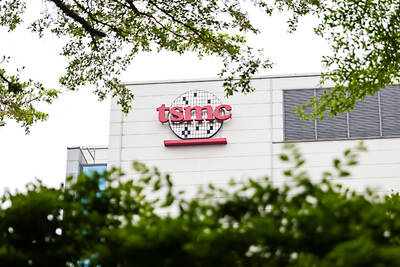
Taiwan Semiconductor Manufacturing Co (TSMC, 台積電), the world’s largest contract chipmaker, said it expects its 2-nanometer (2nm) chip capacity to grow at a compound annual rate of 70 percent from this year to 2028. The projection comes as five fabs begin volume production of 2-nanometer chips this year — two in Hsinchu and three in Kaohsiung — TSMC senior vice president and deputy cochief operating officer Cliff Hou (侯永清) said at the company’s annual technology symposium in Silicon Valley, California, last week. Output in the first year of 2-nanometer production, which began in the fourth quarter of last year, is expected to
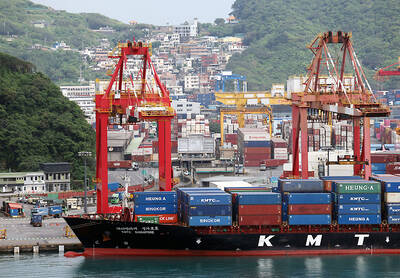
Taiwan’s economy grew far faster than expected in the first quarter, as booming demand for artificial intelligence (AI) applications drove a surge in exports, spilling over into investment and consumption, the Directorate-General of Budget, Accounting and Statistics (DGBAS) said yesterday. GDP growth was 13.69 percent year-on-year during the January-to-March period, beating the DGBAS’ February forecast by 2.23 percentage points and marking the most robust growth in nearly four decades, DGBAS senior official Chiang Hsin-yi (江心怡) told a news conference in Taipei. The result was powered by exports, which remain the backbone of Taiwan’s economy, Chiang said. Outbound shipments jumped 51.12 percent year-on-year to


 RSS
RSS