


A fourth public debate was held today about restarting the recently decommissioned Ma-anshan Nuclear Power Plant, ahead of a referendum on the controversial issue to be held in less than two weeks.
A referendum on Aug. 23 is to ask voters if they agree that “the Ma-anshan Nuclear Power Plant should continue operations upon approval by the competent authority and confirmation that there are no safety concerns.”
Anyone over 18 years of age can vote in the referendum.
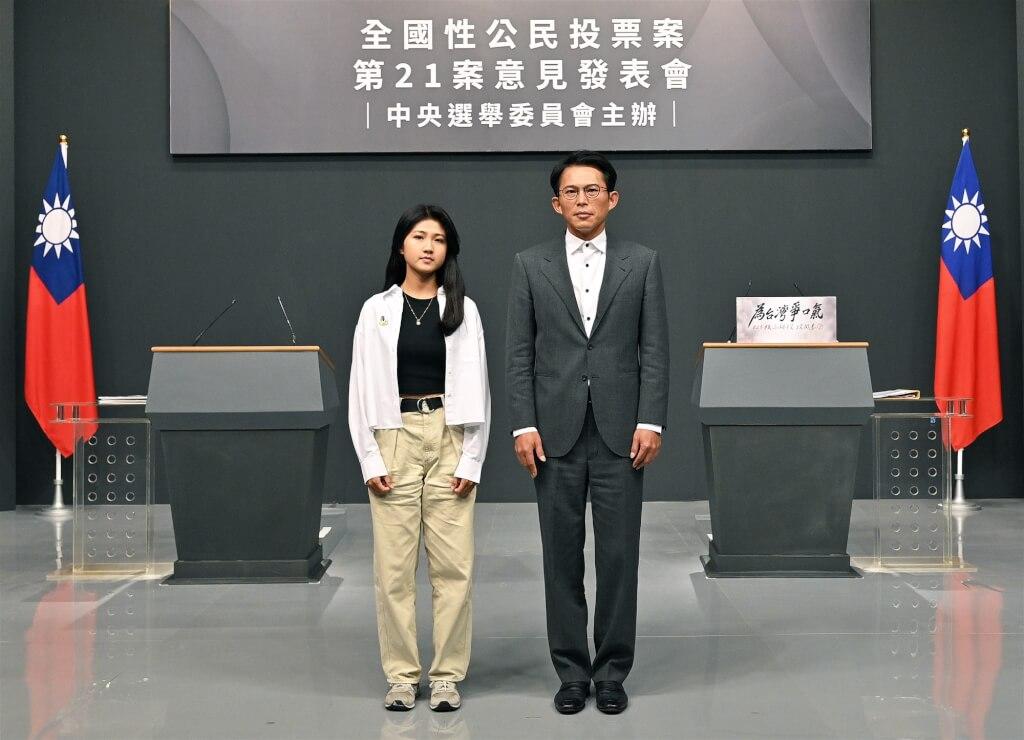
Photo courtesy of the Central Election Commission
The vote comes just three months after its final reactor shut down, officially making Taiwan nuclear-free.
Taiwan People’s Party Chairman Huang Kuo-chang (黃國昌) represented the side in favor, while 20-year-old university student Wu Ya-hsin (吳亞昕) represented the opposition.
Addressing concerns about whether nuclear power plants represent a national security vulnerability, Huang cited a report from the Center for Strategic and International Studies, a US think tank, that said Taiwan’s energy grid lacks resilience and needs nuclear power.
The report, a wargame simulation of a Chinese blockade, said that the government’s decision to shut down the reactor for environmental reasons “greatly increased Taiwan’s energy vulnerability.”
The Democratic Progressive Party knows it should not abandon nuclear energy, as President William Lai (賴清德) last year confirmed that the government has contingency plans to maintain nuclear power capabilities, Huang said.
Huang also downplayed concerns about disposal of nuclear waste, saying that the Ministry of Economic Affairs has already engaged with nuclear disposal facilities in Europe for assistance.
A new technology, deep borehole disposal (DBD), is safe and feasible, and well suited for Taiwan’s small land area, dense population and plate tectonics, Huang said.
DBD is not a theoretical breakthrough — it is a turning point for nuclear policy, he added.
The Ma-anshan power plant in Pingtung County can still hold 562 bundles of nuclear rods, enough to power the plant for three cycles of 18 months each, or about five years in total, Huang said.
The plant is also finalizing plans to construct a new storage facility that would allow it to continue operating without concerns, Huang said.
The claim that its service life can only be extended by four to five years is “completely false,” he added.
For the other side, Wu brought up the example of Japan’s Fukushima Dai-ichi nuclear power plant disaster.
Fourteen years later, 24,000 residents still cannot return home due to concerns about radiation, and at least 300 young people have developed thyroid cancer, she said.
Wu also read out loud a letter from a resident of Fukushima, which said that a nuclear accident can have consequences for up to a century.
Many people claim the nuclear power is inexpensive and clean, but the Fukushima experience shows that costs and recovery time in the aftermath of an accident are enormous, she added.
The latest report by Taiwan Power Co says that the Ma-anshan reactors lie only 900m from a fault, Wu said, adding that when the plant was first built, geological knowledge lagged far behind what it is today.
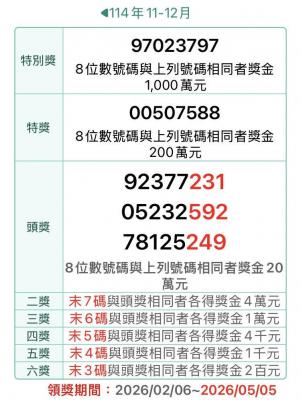
Seven of the 17 NT$10 million (US$311,604) winning receipts from the November-December uniform invoice lottery remain unclaimed as of today, the Ministry of Finance said, urging winners to redeem their prizes by May 5. The reminder comes ahead of the release of the winning numbers for the January-February lottery tomorrow. Among the unclaimed receipts was one for a NT$173 phone bill in Keelung, while others were for a NT$5,913 purchase at Costco in Taipei's Neihu District (內湖), a NT$49 purchase at a FamilyMart in New Taipei City's Tamsui District (淡水), and a NT$500 purchase at a tea shop in New Taipei City's

Taiwanese officials were shown the first of 66 F-16V fighter jets purchased by Taiwan from the United States, the Ministry of National Defense said yesterday, adding the aircraft has completed an initial flight test and is expected to be delivered later this year. A delegation led by Deputy Minister of National Defense Hsu Szu-chien (徐斯儉) visited Lockheed Martin’s F-16 C/D Block 70 (also known as F-16V) assembly line in South Carolina on March 16 to view the aircraft. The jet will undergo a final acceptance flight in the US before being delivered to Taiwan, the
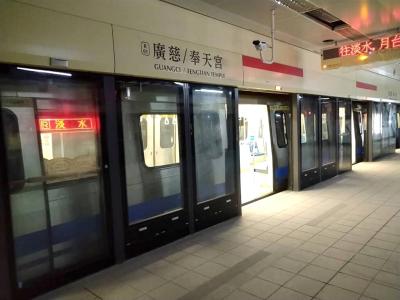
The New Taipei Metro's Sanyin Line and the eastern extension of the Taipei Metro's Tamsui-Xinyi Line (Red Line) are scheduled to begin operations in June, the National Development Council said today. The Red Line, which terminates at Xiangshan Station, would be connected by the 1.4km extension to a new eastern terminal, Guangci/Fengtian Temple Station, while the Sanyin Line would link New Taipei City's Tucheng and Yingge stations via Sanxia District (三峽). The council gave the updates at a council meeting reviewing progress on public construction projects for this year. Taiwan's annual public infrastructure budget would remain at NT$800 billion (US$25.08 billion), with NT$97.3
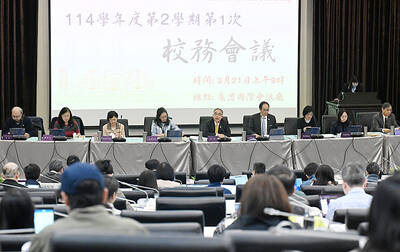
TALENT SCOUTING: The university is investing substantial funds in its future to bring in the kind of researchers that would keep the college internationally competitive National Taiwan University (NTU) plans to invest NT$2 billion (US$62.6 million) to launch two programs aimed at attracting and retaining top research talent, university president Chen Wen-chang (陳文章) said yesterday. The funding would support the “Palm Grove Scholars Project,” which targets academics aged 40 to 55. Up to 20 scholars would be selected, each receiving as much as NT$10 million annually, Chen said. The initiative is designed to attract leading researchers to Taiwan and strengthen NTU’s global competitiveness by fostering a more research-friendly environment and expanding international collaboration, he said. NTU is also introducing a “Hong Hu” chair grant, which would provide Palm


 RSS
RSS