


The US opposes any unilateral changes to the “status quo” in the Taiwan Strait, US President Joe Biden told the UN General Assembly on Wednesday, the first address to the annual event in years by a US president mentioning Taiwan.
“We seek to uphold peace and stability across the Taiwan Strait. We remain committed to our ‘one-China’ policy, which has helped prevent conflict for four decades, and we continue to oppose unilateral changes in the status quo by either side,” he said.
In Taipei, the Ministry of Foreign Affairs said such a reference by a US leader at the forum was “rare.”
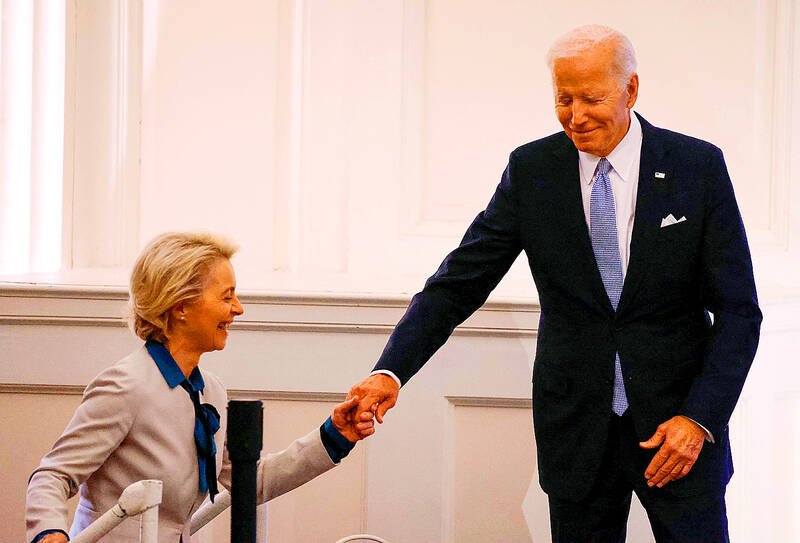
Photo: AFP
TVBS said it was the first such mention since 1971, citing information provided by Taiwan’s representative office in Washington.
The Republic of China, the official name of Taiwan, left the UN in 1971 and the People’s Republic of China took its place. Taiwan has since been excluded from the global body and its agencies.
Biden said Washington does not seek conflict with Beijing and does not ask other nations to choose between the two.
“As we manage shifting geopolitical trends, the United States will conduct itself as a reasonable leader. We do not seek conflict. We do not seek a cold war. We do not ask any nation to choose between the United States or any other partner,” he said. “But the United States will be unabashed and promoting our vision of a free, open, secure and prosperous world, and what we have to offer communities of nations.”
Biden’s remarks on cross-strait relations came three days after he reaffirmed that US troops would defend Taiwan in the event of a Chinese invasion, the clearest statement he has made on this issue since taking office.
Over the past few decades, the US has maintained a stance characterized as “strategic ambiguity” regarding whether it would come to Taiwan’s defense if China attacks the nation.
Since taking office in January last year, Biden has repeatedly used language that appeared to diverge from this long-standing policy.
On each of these occasions, Biden administration officials later walked back his comments and signaled that the US’ Taiwan policy had not changed.
Separately, the foreign ministry thanked US representatives and senators for promoting a Taiwan-related bill that would expedite arms sales to the nation.
The draft Accelerating Arms Transfers to Taiwan Act was proposed by US Representative Steve Chabot and US Senator Brad Sherman on Thursday last week.
Ministry spokeswoman Joanne Ou (歐江安) yesterday thanked the two US lawmakers for the proposal, saying that it demonstrated staunch support for and great concern about Taiwan in the US.
The act would make Taiwan eligible for priority delivery of excess defense articles and require the US secretary of defense to use the US Special Defense Acquisition Fund to speed up procurements.
The act would also authorize the creation of a war reserve stockpile in Taiwan.
Chabot yesterday said the US’ Taiwan Relations Act considers China’s threats against Taiwan as potentially having a long-term impact on the Indo-Pacific region, but neither Taiwan nor the US has treated the problem with sufficient urgency.
“The Ukraine model of weapons deliveries after an invasion starts is just not viable for the defense of an island, and the act will help speed the transfer and delivery of those weapons, so that Taiwan is prepared before it is too late,” Chabot said.
Sherman said that the US’ “resolve to preserve democracy, in Taiwan and around the world, remains ironclad.”

CREDIT-GRABBER: China said its coast guard rescued the crew of a fishing vessel that caught fire, who were actually rescued by a nearby Taiwanese boat and the CGA Maritime search and rescue operations do not have borders, and China should not use a shipwreck to infringe upon Taiwanese sovereignty, the Coast Guard Administration (CGA) said yesterday. The coast guard made the statement in response to the China Coast Guard (CCG) saying it saved a Taiwanese fishing boat. The Chuan Yu No. 6 (全漁6號), a fishing vessel registered in Keelung, on Thursday caught fire and sank in waters northeast of Diaoyutai Islands (釣魚台). The vessel left Keelung’s Badouzih Fishing Harbor (八斗子漁港) at 3:35pm on Sunday last week, with seven people on board — a 62-year-old Taiwanese captain surnamed Chang (張) and six

RISKY BUSINESS: The ‘incentives’ include initiatives that get suspended for no reason, creating uncertainty and resulting in considerable losses for Taiwanese, the MAC said China’s “incentives” failed to sway sentiment in Taiwan, as willingness to work in China hit a record low of 1.6 percent, a Ministry of Labor survey showed. The Directorate-General of Budget, Accounting and Statistics (DGBAS) also reported that the number of Taiwanese workers in China has nearly halved from a peak of 430,000 in 2012 to an estimated 231,000 in 2024. That marked a new low in the proportion of Taiwanese going abroad to work. The ministry’s annual survey on “Labor Life and Employment Status” includes questions respondents’ willingness to seek employment overseas. Willingness to work in China has steadily declined from

The Legislative Yuan’s Finance Committee yesterday approved proposed amendments to the Amusement Tax Act (娛樂稅法) that would abolish taxes on films, cultural activities and competitive sporting events, retaining the fee only for dance halls and golf courses. The proposed changes would set the maximum tax rate for dance halls and golf courses at 50 and 20 percent respectively, with local governments authorized to suspend the levies. Article 2 of the act says that “amusement tax shall be levied on tickets sold or fees charged by amusement places, facilities or activities” in six categories: “Cinema; professional singing, story-telling, dancing, circus, magic show, acrobatics
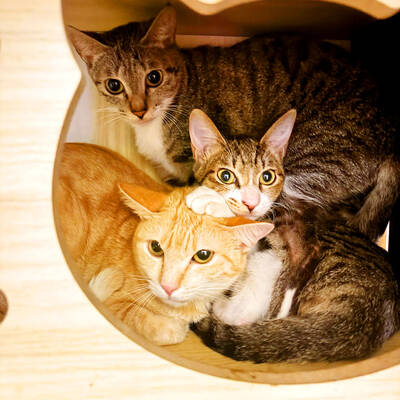
The number of pet cats in Taiwan surpassed that of pet dogs for the first time last year, reaching 1,742,033, a 32.8 percent increase from 2023, the Ministry of Agriculture said yesterday, citing a survey. By contrast, the number of pet dogs declined slightly by 1.2 percent over the same period to 1,462,528, the ministry said. Despite the shift, households with dogs still slightly outnumber those with cats by 1.2 percent. However, while the number of households with multiple dogs has remained relatively stable, households keeping more than two cats have increased, contributing to the overall rise in the feline population. The trend


 RSS
RSS