


Russian President Vladimir Putin yesterday called up 300,000 reservists to fight in Ukraine and backed a plan to annex parts of the country, hinting to the West he was prepared to use nuclear weapons to defend Russia.
It was Russia’s first such mobilization since World War II and signified the biggest escalation of the Ukraine war since Moscow’s Feb. 24 invasion.
It followed mounting casualties and battlefield setbacks for Russian forces, who have been driven from areas they had captured in northeast Ukraine in a Ukrainian counteroffensive this month and are bogged down in the south.
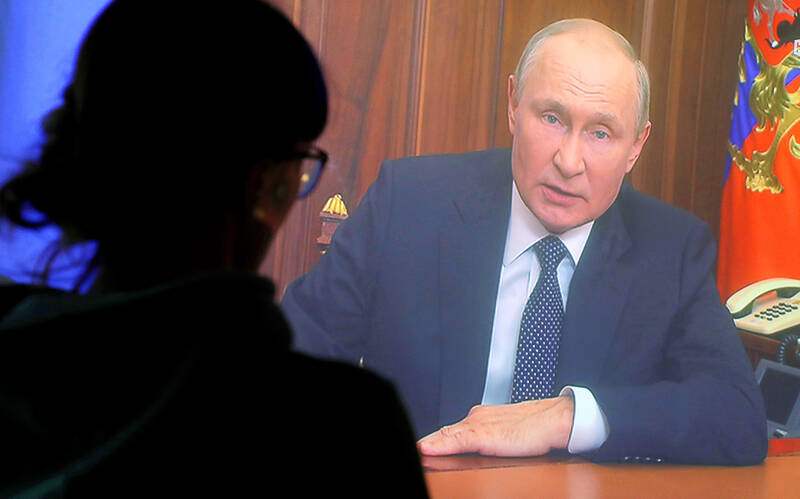
Photo: EPA-EFE
“If the territorial integrity of our country is threatened, we will use all available means to protect our people — this is not a bluff,” Putin said in an address to the nation.
Russia has “lots of weapons to reply,” he added.
Ukraine and its Western allies responded by saying the move showed Russia’s campaign in Ukraine was failing. The allies pledged further support for Ukrainian President Volodymyr Zelenskiy’s government.

Photo: EPA-EFE
Russian Minister of Defense Sergei Shoigu said the partial mobilization would see 300,000 reservists with military experience called up.
Ukrainian presidential adviser Mykhailo Podolyak said it was a predictable step that would prove extremely unpopular.
“Absolutely predictable appeal, which looks more like an attempt to justify their own failure,” Podolyak said. “The war is clearly not going according to Russia’s scenario.”
Flights out of Russia were nearly fully booked this week, airline and travel agent data showed, while Google data showed that searches in Russia for “tickets” and “plane” more than doubled after the start of Putin’s recorded address.
The request “to leave Russia” was carried out 100 times more in the morning than in normal times, Google Trends data showed.
Before Putin’s address, world leaders meeting at the UN in New York denounced the invasion of Ukraine and plans for four occupied regions to hold referendums on joining Russia.
Putin said the partial mobilization of its 2 million-strong military reservists was to defend Russia and its territories, adding that the West did not want peace in Ukraine.
He said that Washington, London and Brussels were pushing Kyiv to “transfer military operations to our territory.”
“Nuclear blackmail has also been used,” Putin said, citing Ukraine’s Zaporozhzhia nuclear power plant, which both countries have accused each other of endangering in the fighting.
He also said that officials of NATO countries had made statements about “the possibility and admissibility of using weapons of mass destruction against Russia — nuclear weapons.”
“I want to remind you that our country also has various means of destruction, and in some components more modern than those of the NATO countries,” he said.
In an apparently coordinated move, pro-Russian regional leaders on Tuesday announced referendums to be held from Friday to Tuesday next week in the Luhansk, Donetsk, Kherson and Zaporizhzhia regions, representing about 15 percent of Ukrainian territory.
Russia already considers Luhansk and Donetsk, which together make up the Donbas region that Moscow partially occupied in 2014, to be independent states. Ukraine and the West consider all parts of Ukraine held by Russian forces to be illegally occupied.
Additional reporting by AFP
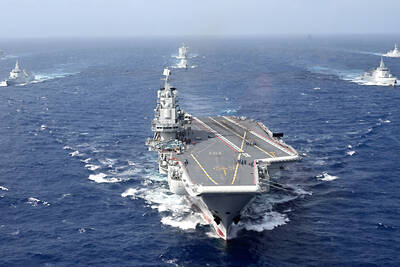
PROVOCATIVE: Chinese Deputy Ambassador to the UN Sun Lei accused Japan of sending military vessels to deliberately provoke tensions in the Taiwan Strait China denounced remarks by Japan and the EU about the South China Sea at a UN Security Council meeting on Monday, and accused Tokyo of provocative behavior in the Taiwan Strait and planning military expansion. Ayano Kunimitsu, a Japanese vice foreign minister, told the Council meeting on maritime security that Tokyo was seriously concerned about the situation in the East China and South China seas, and reiterated Japan’s opposition to any attempt to change the “status quo” by force, and obstruction of freedom of navigation and overflight. Stavros Lambrinidis, head of the EU delegation to the UN, also highlighted South China Sea
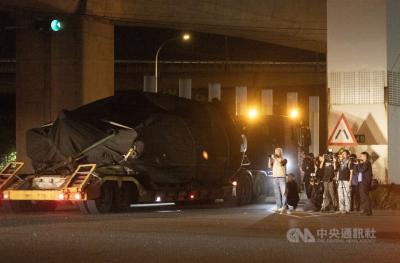
The final batch of 28 M1A2T Abrams tanks purchased from the US arrived at Taipei Port last night and were transported to the Armor Training Command in Hsinchu County’s Hukou Township (湖口), completing the military’s multi-year procurement of 108 of the tanks. Starting at 12:10am today, reporters observed more than a dozen civilian flatbed trailers departing from Taipei Port, each carrying an M1A2T tank covered with black waterproof tarps. Escorted by military vehicles, the convoy traveled via the West Coast Expressway to the Armor Training Command, with police implementing traffic control. The army operates about 1,000 tanks, including CM-11 Brave Tiger
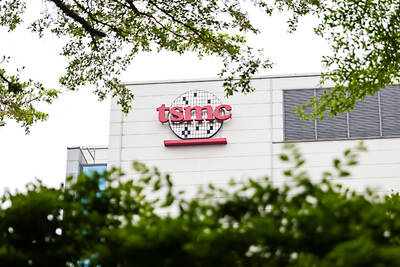
Taiwan Semiconductor Manufacturing Co (TSMC, 台積電), the world’s largest contract chipmaker, said it expects its 2-nanometer (2nm) chip capacity to grow at a compound annual rate of 70 percent from this year to 2028. The projection comes as five fabs begin volume production of 2-nanometer chips this year — two in Hsinchu and three in Kaohsiung — TSMC senior vice president and deputy cochief operating officer Cliff Hou (侯永清) said at the company’s annual technology symposium in Silicon Valley, California, last week. Output in the first year of 2-nanometer production, which began in the fourth quarter of last year, is expected to
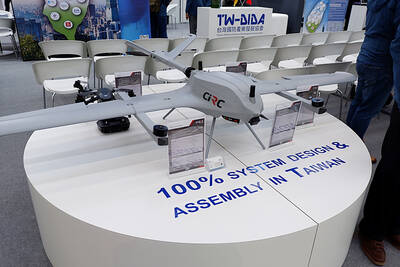
Taiwan’s drone exports surged past US$100 million in the first quarter, exceeding last year’s full-year total, with the Czech Republic emerging as the largest buyer, the Ministry of Economic Affairs said. Exports of complete drones reached US$115.85 million in the period, about 1.2 times the total recorded for all of last year, the ministry said in a report. Exports to the Czech Republic accounted for about US$100 million, far outpacing other markets. Poland, last year’s top destination, recorded about US$11.75 million in the first quarter. Taiwan’s drone exports have expanded rapidly in the past few years, with last year’s total


 RSS
RSS