


A condition for the resumption of bilateral climate talks between China and the US is Washington dispelling the “negative influence” left by US House of Representatives Speaker Nancy Pelosi’s visit to Taiwan last month, Beijing said yesterday.
In response to the visit on Aug. 2 and 3, China on Aug. 5 suspended bilateral cooperation with the US in a number of areas, including climate talks and dialogue between senior-level military commanders.
In an interview with the Financial Times on Tuesday, US Special Envoy on Climate Change John Kerry — who earlier this month said the suspension of bilateral climate talks punished the entire world — urged Chinese President Xi Jinping (習近平) to resume the discussions.

Photo: AFP
Kerry told the newspaper that he was hopeful the countries could “get back together” ahead of the UN’s COP27 climate summit in November in the Egyptian resort of Sharm el-Sheikh.
China yesterday responded to Kerry’s remarks by stating that the resumption of climate talks with the US was dependent on actions taken by Washington to address the “negative influence” of Pelosi’s Taiwan visit.
“The US side should dispel the negative influence of Pelosi scuttling to Taiwan, this is an indispensable condition of China-US climate change cooperation,” the Chinese Ministry of Foreign Affairs said in a statement.
The statement also said that China would continue to participate in international forums on climate change.
Beijing’s response highlights the divergent approaches to global climate change cooperation between the world’s two largest powers.
While officials in the administration of US President Joe Biden, including Kerry, have repeatedly expressed hope that US-China cooperation on climate change would not be affected by tensions on other fronts, Beijing has rejected any separating of issues in US-China relations.

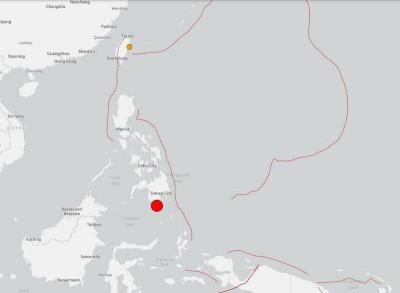
A magnitude 7.8 earthquake struck off the southern coast of Mindanao in the Philippines at 7:38am today, prompting the US Tsunami Warning System to issue an alert for neighboring countries, including Taiwan. The system issued a purple alert indicating a "tsunami threat." The potential threat zone includes Taiwan, the Philippines, Papua New Guinea, Yap and Palau. There were no immediate reports of major damage in the Philippines or Indonesia. The quake struck at a depth of 10km, said the German Research Centre for Geosciences, which had earlier pegged the earthquake at magnitude 8.2. Phivolcs, the Philippine agency, said the quake was magnitude 7 and

RESILIENCE: Taiwan plays a key role in semiconductors, energy, information infrastructure and advanced manufacturing, AIT Director Raymond Greene said Taiwan’s continued investment in deterrence and resilience remains vital, especially in uncrewed systems and other emerging technologies, American Institute in Taiwan (AIT) Director Raymond Greene said yesterday. Greene made the remarks at the annual National Strategic Summit on Supply Chain Resilience held by the Research Institute for Democracy, Society and Emerging Technology (DSET), a government-backed think tank. As Taiwan last year became the US’ fourth-largest trading partner and supply chain security is becoming more important, cooperation in emerging technologies continues to deepen between the two countries, he said. The US is committed to accelerating innovation, building key infrastructure, strengthening cooperation

The National Chungshan Institute of Science and Technology yesterday showcased its locally developed variants of the Vision 60 robotic patrol dog, which it plans to deploy on the nation’s outlying territories in the South China Sea. The variants were produced under the Joint Lab project — created by the institute and domestic companies — and assembled with domestically produced motors, lenses and artificial intelligence (AI) systems alongside licensed tech from the US, Missile and Rocket Systems Research Division deputy director Jen Kuo-kang (任國光) told the media event at a military base in Taipei’s Dazhi (大直) area. Taiwan has built up its strengths

RIGHT DIRECTION: Taiwan’s efforts to prevent forced labor include a proposal to ‘fully prohibit’ employers from withholding workers’ documents, an official said Taiwan is to establish a mechanism to restrict imports of goods linked to forced labor, the Executive Yuan said yesterday, after the US proposed imposing additional tariffs on Taiwanese goods over labor concerns. “The Ministry of Labor and the Ministry of Economic Affairs are to establish an interministerial review procedure,” Executive Yuan spokesperson Michelle Lee (李慧芝) said at a news briefing in Taipei. “The government is to use the Foreign Trade Act [貿易法] as the legal basis to restrict imports of goods produced with forced labor” and bring its supply chain governance more in line with international standards on human rights, resilience


 RSS
RSS