


Among 100 cases of multisystem inflammatory syndrome in children (MIS-C) reported this year, 62 were younger than six and 38 were aged six to 12, while only 19 among them had been vaccinated against COVID-19, the Centers for Disease Control (CDC) said yesterday.
Meanwhile, the number of daily new cases of COVID-19 is expected to increase next week as the Omicron BA.5 subvariant of SARS-CoV-2 spreads, the Central Epidemic Command Center (CECC) said, adding that the Pfizer-BioNTech vaccine for young children is expected to become available by next weekend.
CDC Deputy Director-General Chuang Jen-hsiang (莊人祥), the CECC’s spokesman, said that 24,873 new local cases, 204 imported cases and 33 deaths were confirmed yesterday.
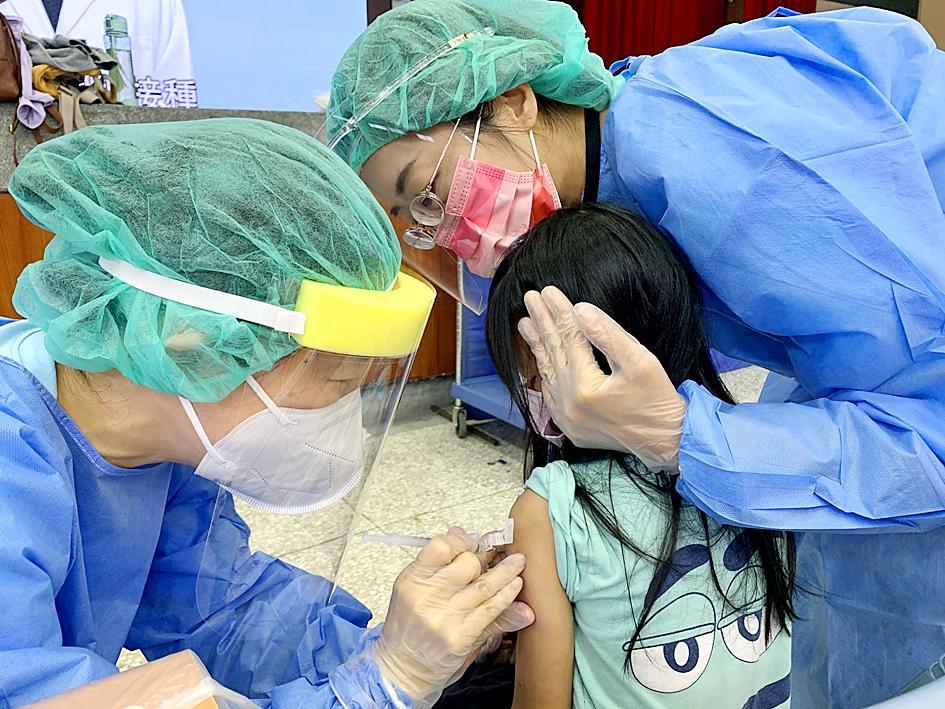
Photo courtesy of Mennonite Christian Hospital
The local caseload is 4.2 percent higher than the figure on Wednesday last week, Chuang said.
The most cases were reported in New Taipei City with 5,073, followed by Taipei (3,054), Taichung (2,966), Taoyuan (2,793), Kaohsiung (2,015), Tainan (1,669) and fewer than 1,000 cases in the 16 other administrative regions, CECC data showed.
CDC Deputy Director-General Philip Lo (羅一鈞), deputy head of the CECC’s medical response division, said that two severe cases of MIS-C were confirmed, two boys aged one and three.
Deputy Minister of Health and Welfare Victor Wang (王必勝), who heads the CECC, said that the total number of new COVID-19 cases this week is expected to be about the same as last week, but numbers are rising in northern Taiwan.
The daily caseloads are expected to rise next week, especially in the nation’s north, Wang said.
A surge is expected to begin by late this month, he said, adding that people should seek medical attention for a COVID-19 diagnosis if they test positive with an at-home rapid test.
The first shipment of Pfizer-BioNTech vaccines for young children is expected to arrive in Taiwan tomorrow and as lot release testing might take about seven days, it would likely be available by next weekend, Wang said.
People can go onto the CDC’s Web site to find hospitals and clinics for COVID-19 telemedicine consultations or outpatient services, to confirm an infection if they test positive and antiviral prescriptions if they meet the criteria, Lo said.
Asked about a doctor’s comments on Facebook citing a British study saying that while a sore throat is the most common symptom of Omicron cases, the next common symptom is a “hoarse voice,” Lo said that the study compared symptoms of people infected before Janurary with the Delta variant and those with Omicron.
There were more reports of a hoarse voice among people with Omicron, Lo said.
However, 50 to 60 percent of people with Omicron reported a sore throat, about 40 percent reported coughing and about 30 percent had a hoarse voice, he added.
The common cold and COVID-19 can both cause respiratory symptoms that lead to a hoarse voice, so it is not a symptom that is being tracked closely, he said.
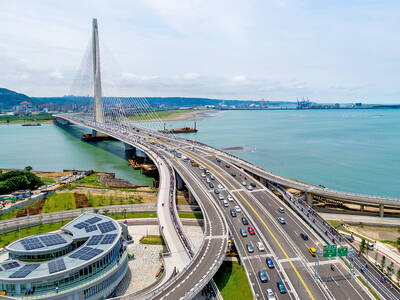
The Ministry of Transportation and Communications yesterday inaugurated the Danjiang Bridge across the Tamsui River in New Taipei City, saying that the structure would be an architectural icon and traffic artery for Taiwan. Feted as a major engineering achievement, the Danjiang Bridge is 920m long, 211m tall at the top of its pylon, and is the longest single-pylon asymmetric cable-stayed bridge in the world, the government’s Web site for the structure said. It was designed by late Iraqi-British architect Zaha Hadid. The structure, with a maximum deck of 70m, accommodates road and light rail traffic, and affords a 200m navigation channel for boats,
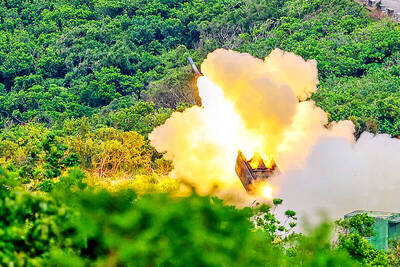
PRECISION STRIKES: The most significant reason to deploy HIMARS to outlying islands is to establish a ‘dead zone’ that the PLA would not dare enter, a source said A High Mobility Artillery Rocket System (HIMARS) would be deployed to Penghu County and Dongyin Island (東引) in Lienchiang County (Matsu) to force the Chinese military to retreat at least 100km from the coastline, a military source said yesterday. Taiwan has been procuring HIMARS and Army Tactical Missile Systems (ATACMS) from the US in batches. Once all batches have been delivered, Taiwan would possess 111 HIMARS units and 504 ATACMS, which have a range of 300km. Considering that “offense is the best defense,” the military plans to forward-deploy the systems to outlying islands such as Penghu and Dongyin so that

WHAT WAS ALL THAT FOR? Jaw Shaw-kong said that Cheng Li-wen had pushed for more drastic cuts and attacked him, just for the outcome to be nearly identical to his bill The legislature yesterday passed a supplementary budget bill to fund the purchase of separate packages of US military equipment, with the combined amount of spending capped at NT$780 billion (US$24.8 billion). The Chinese Nationalist Party (KMT) and Taiwan People’s Party (TPP) used their legislative majority to pass the bill, which runs until 2033 and has two main funding provisions. One was for NT$300 billion of arms sales already approved by the US for Taiwan on Dec. 17 last year, the other was for NT$480 billion for another arms package expected to be announced by Washington. The bill, which fell short of the NT$1.25

‘CLEAR MESSAGE’: The bill would set up an interagency ‘tiger team’ to review sanctions tools and other economic options to help deter any Chinese aggression toward Taiwan US Representative Young Kim has introduced a bill to deter Chinese aggression against Taiwan, calling for an interagency “tiger team” to preplan coordinated sanctions and economic measures in response to possible Chinese military or political action against Taiwan. “[Chinese President] Xi Jinping [習近平] has directed the People’s Liberation Army to be ready to invade Taiwan by 2027. China has a plan. America should have one too,” Kim said in a news release on Thursday last week. She introduced the “Deter PRC [People’s Republic of China] aggression against Taiwan act” to “ensure the US has a coordinated sanctions strategy ready should


 RSS
RSS