


Taichung police on Saturday released 14 people suspected of vandalizing murals at the city’s Rainbow Village tourist site.
The village contains murals and other street art by 98-year-old veteran Huang Yung-fu (黃永阜), who in 2008 started painting on the buildings of a military dependents’ village that were slated for demolition.
Police said that 14 workers from Rainbow Creative Co, which the Taichung City Government contracted in 2013 to maintain the designated cultural landmark, including company head Wei Pi-jen (魏丕仁), were caught painting over Huang’s murals.
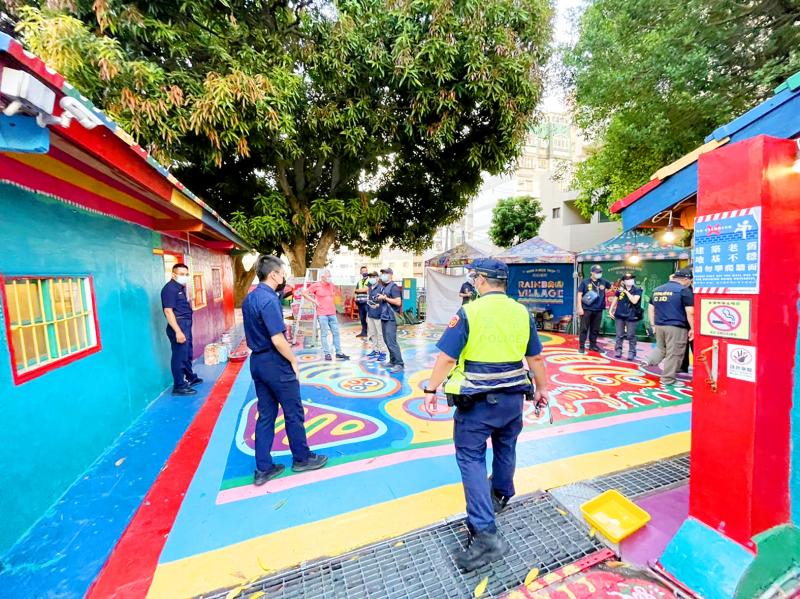
Photo courtesy of the Taichung City Government via CNA
Taichung prosecutors are investigating.
Wei told local media that the action was to protest the government’s unilateral decision to have them move out of the village today.
However, a dispute over profit sharing has emerged as Wei argued that Huang’s murals were “passed down” to his company five years ago and that the village was now part of the company’s intellectual property.

Photo: Su Chin-feng, Taipei Times
The Taichung City Government said its contract with the company to run the village and sell related merchandise was terminated yesterday ahead of the start of construction to reinforce buildings in the village.
The park would be closed for six months before resuming operations in February next year, city officials said, adding that the intellectual property issue is being reviewed in court.
Regardless of the dispute, any damage to the village is intolerable, the Taichung Cultural Affairs Bureau said, adding that it would sue Rainbow Creative for damages.
Upon learning of the vandalism, Huang yesterday called Wei a “bad guy” and told reporters that his lifework was ruined.
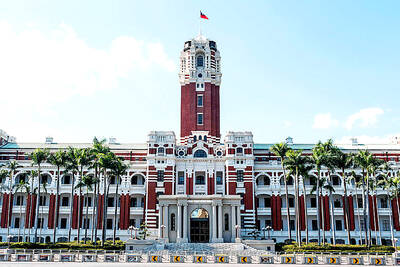
SECURITY: Taipei presses the US for arms supplies, saying the arms sales are not only a reflection of the US security commitment to Taiwan but also serve as a mutual deterrent against regional threats Taiwan is committed to preserving the cross-strait “status quo” and contributing to regional peace and stability, the Presidential Office said yesterday. “It is an undeniable fact that the Republic of China is a sovereign and independent democratic nation,” Presidential Office spokeswoman Karen Kuo (郭雅慧) reiterated, adding that Beijing has no right to claim sovereignty over Taiwan. The statements came after US President Donald Trump warned against Taiwanese independence. Trump wrapped up a state visit to Beijing on Friday, during which Chinese President Xi Jinping (習近平) had pressed him not to support Taiwan. Taiwan depends heavily on US security backing to deter China from carrying
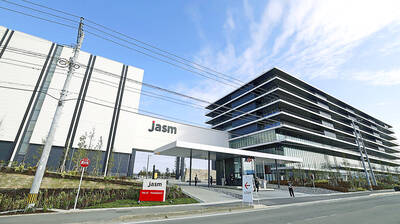
The subsidiary of Taiwan Semiconductor Manufacturing Co (TSMC, 台積電) in Kumamoto, Japan, turned a profit in the first quarter of this year, marking the first time the first fab of the unit has become profitable since mass production started at the end of 2024. According to the contract chipmaker’s financial statement released on Friday, Japan Advanced Semiconductor Manufacturing Inc (JASM), a joint venture running the fab in Kumamoto, posted NT$951 million (US$30.19 million) in profit in the January-to-March period, compared with a loss of NT$1.39 billion in the previous quarter, and a loss of NT$3.25 billion in the first quarter of
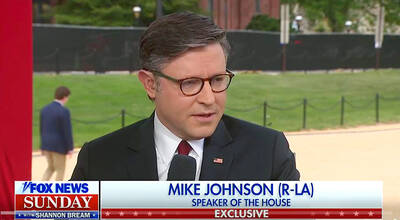
RESOLUTE BACKING: Two Republican senators are planning to introduce legislation that would impose immediate sanctions on China if it attempts to invade Taiwan US House of Representatives Speaker Mike Johnson on Sunday reaffirmed US congressional support for Taiwan, saying the US and “all freedom-loving people” have a stake in preventing China from seizing Taiwan by force. Johnson made the remarks in an interview with Fox News Sunday on US President Donald Trump’s summit with Chinese President Xi Jinping (習近平) last week. In an interview that aired on Friday on Fox News, just as Trump wrapped up a high-stakes visit to China, he said he has yet to green-light a new US$14 billion arms package to Taiwan and that it “depends on China.” “It’s a very good
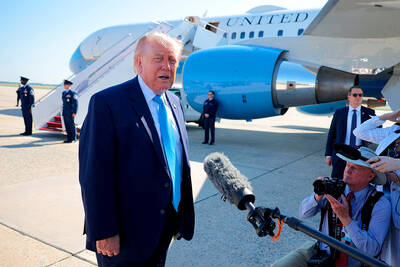
US President Donald Trump yesterday said he would speak to President William Lai (賴清德) as his administration considers whether to move ahead with a US$14 billion weapons sale to Taiwan — a potential arms deal that has drawn criticism from China. “Well, I’ll speak to him. I speak to everybody,” Trump told reporters yesterday when asked if he had any plans to call his counterpart, although he did not offer a time frame for when such a conversation could take place. Trump previously said he would speak to the person “that’s running Taiwan,” without specifying who he meant. “We have that situation very


 RSS
RSS