


Badminton world No. 2 Tai Tzu-ying (戴資穎) of Taiwan yesterday won the Yonex Taipei Open for a fourth time, beating World No. 35 Saena Kawakami of Japan 21-17, 21-16 at the Taipei Heping Basketball Gymnasium.
World No. 4 Chou Tien-chen (周天成) also did Taiwan proud in the men’s singles, beating World No. 38 Kodai Naraoka of Japan 14-21, 21-10, 21-6 in 1 hour, 1 minute.
Tai’s final lasted 37 minutes — her longest match during the tournament.

Photo: Fang Pin-chao, Taipei Times
Despite Tai taking an early lead in both games, Kawakami managed to even the score twice during the first game and was just one point behind Tai during the second.
After the match, Tai said that Japanese players always play steadily and move fast, and she had to remind herself to keep unforced errors to a minimum.
Tai became the third female player to win four women’s singles titles at the Taipei Open, after winning it in 2012, 2016 and 2018. The others are Kirsten Larsen of Denmark and Sung Ji-hyun of South Korea.
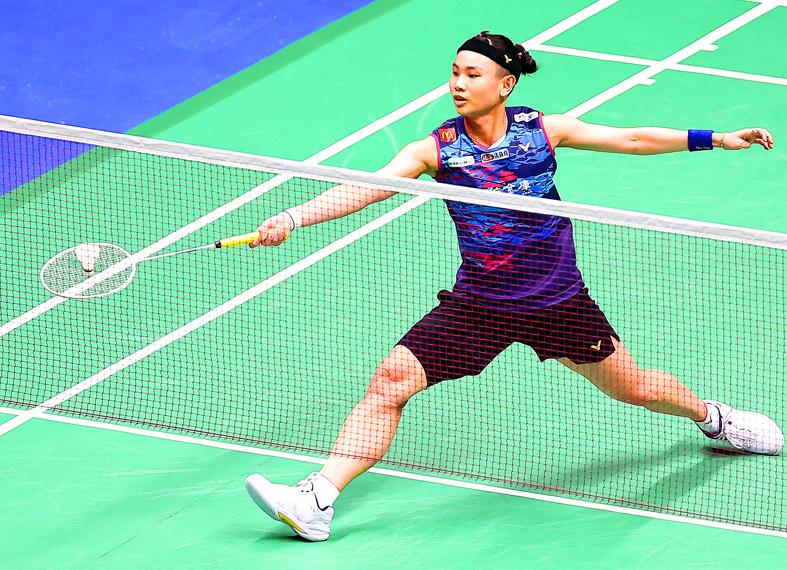
Photo: CNA
“It’s been 10 years. It means I’ve been playing for quite a while, but I will still try” to win more titles, Tai said.
It was also her third title this season, following back-to-back wins at the Thailand Open in May and the Indonesia Open last month.
Tai, who won silver at the Tokyo Olympics, said she next plans to play at the Japan Open from Aug. 30 to Sept. 4.

Photo: CNA
Asked if she would try to defend her title at the Taipei Open next year, Tai said: “Let me finish the tournaments this year, and we will see next year.”
In the men’s doubles, Taiwanese Olympic gold medalists Lee Yang (李洋) and Wang Chi-lin (王齊麟) lost 18-21, 21-11, 18-21 to Man Wei-chong (萬緯聰) and Tee Kai-wun (鄭凱文) of Malaysia.

‘NO SECURITY RISK’: The Railway Bureau reassured the public that the technicians’ activities were limited to technical guidance and did not involve sensitive systems The Railway Bureau yesterday said it had invited eight Chinese technicians to assist with an airport MRT construction project. The bureau issued the confirmation after an Internet user said Chinese nationals had entered the construction zone of Taiwan Taoyuan International Airport’s Terminal 3 project. They asked why “individuals from an enemy state” were allowed access to such a major national infrastructure project, which raised serious concerns over Taiwan’s industrial safety, sensitive systems and information security. The bureau’s Northern Region Engineering Branch Office said subcontractor Taiwan Handle Industrial Co (台灣手把工業) of the Taoyuan airport MRT’s “Contract No. CU05 Project A14 Station Civil, MEP &

A US uncrewed surface vessel (USV) encountered multiple Chinese warships during an autonomous transit of the Taiwan Strait, US defense company Seasats said in a statement on Wednesday. Seasats announced that a Lightfish USV had completed the first autonomous transit of the Taiwan Strait. Over five days, the USV traversed the entire length of the Strait while constantly monitoring surface vessel traffic, the company said. The Lightfish encountered multiple Chinese warships, one of which was a Chinese People’s Liberation Army Navy (PLAN) Type 056 corvette, it said. The Chinese vessels were operating “well within Taiwan’s exclusive economic zone without transmitting their identity via the
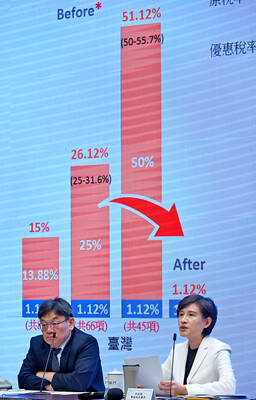
GREATER REACH? Auto parts and wood products would face tariffs of up to 15%, matching those targeting the EU, Japan and South Korea, Vice Premier said The US has announced that preferential tariff treatment for Taiwan’s non-semiconductor Section 232 goods would take effect retroactively from May 1, the Executive Yuan said yesterday. The US government yesterday posted a notice on the Federal Register’s public inspection Web site previewing tariff concessions for Taiwan under a memorandum of understanding (MOU) on Taiwan-US investment after two months of negotiations. The MOU signed on Jan. 15 stipulated three major preferential tariff arrangements: a 15 percent “reciprocal” tariff rate for Taiwan without stacking most-favored nation (MFN) rates; preferential Section 232 treatment for semiconductors and related products; and preferential Section 232 treatment for non-semiconductor

The National Chungshan Institute of Science and Technology yesterday showcased its locally developed variants of the Vision 60 robotic patrol dog, which it plans to deploy on the nation’s outlying territories in the South China Sea. The variants were produced under the Joint Lab project — created by the institute and domestic companies — and assembled with domestically produced motors, lenses and artificial intelligence (AI) systems alongside licensed tech from the US, Missile and Rocket Systems Research Division deputy director Jen Kuo-kang (任國光) told the media event at a military base in Taipei’s Dazhi (大直) area. Taiwan has built up its strengths


 RSS
RSS