


The Central Epidemic Command Center (CECC) and local governments have agreed to ease restrictions on close contacts of COVID-19 cases, although the details are still being discussed, the center said yesterday.
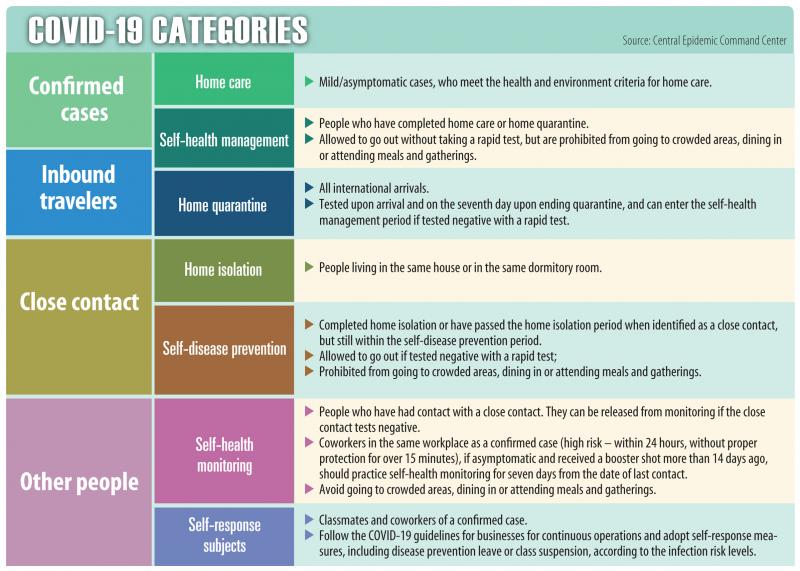
The discussions follow Premier Su Tseng-chang (蘇貞昌) on Saturday approving a proposal to shorten the “3+4” policy — three days of home isolation followed by four days of self-disease prevention — for close contacts who have received booster doses.
“We did not reach a consensus on how to revise the current restrictions, but we all agreed that the administrative burden must be reduced and the intensity of restrictions must be eased, so we will further discuss supplementary measures,” said Minister of Health and Welfare Chen Shih-chung (陳時中), who heads the CECC.

Photo: Tien Yu-hua, Taipei Times
As for the proposal to change the “3+4” policy to what Chen has called a “0+7” policy, he said that only one of the local governments wants to keep the “3+4” policy.
Meeting participants had different opinions on whether a “0+7” policy should involve seven days of self-health management or self-disease prevention, or another option, for close contacts who have received a booster shot, Chen said.
Some participants were also worried about a possible increase in infection risk if home isolation is totally removed, as previous cases have shown that a certain percentage of their close contacts tested positive during home isolation, he added.

Photo courtesy of Central Epidemic Command Center
Chen said he did not insist on either of the suggestions and would respect whatever decision is made, as long as all parties are willing to cooperate and implement the policy effectively.
The CECC yesterday reported 68,732 local infections, 37 imported cases and 19 deaths.
A total of 101 new moderate cases and 24 severe cases were reported, and a previously moderate case has become a severe case, Chen said.
All 19 people whose deaths were confirmed yesterday were aged 65 or older with underlying health conditions, eight of whom were unvaccinated, said Centers for Disease Control Deputy Director-General Philip Lo (羅一鈞), deputy chief of the CECC’s medical response division.
Asked about a two-year-old boy with COVID-19 who died on Saturday in Keelung following emergency treatment, Lo said a non-family caregiver had contracted COVID-19 and was tested at the Ministry of Health and Welfare’s Keelung Hospital after developing symptoms on Thursday.
He returned home to rest, as his body temperature and blood oxygen level were normal, Lo said.
The boy tested positive on Friday and was rushed to the hospital in an ambulance after developing a fever and having convulsions, he said.
The toddler had a fever of 42.4°C, rapid breathing and a fast heart rate, he added.
A doctor of pediatric infectious diseases at the hospital suspected that the boy had viral encephalitis and suggested that he be referred to another hospital, so the Keelung Health Bureau helped transfer the boy to Taipei Veterans General Hospital (TVGH) at about midnight.
Although medical personnel at the Keelung hospital’s emergency room had given the boy an intravenous infusion, antibiotics and anticonvulsive drugs before he was transferred to TVGH, he died at about 8am on Saturday, he said.
The cause of death was COVID-19 with acute encephalitis and multiple organ failure, he said.

CREDIT-GRABBER: China said its coast guard rescued the crew of a fishing vessel that caught fire, who were actually rescued by a nearby Taiwanese boat and the CGA Maritime search and rescue operations do not have borders, and China should not use a shipwreck to infringe upon Taiwanese sovereignty, the Coast Guard Administration (CGA) said yesterday. The coast guard made the statement in response to the China Coast Guard (CCG) saying it saved a Taiwanese fishing boat. The Chuan Yu No. 6 (全漁6號), a fishing vessel registered in Keelung, on Thursday caught fire and sank in waters northeast of Diaoyutai Islands (釣魚台). The vessel left Keelung’s Badouzih Fishing Harbor (八斗子漁港) at 3:35pm on Sunday last week, with seven people on board — a 62-year-old Taiwanese captain surnamed Chang (張) and six

RISKY BUSINESS: The ‘incentives’ include initiatives that get suspended for no reason, creating uncertainty and resulting in considerable losses for Taiwanese, the MAC said China’s “incentives” failed to sway sentiment in Taiwan, as willingness to work in China hit a record low of 1.6 percent, a Ministry of Labor survey showed. The Directorate-General of Budget, Accounting and Statistics (DGBAS) also reported that the number of Taiwanese workers in China has nearly halved from a peak of 430,000 in 2012 to an estimated 231,000 in 2024. That marked a new low in the proportion of Taiwanese going abroad to work. The ministry’s annual survey on “Labor Life and Employment Status” includes questions respondents’ willingness to seek employment overseas. Willingness to work in China has steadily declined from

The Legislative Yuan’s Finance Committee yesterday approved proposed amendments to the Amusement Tax Act (娛樂稅法) that would abolish taxes on films, cultural activities and competitive sporting events, retaining the fee only for dance halls and golf courses. The proposed changes would set the maximum tax rate for dance halls and golf courses at 50 and 20 percent respectively, with local governments authorized to suspend the levies. Article 2 of the act says that “amusement tax shall be levied on tickets sold or fees charged by amusement places, facilities or activities” in six categories: “Cinema; professional singing, story-telling, dancing, circus, magic show, acrobatics

The number of pet cats in Taiwan surpassed that of pet dogs for the first time last year, reaching 1,742,033, a 32.8 percent increase from 2023, the Ministry of Agriculture said yesterday, citing a survey. By contrast, the number of pet dogs declined slightly by 1.2 percent over the same period to 1,462,528, the ministry said. Despite the shift, households with dogs still slightly outnumber those with cats by 1.2 percent. However, while the number of households with multiple dogs has remained relatively stable, households keeping more than two cats have increased, contributing to the overall rise in the feline population. The trend


 RSS
RSS