


Local COVID-19 cases might peak late this month, the Central Epidemic Command Center (CECC) said yesterday, while reporting that nine large polymerase chain reaction (PCR) testing stations would be set up in Taipei, New Taipei City, Taoyuan and Keelung.
Minister of Health and Welfare Chen Shih-chung (陳時中), who heads the center, said 63,964 local COVID-19 cases and 77 imported cases were confirmed yesterday.
The local case count was roughly the same as the two previous days, but 92 new moderate cases and 38 new severe cases were reported, while 40 deaths related to the virus were confirmed, Chen said.
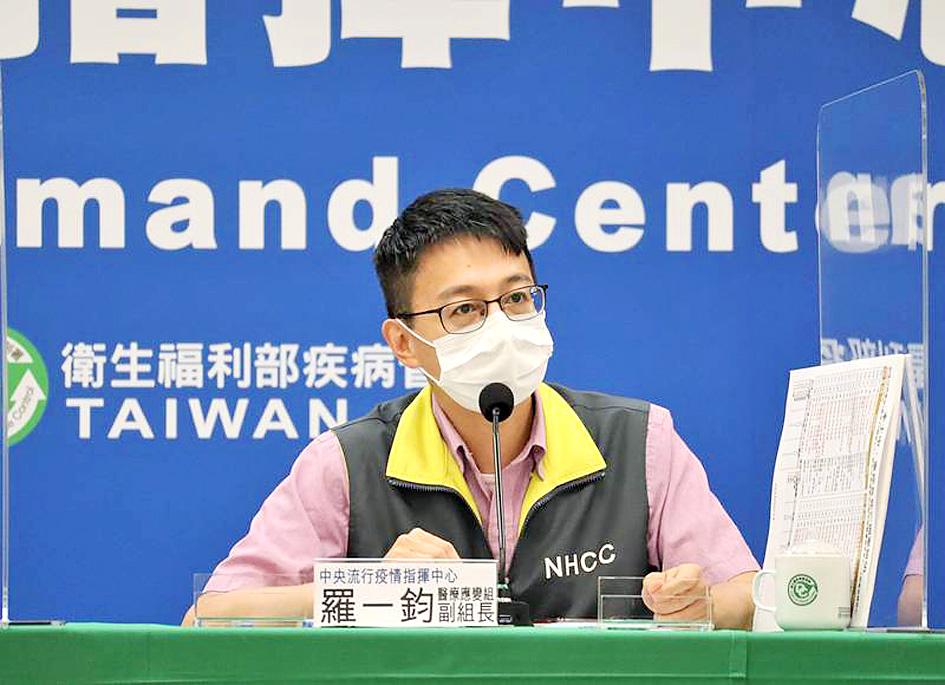
Photo courtesy of the CECC
Of the 609,121 local infections reported from Jan. 1 to Friday, 269 were severe cases, including 196 deaths, accounting for 0.04 percent of all cases, he said, adding that moderate cases accounted for 0.17 percent.
Of the new deaths reported, 37.5 percent were unvaccinated and 67.5 percent had not received a booster shot, said Centers for Disease Control (CDC) Deputy Director-General Philip Lo (羅一鈞), deputy head of the CECC’s medical response division.
Among the 130 moderate and severe cases, 25 moderate cases and 14 severe cases were unvaccinated, he said.
Chen said the nation’s testing capacity can expand to about 220,000 tests per day, so if confirmed cases reach 70 percent of that number, the case count could be underestimated.
However, about 100,000 tests per day have been conducted recently, he added.
The center estimates that local case numbers could peak at about 100,000 between Friday next week and May 30, Lo said.
The center’s previous estimation was that the peak might be between 100,000 to 200,000 cases per day, but daily case counts have not yet reached 100,000 and have remained roughly the same over the past few days, he said.
As President Tsai Ing-wen (蔡英文) on Friday said that large PCR testing stations should be set up in Taipei, New Taipei City, Taoyuan and Keelung, the CECC yesterday revealed nine stations that are soon to be established.
The testing stations in Taipei would be at Liberty Square (自由廣場), operated by Taipei Veterans General Hospital; National Taiwan University (NTU) College of Medicine’s gymnasium, operated by NTU Hospital; and Taipei Municipal Stadium (台北市立體育場), for which the team is under evaluation.
In New Taipei City, they would be in Sijhih District (汐止), operated by Tri-Service General Hospital (TSGH); Sanchong District (三重), operated by TSGH’s Songshan branch; and Jiangzicui (江子翠), operated by New Taipei City Hospital.
In Taoyuan, they would be in Dayuan District (大園), operated by the Taipei Medical University-affiliated Hsin Kuo Min Hospital; and Longtan District (龍潭), operated by Taoyaun Armed Forces General Hospital.
The testing station in Keelung would be at Keelung Civic Plaza (市民廣場) and operated by Keelung City Municipal Hospital.
The CECC is also trying to give people eligible for oral COVID-19 antiviral drugs better access to medication, Chen said, adding that 1,038 courses of Paxlovid and 381 courses of molnupiravir were prescribed on Friday.
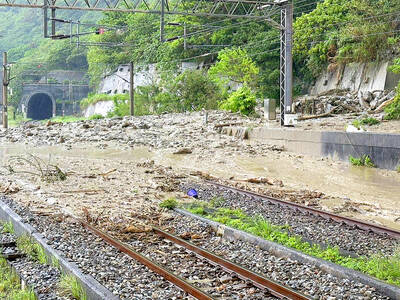
ROLLER-COASTER RIDE: More than five earthquakes ranging from magnitude 4.4 to 5.5 on the Richter scale shook eastern Taiwan in rapid succession yesterday afternoon Back-to-back weather fronts are forecast to hit Taiwan this week, resulting in rain across the nation in the coming days, the Central Weather Administration said yesterday, as it also warned residents in mountainous regions to be wary of landslides and rockfalls. As the first front approached, sporadic rainfall began in central and northern parts of Taiwan yesterday, the agency said, adding that rain is forecast to intensify in those regions today, while brief showers would also affect other parts of the nation. A second weather system is forecast to arrive on Thursday, bringing additional rain to the whole nation until Sunday, it
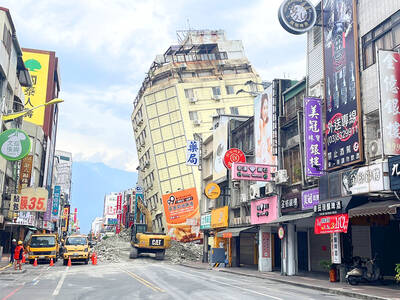
LANDSLIDES POSSIBLE: The agency advised the public to avoid visiting mountainous regions due to more expected aftershocks and rainfall from a series of weather fronts A series of earthquakes over the past few days were likely aftershocks of the April 3 earthquake in Hualien County, with further aftershocks to be expected for up to a year, the Central Weather Administration (CWA) said yesterday. Based on the nation’s experience after the quake on Sept. 21, 1999, more aftershocks are possible over the next six months to a year, the agency said. A total of 103 earthquakes of magnitude 4 on the local magnitude scale or higher hit Hualien County from 5:08pm on Monday to 10:27am yesterday, with 27 of them exceeding magnitude 5. They included two, of magnitude
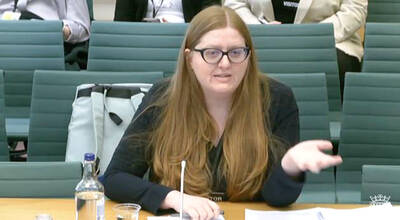
CONDITIONAL: The PRC imposes secret requirements that the funding it provides cannot be spent in states with diplomatic relations with Taiwan, Emma Reilly said China has been bribing UN officials to obtain “special benefits” and to block funding from countries that have diplomatic ties with Taiwan, a former UN employee told the British House of Commons on Tuesday. At a House of Commons Foreign Affairs Committee hearing into “international relations within the multilateral system,” former Office of the UN High Commissioner for Human Rights (OHCHR) employee Emma Reilly said in a written statement that “Beijing paid bribes to the two successive Presidents of the [UN] General Assembly” during the two-year negotiation of the Sustainable Development Goals. Another way China exercises influence within the UN Secretariat is

Taiwan’s first drag queen to compete on the internationally acclaimed RuPaul’s Drag Race, Nymphia Wind (妮妃雅), was on Friday crowned the “Next Drag Superstar.” Dressed in a sparkling banana dress, Nymphia Wind swept onto the stage for the final, and stole the show. “Taiwan this is for you,” she said right after show host RuPaul announced her as the winner. “To those who feel like they don’t belong, just remember to live fearlessly and to live their truth,” she said on stage. One of the frontrunners for the past 15 episodes, the 28-year-old breezed through to the final after weeks of showcasing her unique


 RSS
RSS