


A delegation from the Youth Division of Japan’s ruling Liberal Democratic Party (LDP) yesterday said it welcomed Taiwan’s efforts to join the Comprehensive and Progressive Agreement for Trans-Pacific Partnership (CPTPP), as it is an economic framework with strategic implications for Japan and the Indo-Pacific region.
Norikazu Suzuki, a member of the 11-member delegation led by LDP Youth Division head Masanobu Ogura, made the remarks at a meeting with President Tsai Ing-wen (蔡英文) at the Presidential Office in Taipei.
Tsai said that Taiwan is committed to making the legal and regulatory changes necessary for it to join the Tokyo-led transnational trade pact, a bid the government launched in September last year.
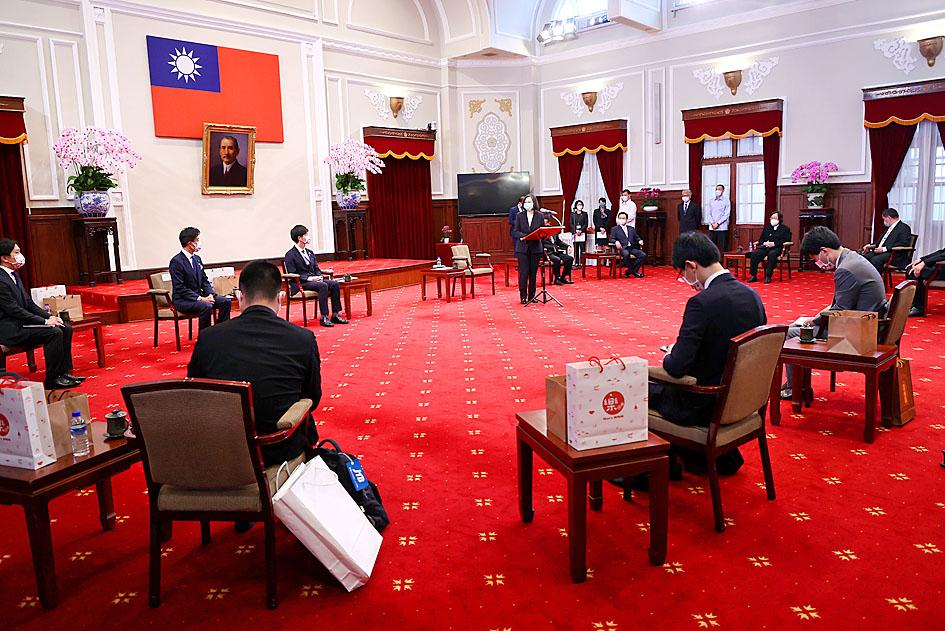
Photo: CNA
Taiwan is an able and willing contributor to the international community, and should be admitted to the International Civil Aviation Organization (ICAO), the UN Framework Convention on Climate Change, Interpol and the upcoming World Health Assembly, she added.
Tsai also espoused Taiwan-Japan cooperation in regional and global issues, citing former Japanese prime minister Shinzo Abe’s remarks at a teleconference in March last year that a Taiwan emergency is an emergency for Japan and its alliance with the US.
The national security of Taiwan and Japan are not independent issues, but one that is conjoined by the geopolitics of the first island chain, she said, adding that the two countries share a special and important relationship that must be strengthened into the future.
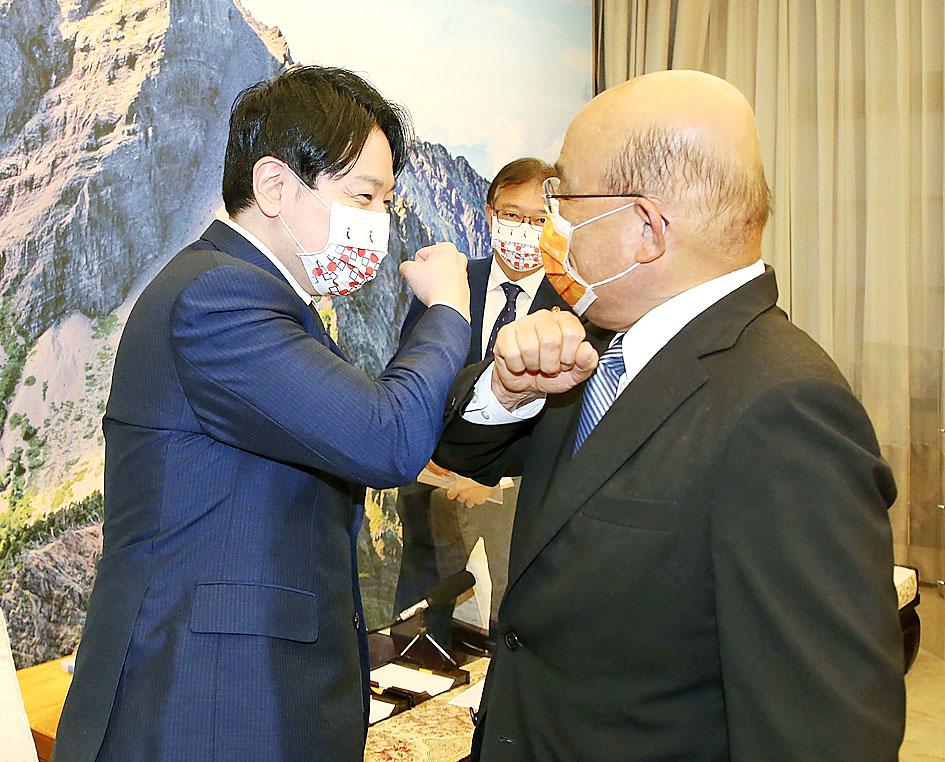
Photo: CNA
Taiwan and Japan will strive together to maintain peace in the Indo-Pacific region and stand by the international alliance of democracies against authoritarian tides, she said.
Suzuki said that Japan and Taiwan oppose any use of force by authoritarian regimes to unilaterally change the “status quo.”
Peace and stability in the Taiwan Strait is crucial to the security of Japan, he said, adding that this is increasingly appreciated by the new generation of Japanese politicians.
In a meeting with Premier Su Tseng-chang (蘇貞昌) the previous day, the delegation also said it would provide its “utmost support” for Taiwan’s application to join the CPTPP.
Taiwan is a critical global semiconductor manufacturing hub and an important free trade partner, Ogura said, adding that people in Japan have also taken note of the efforts made by the Taiwanese government and the legislature to bring the nation’s laws and regulations in line with the high standards required by the CPTPP.
The youth division also supports Taiwan’s participation in international organizations such as the WHO and the ICAO, he added.
The delegation arrived in Taipei on Tuesday for a five-day visit.
According to the Ministry of Foreign Affairs, one of the five Diet members in the delegation yesterday tested positive for COVID-19.
In accordance with COVID-19 rules for their visit, the delegation underwent virus screenings yesterday, ministry spokeswoman Joanne Ou (歐江安) said. She did not disclose the name of the Diet member.
The other members of the group that the COVID- positive Diet member was in tested negative earlier yesterday. The Diet member and others in the same group have been asked to cancel all their planned public appearances in Taiwan.
The second group, which all tested negative early yesterday, continued their original schedule which included meeting with Tsai.

‘NO SECURITY RISK’: The Railway Bureau reassured the public that the technicians’ activities were limited to technical guidance and did not involve sensitive systems The Railway Bureau yesterday said it had invited eight Chinese technicians to assist with an airport MRT construction project. The bureau issued the confirmation after an Internet user said Chinese nationals had entered the construction zone of Taiwan Taoyuan International Airport’s Terminal 3 project. They asked why “individuals from an enemy state” were allowed access to such a major national infrastructure project, which raised serious concerns over Taiwan’s industrial safety, sensitive systems and information security. The bureau’s Northern Region Engineering Branch Office said subcontractor Taiwan Handle Industrial Co (台灣手把工業) of the Taoyuan airport MRT’s “Contract No. CU05 Project A14 Station Civil, MEP &

A US uncrewed surface vessel (USV) encountered multiple Chinese warships during an autonomous transit of the Taiwan Strait, US defense company Seasats said in a statement on Wednesday. Seasats announced that a Lightfish USV had completed the first autonomous transit of the Taiwan Strait. Over five days, the USV traversed the entire length of the Strait while constantly monitoring surface vessel traffic, the company said. The Lightfish encountered multiple Chinese warships, one of which was a Chinese People’s Liberation Army Navy (PLAN) Type 056 corvette, it said. The Chinese vessels were operating “well within Taiwan’s exclusive economic zone without transmitting their identity via the
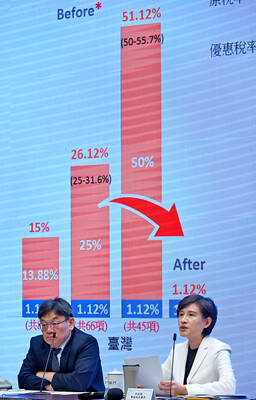
GREATER REACH? Auto parts and wood products would face tariffs of up to 15%, matching those targeting the EU, Japan and South Korea, Vice Premier said The US has announced that preferential tariff treatment for Taiwan’s non-semiconductor Section 232 goods would take effect retroactively from May 1, the Executive Yuan said yesterday. The US government yesterday posted a notice on the Federal Register’s public inspection Web site previewing tariff concessions for Taiwan under a memorandum of understanding (MOU) on Taiwan-US investment after two months of negotiations. The MOU signed on Jan. 15 stipulated three major preferential tariff arrangements: a 15 percent “reciprocal” tariff rate for Taiwan without stacking most-favored nation (MFN) rates; preferential Section 232 treatment for semiconductors and related products; and preferential Section 232 treatment for non-semiconductor

The National Chungshan Institute of Science and Technology yesterday showcased its locally developed variants of the Vision 60 robotic patrol dog, which it plans to deploy on the nation’s outlying territories in the South China Sea. The variants were produced under the Joint Lab project — created by the institute and domestic companies — and assembled with domestically produced motors, lenses and artificial intelligence (AI) systems alongside licensed tech from the US, Missile and Rocket Systems Research Division deputy director Jen Kuo-kang (任國光) told the media event at a military base in Taipei’s Dazhi (大直) area. Taiwan has built up its strengths


 RSS
RSS