


The Central Epidemic Command Center (CECC) yesterday reported the nation’s fourth COVID-19 death this year and 442 new locally transmitted cases.
The latest death was a woman in her 90s who was confirmed with COVID-19 on Monday. She was linked to a cluster infection in Keelung involving several police officers.
She died on Friday, the CECC said.
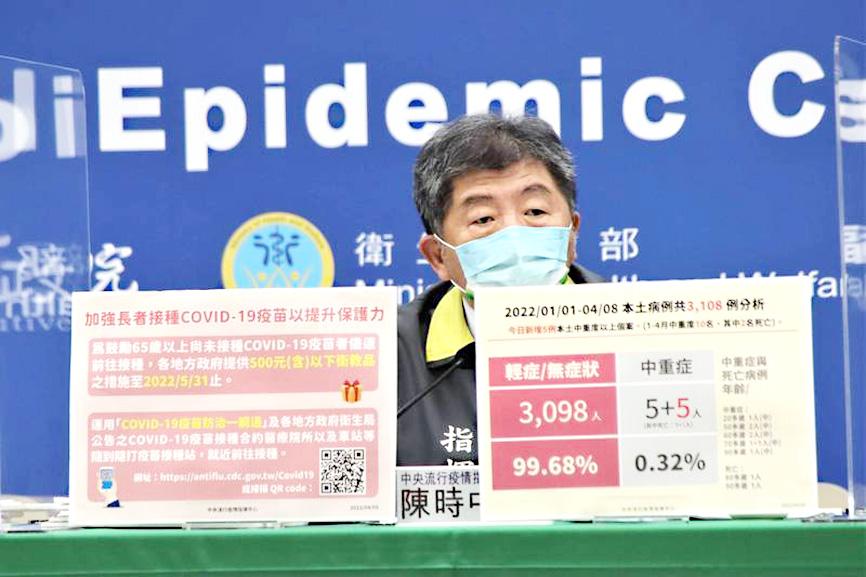
Photo courtesy of CECC
The woman had high blood pressure and Parkinson’s disease, and had not been vaccinated against COVID-19, Centers for Disease Control Deputy Director-General Philip Lo (羅一鈞), deputy head of the CECC’s medical response division, told a news conference.
Her blood oxygen saturation level was below 94 percent, Lo said.
She also developed bacterial pneumonia and septic shock while being treated with remdesivir before passing away, he added.
Yesterday’s local case count of 442 was the highest single-day tally for this year. The CECC has reported more than 100 new domestic cases every day since Friday last week.
The six special municipalities continue to account for the majority of cases, Minister of Health and Welfare Chen Shih-chung (陳時中) told the news conference.
New Taipei City had the highest number of new cases with 143, followed by Taipei with 95, Taoyuan with 41, Kaohsiung with 38, Taichung with seven and Tainan with six, said Chen, who heads the CECC.
Other areas in Taiwan that recorded at least 10 cases include Keelung with 39 cases, Hualien County with 24, Pingtung County with 14 and Yilan County with 10, Chen said.
The CECC reported five new moderate to severe infections, including the deceased woman, bringing the total to 10 this year. She was the second person with moderate to severe infection to die this year. The remainder of the local cases reported yesterday were mild or asymptomatic.
The CECC has reported 3,108 local cases this year so far.
The center also reported 136 new imported cases yesterday, 107 of whom tested positive upon arrival in Taiwan.
The CECC also expanded a rapid antigen test requirement for passengers arriving from Vietnam on all airlines, instead of only Vietnamese carriers, as it had announced on Thursday.
Starting yesterday, passengers from Vietnam must present a negative rapid antigen test for COVID-19 within six hours of boarding a flight to Taiwan, Chen said.
They must also present a negative polymerase chain reaction test result from within two days before the flight. The program is to run until May 6.
While COVID-19 positivity rates have fallen among passengers arriving on Vietnam Airlines, Vietjet Air and Bamboo Airways since the measure was introduced on Thursday, the CECC noticed an increase among passengers arriving on Taiwanese carriers, Chen said.
Therefore, the policy’s coverage has been expanded to reduce the impact of imported cases on Taiwan’s medical system amid a spike in domestic cases, he added.
The CECC has confirmed 26,836 cases since the COVID-19 pandemic began in early 2020, including 18,149 locally transmitted infections. It has reported 854 deaths from the disease.

‘NO SECURITY RISK’: The Railway Bureau reassured the public that the technicians’ activities were limited to technical guidance and did not involve sensitive systems The Railway Bureau yesterday said it had invited eight Chinese technicians to assist with an airport MRT construction project. The bureau issued the confirmation after an Internet user said Chinese nationals had entered the construction zone of Taiwan Taoyuan International Airport’s Terminal 3 project. They asked why “individuals from an enemy state” were allowed access to such a major national infrastructure project, which raised serious concerns over Taiwan’s industrial safety, sensitive systems and information security. The bureau’s Northern Region Engineering Branch Office said subcontractor Taiwan Handle Industrial Co (台灣手把工業) of the Taoyuan airport MRT’s “Contract No. CU05 Project A14 Station Civil, MEP &

The National Chungshan Institute of Science and Technology yesterday showcased its locally developed variants of the Vision 60 robotic patrol dog, which it plans to deploy on the nation’s outlying territories in the South China Sea. The variants were produced under the Joint Lab project — created by the institute and domestic companies — and assembled with domestically produced motors, lenses and artificial intelligence (AI) systems alongside licensed tech from the US, Missile and Rocket Systems Research Division deputy director Jen Kuo-kang (任國光) told the media event at a military base in Taipei’s Dazhi (大直) area. Taiwan has built up its strengths

TIT-FOR-TAT: The US allegedly revoked the visa of a Chinese national working at Xinhua News Agency in the US in response to Beijing’s expulsion of Vivian Wang The Presidential Office yesterday condemned China for expelling a New York Times correspondent from Beijing following the newspaper’s interview with President William Lai (賴清德), saying the move highlighted Beijing’s suppression of press freedom and its threat to international news media. Taiwan has noted a series of recent incidents in which Beijing used similar tactics to “threaten and pressure international media outlets and journalists,” Presidential Office spokeswoman Karen Kuo (郭雅慧) said in a statement. “This concerns not only press freedom and freedom of expression, but also the safety of journalists, and Taiwan and relevant partners are paying close attention to the situation,” she

NOT IMMEDIATE: Taiwan has a chance to appeal the proposed 10 percent tariff before it starts, while other countries face a 12.5 percent tariff from the trade office Taiwan is among 60 economies determined by the US to have failed to impose or enforce a ban on the importation of goods produced with forced labor, according to a notice released on Tuesday by the Office of the US Trade Representative (USTR), which proposed imposing an additional 10 percent or more tariff on them. The USTR in a statement said that following an investigation, it had determined under Section 301 of the Trade Act of 1974 that the failure of the 60 economies to impose and effectively enforce a prohibition on the importation of goods produced with forced labor is


 RSS
RSS