


Russian President Vladimir Putin on Tuesday lambasted the US and its allies for “deceiving” Russia over the expansion of NATO, but suggested further talks might yield a resolution that address Moscow’s security concerns.
“I hope that dialogue will continue,” Putin said in his first detailed public comments since December on the tensions.
Western officials say Russia has built up more than 100,000 troops near the border with Ukraine and warned of punishing economic sanctions if Moscow invades, something the Kremlin says it does not plan to do.
Putin reiterated that US responses delivered last week to Moscow’s security proposals “ignored” Moscow’s key demands: binding commitments not to expand NATO further in the east and not to deploy offensive weapons near Russia’s borders, as well as to roll back alliance military infrastructure in eastern Europe.
However, he said he hoped a diplomatic resolution could yet be found.
“We realize it won’t be easy and of course I’m not ready today to say what that will be,” Putin said at a Kremlin press conference with Hungarian Prime Minister Viktor Orban.
Although Moscow has so far ignored Western calls to pull its troops back from the border with Ukraine, Putin’s comments suggested the Kremlin is willing to continue talks, even though the US and its allies have rejected his main demands outright.
The US says NATO is a defensive alliance and not a threat to Russia.
To help address Russian concerns, Washington has offered to discuss limits on missile deployments and military maneuvers in Europe. Russian Minister of Foreign Affairs Sergei Lavrov called those “secondary issues” after a telephone call on Tuesday with US Secretary of State Antony Blinken, but also suggested diplomacy would continue.
Russia is still deciding on its formal response to the latest US proposals and will present it to Putin for a decision on how to proceed, Lavrov said.
In his comments, Putin repeated accusations that NATO reneged on assurances made in the early 1990s that the alliance would not expand in the east.
He added that US missile defense systems in Romania and Poland are a threat to Russia, as they could be used to launch cruise missiles.
The US says no binding assurances were given on alliance expansion and insists it has no plans to deploy such weapons in those countries.
Putin accused the US of using Ukraine as a tool to “contain” Russia.
He detailed his fears about possible NATO membership for Ukraine, saying that once part of the alliance, Kiev could use Western cover to undertake a military move to retake Crimea, which Russia annexed in 2014.
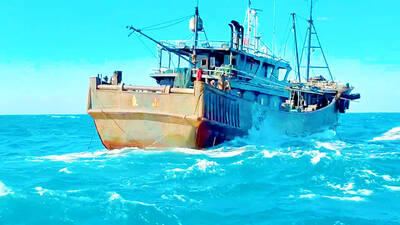
MAKING WAVES: China’s maritime militia could become a nontraditional threat in war, clogging up shipping lanes to prevent US or Japanese intervention, a report said About 1,900 Chinese ships flying flags of convenience and fishing vessels that participated in China’s military exercises around Taiwan last month and in January have been listed for monitoring, Coast Guard Administration (CGA) Deputy Director-General Hsieh Ching-chin (謝慶欽) said yesterday. Following amendments to the Commercial Port Act (商港法) and the Law of Ships (船舶法) last month, the CGA can designate possible berthing areas or deny ports of call for vessels suspected of loitering around areas where undersea cables can be accessed, Oceans Affairs Council Minister Kuan Bi-ling (管碧玲) said. The list of suspected ships, originally 300, had risen to about 1,900 as
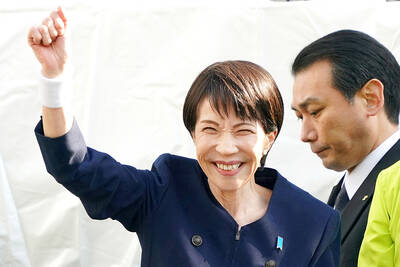
Japan’s strategic alliance with the US would collapse if Tokyo were to turn away from a conflict in Taiwan, Japanese Prime Minister Sanae Takaichi said yesterday, but distanced herself from previous comments that suggested a possible military response in such an event. Takaichi expressed her latest views on a nationally broadcast TV program late on Monday, where an opposition party leader criticized her for igniting tensions with China with the earlier remarks. Ties between Japan and China have sunk to the worst level in years after Takaichi said in November that a hypothetical Chinese attack on Taiwan could bring about a Japanese
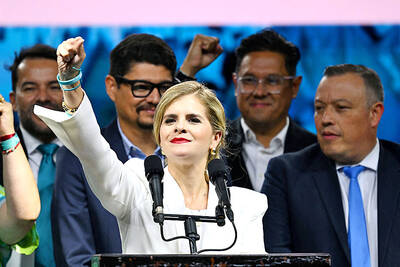
Right-wing political scientist Laura Fernandez on Sunday won Costa Rica’s presidential election by a landslide, after promising to crack down on rising violence linked to the cocaine trade. Fernandez’s nearest rival, economist Alvaro Ramos, conceded defeat as results showed the ruling party far exceeding the threshold of 40 percent needed to avoid a runoff. With 94 percent of polling stations counted, the political heir of outgoing Costa Rican President Rodrigo Chaves had captured 48.3 percent of the vote compared with Ramos’ 33.4 percent, the Supreme Electoral Tribunal said. As soon as the first results were announced, members of Fernandez’s Sovereign People’s Party
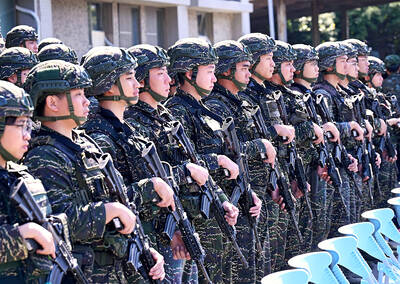
MORE RESPONSIBILITY: Draftees would be expected to fight alongside professional soldiers, likely requiring the transformation of some training brigades into combat units The armed forces are to start incorporating new conscripts into combined arms brigades this year to enhance combat readiness, the Executive Yuan’s latest policy report said. The new policy would affect Taiwanese men entering the military for their compulsory service, which was extended to one year under reforms by then-president Tsai Ing-wen (蔡英文) in 2022. The conscripts would be trained to operate machine guns, uncrewed aerial vehicles, anti-tank guided missile launchers and Stinger air defense systems, the report said, adding that the basic training would be lengthened to eight weeks. After basic training, conscripts would be sorted into infantry battalions that would take


 RSS
RSS