


The International Olympic Committee (IOC) is responsible for ensuring the equal treatment of all delegations, including the assurance that Taiwan would not be belittled at the opening and closing ceremonies of the Beijing Winter Olympics, Executive Yuan spokesman Lo Ping-cheng (羅秉成) said yesterday.
The comment came in response to backlash following an announcement on Monday that Taiwan’s delegation would be attending the ceremonies tomorrow and on Feb. 20, despite initially saying it would not participate.
Explaining its sudden reversal, the Chinese Taipei Olympic Committee (CTOC) said that the IOC sent notices on Saturday requiring all delegations to the Games to cooperate.
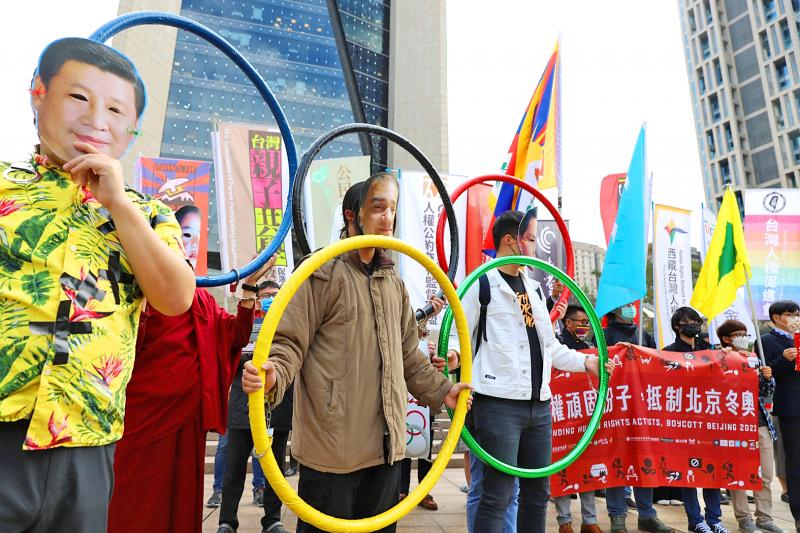
Photo: CNA
The delegation was initially not to participate due to flight schedule conflicts and COVID-19 prevention measures.
In a statement on Tuesday condemning the decision, the Taiwan Association for Human Rights and other groups accused the CTOC and Sports Administration of going against the official consensus.
They also called on the athletes and other representatives not to participate, as doing so would be “tantamount to endorsing China’s human rights violations.”
Photo: EPA-EFE
Taiwan Association for China Human Rights chairman Yang Sen-hong (楊憲宏), who has long protested Taiwan’s participation in the Beijing Games, said the IOC is basically doing China’s bidding, meaning that the CTOC is to some extent also conforming to China’s wishes.
It also chose Lunar New Year’s Eve to make its announcement to minimize the immediate backlash, Yang said.
The entire situation smacks of fraud, with the CTOC going back on its word after the IOC allegedly warned that not attending would affect Taiwan’s membership, he added.
The government must fully explain its decision, as under the current international climate, it seems unlikely that failure to attend would affect a nation’s Olympic status, he said.
Lo yesterday said the decision was made after the IOC in discussions with the CTOC expressed the wish that it could cooperate with its policy.
Little political interference is expected and the situation does not merit excessive speculation or interpretation, he added.
The IOC is responsible for implementing the Olympic Charter, which guarantees equal treatment for all participants in the Games, Lo said, adding that China, as the host country, shares this responsibility.
If a situation arises in which the nation’s sovereignty is minimized, then the Executive Yuan would respond, he added.
Additional reporting by Wu Su-wei

The National Chungshan Institute of Science and Technology yesterday showcased its locally developed variants of the Vision 60 robotic patrol dog, which it plans to deploy on the nation’s outlying territories in the South China Sea. The variants were produced under the Joint Lab project — created by the institute and domestic companies — and assembled with domestically produced motors, lenses and artificial intelligence (AI) systems alongside licensed tech from the US, Missile and Rocket Systems Research Division deputy director Jen Kuo-kang (任國光) told the media event at a military base in Taipei’s Dazhi (大直) area. Taiwan has built up its strengths

RIGHT DIRECTION: Taiwan’s efforts to prevent forced labor include a proposal to ‘fully prohibit’ employers from withholding workers’ documents, an official said Taiwan is to establish a mechanism to restrict imports of goods linked to forced labor, the Executive Yuan said yesterday, after the US proposed imposing additional tariffs on Taiwanese goods over labor concerns. “The Ministry of Labor and the Ministry of Economic Affairs are to establish an interministerial review procedure,” Executive Yuan spokesperson Michelle Lee (李慧芝) said at a news briefing in Taipei. “The government is to use the Foreign Trade Act [貿易法] as the legal basis to restrict imports of goods produced with forced labor” and bring its supply chain governance more in line with international standards on human rights, resilience

NOT IMMEDIATE: Taiwan has a chance to appeal the proposed 10 percent tariff before it starts, while other countries face a 12.5 percent tariff from the trade office Taiwan is among 60 economies determined by the US to have failed to impose or enforce a ban on the importation of goods produced with forced labor, according to a notice released on Tuesday by the Office of the US Trade Representative (USTR), which proposed imposing an additional 10 percent or more tariff on them. The USTR in a statement said that following an investigation, it had determined under Section 301 of the Trade Act of 1974 that the failure of the 60 economies to impose and effectively enforce a prohibition on the importation of goods produced with forced labor is

TIT-FOR-TAT: The US allegedly revoked the visa of a Chinese national working at Xinhua News Agency in the US in response to Beijing’s expulsion of Vivian Wang The Presidential Office yesterday condemned China for expelling a New York Times correspondent from Beijing following the newspaper’s interview with President William Lai (賴清德), saying the move highlighted Beijing’s suppression of press freedom and its threat to international news media. Taiwan has noted a series of recent incidents in which Beijing used similar tactics to “threaten and pressure international media outlets and journalists,” Presidential Office spokeswoman Karen Kuo (郭雅慧) said in a statement. “This concerns not only press freedom and freedom of expression, but also the safety of journalists, and Taiwan and relevant partners are paying close attention to the situation,” she


 RSS
RSS