


The EU and China are planning to hold a summit in late March, EU High Representative for Foreign Affairs and Security Policy Josep Borrell said on Friday amid concerns over a Chinese blockade of Lithuania’s exports.
“An EU-China summit is planned, at first glance for the end of March. It will give me a chance to travel to China to prepare for it,” Borrell announced after an informal meeting of EU foreign ministers in Brest, France.
The last EU-China summit took place via videoconference in June 2020 between the presidents of the EU institutions and Chinese leaders.
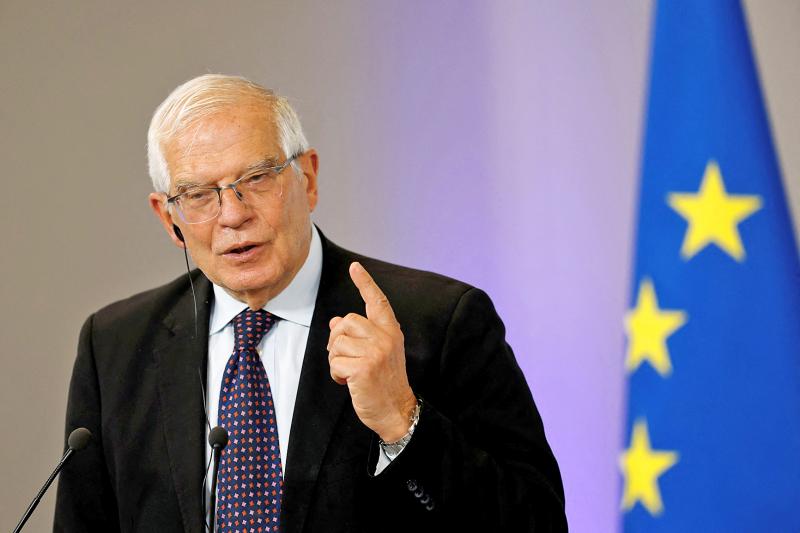
Photo: Reuters
European Council President Charles Michel, European Commission President Ursula von der Leyen and Borrell spoke at the time with Chinese Premier Li Keqiang (李克強) before holding an exchange of views with Chinese President Xi Jinping (習近平).
The summit “will be an important moment to see where we are in our relations with China. There are things that are going well, others less well,” Borrell said.
During the meeting in Brest, the foreign affairs ministers discussed the Chinese actions against Lithuania and their impact on other EU member states, he said.
The ministers expressed complete solidarity with Lithuania and talks are under way to “pursue de-escalation in this crisis,” he said.
In November, China downgraded diplomatic ties with Lithuania and stopped issuing visas there in protest at Vilnius’ decision to allow Taiwan to open a representative office under its own name.
China balks at any official use of the word Taiwan, which it considers part of its territory.
Several Lithuanian companies and business leaders complained last month that China was blocking their exports as their goods were not clearing customs in the country.
EU Trade Commissioner Valdis Dombrovskis told a German newspaper that Chinese customs was also not processing goods from other EU countries that contain parts from Lithuania.
The EU is discussing a draft regulation against what it considers coercive and intimidating measures — a tool aimed at punishing quickly any country using economic sanctions to exert pressure against the EU or one of its members.

LEVERAGE: China did not ‘need to fire a shot’ to deny Taiwan airspace over Africa when it owns ‘half the continent’s debt,’ a US official said, calling it economic warfare The EU has raised concerns about overflight rights following the delay of President William Lai’s (賴清德) planned state visit to the Kingdom of Eswatini after three African nations denied overflight clearance for his charter at the last minute. Taiwanese allies Paraguay and Saint Kitts and Nevis, as well as several US lawmakers and the Inter-Parliamentary Alliance on China (IPAC) condemned China for allegedly pressuring the countries. Lai was scheduled to fly directly to Taiwan’s only African ally from yesterday to Sunday to celebrate the 40th anniversary of King Mswati III’s accession and his 58th birthday, but Seychelles, Mauritius and Madagascar suddenly revoked
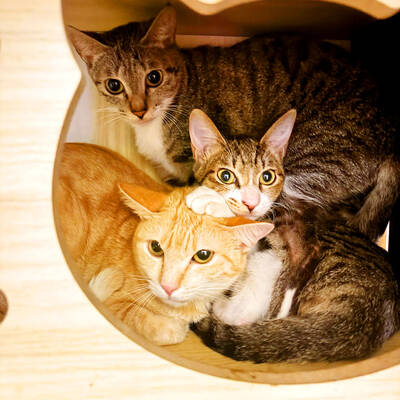
The number of pet cats in Taiwan surpassed that of pet dogs for the first time last year, reaching 1,742,033, a 32.8 percent increase from 2023, the Ministry of Agriculture said yesterday, citing a survey. By contrast, the number of pet dogs declined slightly by 1.2 percent over the same period to 1,462,528, the ministry said. Despite the shift, households with dogs still slightly outnumber those with cats by 1.2 percent. However, while the number of households with multiple dogs has remained relatively stable, households keeping more than two cats have increased, contributing to the overall rise in the feline population. The trend
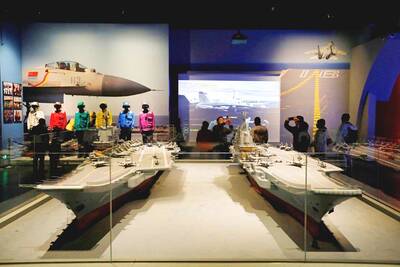
China on Wednesday teased in a video an aircraft carrier that could be its fourth, and the first using nuclear power, while making an allusion to Taiwan and vowing to further build up its islands, as it looks to boost maritime power, secure resources and bolster territorial claims. The video, issued on the eve of the 77th founding anniversary of the Chinese People’s Liberation Army Navy, featured fictional officers with names that are homophones of three commissioned aircraft carriers, the Liaoning (遼寧), Shandong (山東) and Fujian (福建). Titled Into the Deep, it showed a 19-year-old named “Hejian” (何劍) joining the group, sparking
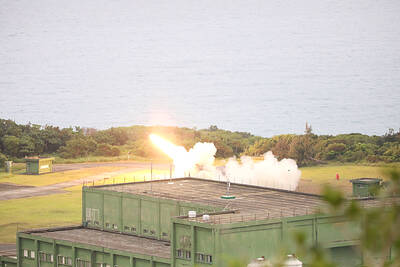
Taiwan has signed six arms procurement offers from the US totaling more than NT$208 billion (US$6.59 billion) covering long-range precision strike systems, missile stockpile replenishment and joint production of large-caliber ammunition, the Ministry of National Defense said yesterday. The government’s proposed NT$1.25 trillion special defense budget has been stalled in the Legislative Yuan as opposition lawmakers question the amount and procurement items, while the Presidential Office and defense ministry say that the full amount is necessary to safeguard Taiwan. Minister of National Defense Wellington Koo (顧立雄) on Monday briefed the legislature’s Foreign Affairs and National Defense Committee on the defense budget for


 RSS
RSS