


Search-and-rescue teams yesterday searched for an air force pilot after his F-16V Block 20 jet went missing during an afternoon bombing exercise near the coastline of Chiayi County’s Dongshih Township (東石鄉), the air force said.
The search continued as of press time last evening.
The single-seat jet (serial number 6650) disappeared from radar screens at 3:23pm, about 30 minutes after it took off from Chiayi Air Base, air force Inspector General Major General Liu Hui-chien (柳惠千) told a news conference in Taipei.
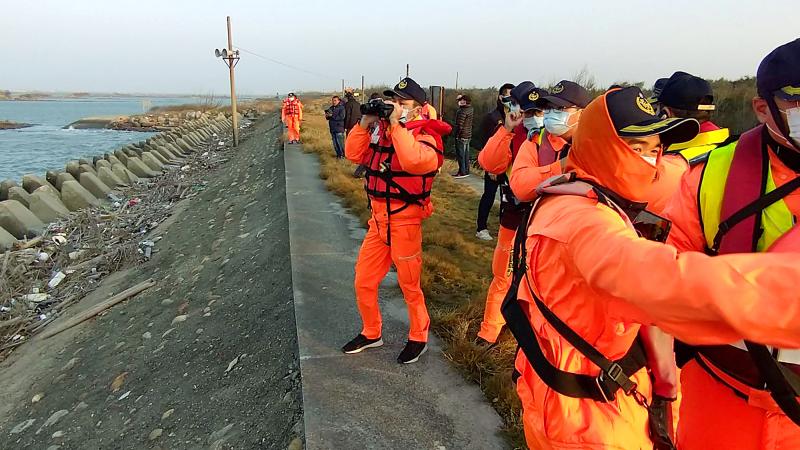
Photo: CNA
All F-16Vs are temporarily suspended from exercises pending the completion of emergency checks on the fleet, he said.
The fighter piloted by air force Captain Chen Yi (陳奕) was taking part in an exercise over the Shueisi Bombing Range near the Aogu Wetland (鰲鼓) when it vanished, Liu said, adding that its last known location was 100m north of a floating target on the range.
Investigators had not ruled out weather conditions, maintenance failure or pilot error as the cause of the apparent crash, he said.
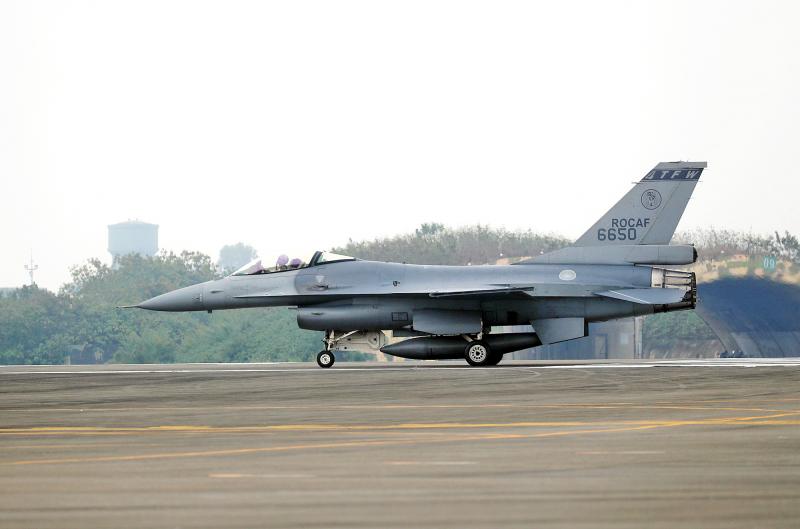
Photo: CNA
Visibility and cloud conditions were within safety parameters appropriate to the exercise, he said.
The missing fighter jet, which rolled off the assembly line on July 24, 1998, had accrued 3,415 flying hours and its most recent inspection was conducted on Dec. 28 last year, Liu said.
The aircraft’s landing gear had been slightly damaged after being accidentally retracted by human error, but records showed that the damage had been repaired prior to yesterday’s incident, he said.

‘NO SECURITY RISK’: The Railway Bureau reassured the public that the technicians’ activities were limited to technical guidance and did not involve sensitive systems The Railway Bureau yesterday said it had invited eight Chinese technicians to assist with an airport MRT construction project. The bureau issued the confirmation after an Internet user said Chinese nationals had entered the construction zone of Taiwan Taoyuan International Airport’s Terminal 3 project. They asked why “individuals from an enemy state” were allowed access to such a major national infrastructure project, which raised serious concerns over Taiwan’s industrial safety, sensitive systems and information security. The bureau’s Northern Region Engineering Branch Office said subcontractor Taiwan Handle Industrial Co (台灣手把工業) of the Taoyuan airport MRT’s “Contract No. CU05 Project A14 Station Civil, MEP &

The National Chungshan Institute of Science and Technology yesterday showcased its locally developed variants of the Vision 60 robotic patrol dog, which it plans to deploy on the nation’s outlying territories in the South China Sea. The variants were produced under the Joint Lab project — created by the institute and domestic companies — and assembled with domestically produced motors, lenses and artificial intelligence (AI) systems alongside licensed tech from the US, Missile and Rocket Systems Research Division deputy director Jen Kuo-kang (任國光) told the media event at a military base in Taipei’s Dazhi (大直) area. Taiwan has built up its strengths

NOT IMMEDIATE: Taiwan has a chance to appeal the proposed 10 percent tariff before it starts, while other countries face a 12.5 percent tariff from the trade office Taiwan is among 60 economies determined by the US to have failed to impose or enforce a ban on the importation of goods produced with forced labor, according to a notice released on Tuesday by the Office of the US Trade Representative (USTR), which proposed imposing an additional 10 percent or more tariff on them. The USTR in a statement said that following an investigation, it had determined under Section 301 of the Trade Act of 1974 that the failure of the 60 economies to impose and effectively enforce a prohibition on the importation of goods produced with forced labor is
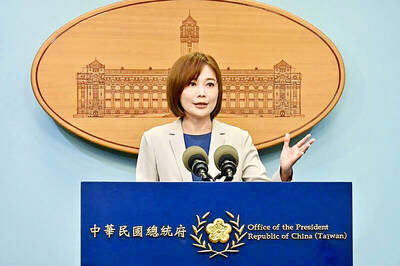
TIT-FOR-TAT: The US allegedly revoked the visa of a Chinese national working at Xinhua News Agency in the US in response to Beijing’s expulsion of Vivian Wang The Presidential Office yesterday condemned China for expelling a New York Times correspondent from Beijing following the newspaper’s interview with President William Lai (賴清德), saying the move highlighted Beijing’s suppression of press freedom and its threat to international news media. Taiwan has noted a series of recent incidents in which Beijing used similar tactics to “threaten and pressure international media outlets and journalists,” Presidential Office spokeswoman Karen Kuo (郭雅慧) said in a statement. “This concerns not only press freedom and freedom of expression, but also the safety of journalists, and Taiwan and relevant partners are paying close attention to the situation,” she


 RSS
RSS