


Building a solid alliance against authoritarianism is the common goal of democratic nations worldwide, and Taiwan is willing to share its experience with the world, President Tsai Ing-wen (蔡英文) said yesterday.
Tsai made the remarks at the Open Parliament Forum in Taipei, a two-day event that began yesterday.
In her opening speech, Tsai said that the participants were all key members of a solid democratic alliance that was expanding worldwide to repel authoritarianism.
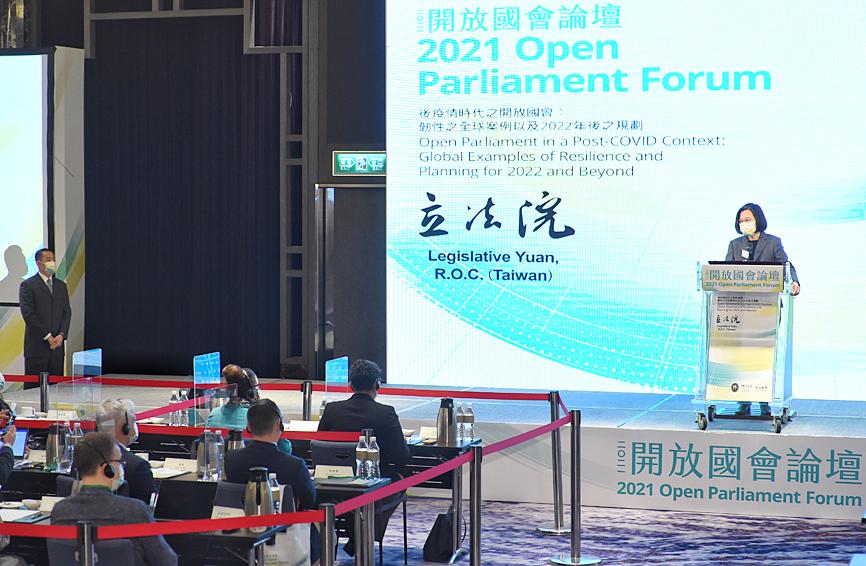
Photo: Liu Hsin-de, Taipei Times
Having experienced authoritarian rule, Taiwanese know that democracy is “a hard-won fruit” and should be continually reinforced, she said, adding that Taiwan has brought greater transparency to its parliamentary operations.
Situated on the front line of democracies, Taiwan is willing to share its experience, and defend democracy and freedom together with all democratic partners, she said.
Belizean House of Representatives Speaker Valerie Woods said that Taiwan is an important development partner for Latin American and Caribbean countries, while its commitment to achieve carbon neutrality by 2050 is welcomed by Belize, which feels deeply about the impact of climate change.
Belize would continue to advocate for Taiwan’s participation in the international arena, including UN events, she said.
In his speech, US National Democratic Institute president Derek Mitchell recalled visiting Taiwan 33 years ago as a Mandarin student.
At that time, martial law had just been lifted and Taiwan was uncertain about its future, but now it has become a “beacon of democracy in Asia,” he said.
Taiwan has demonstrated its resilience in the face of constant security threats, he added.
In March, the institute — which is cohosting the forum — opened a branch office in Taiwan, and it has been working with local legislators to promote open parliaments, Mitchell said.
The institute aims to become a regional hub, helping Taiwan develop ties with other democracies and promoting cooperation in areas such as combating disinformation, and youth and women’s participation in politics, he added.
Trust is the most important quality for a democracy, Mitchell said, reflecting on the first session’s theme: “Parliamentary transparency, trust and inclusiveness.”
A democracy thrives when there is trust between the government and society, which is not the case in some countries, he said.
In a prerecorded message, Czech Senate President Milos Vystrcil said he believes that the role played by engaged citizens remains “essential to the functioning of a standard democratic society.”
Other key principles of open governance are transparency and responsibility, he added.
Twenty-six members of parliament from 20 countries — including Belize, the Czech Republic, Estonia, Latvia, Lithuania and the US — are taking part in the forum, either in-person or via video link, the Ministry of Foreign Affairs said.
Additional reporting by CNA

Japan has deployed long-range missiles in a southwestern region near China, the Japanese defense minister said yesterday, at a time when ties with Beijing are at their lowest in recent years. The missiles were installed in Kumamoto in the southern region of Kyushu, as Japan is attempting to shore up its military capacity as China steps up naval activity in the East China Sea. “Standoff defense capabilities enable us to counter the threat of enemy forces attempting to invade our country ... while ensuring the safety of our personnel,” Japanese Minister of Defense Shinjiro Koizumi said. “This is an extremely important initiative for

MORE POPULAR: Taiwan Pass sales increased by 59 percent during the first quarter compared with the same period last year, the Tourism Administration said The Tourism Administration yesterday said that it has streamlined the Taiwan Pass, with two versions available for purchase beginning today. The tourism agency has made the pass available to international tourists since 2024, allowing them to access the high-speed rail, Taiwan Railway Corp services, four MRT systems and four Taiwan Tourist Shuttles. Previously, five types of Taiwan Pass were available, but some tourists have said that the offerings were too complicated. The agency said only two types of Taiwan Pass would be available, starting from a three-day pass with the high-speed rail and a three-day pass with Taiwan Railway Corp. The former costs NT$2,800

POLLS CONCERNS: There are concerns within the KMT that a Cheng Li-wun-Xi Jinping meeting could trigger a voter backlash in elections in November Chinese Nationalist Party (KMT) Chairwoman Cheng Li-wun (鄭麗文) accepted an invitation from Chinese President Xi Jinping (習近平) to visit next month, her party and Chinese state media reported yesterday. Cheng, who took up her role in November last year, “gladly accepted” the invitation to lead a delegation to China, the KMT said in a statement, confirming a Xinhua news agency report. Cheng “looks forward to joint efforts by both parties to advance the peaceful development of cross-strait relations, promote cross-strait exchanges and cooperation, and work for peace in the Taiwan Strait and greater well-being for people on both sides,” the statement said. Chinese

SIGNIFICANT TO THE WORLD: The delegation’s visit aims to send a clear message that bipartisan support for Taiwan is consistent, US Senator Jeanne Shaheen said The US Senate’s bipartisan support for Taiwan remains strong and Taiwan-US ties would continue for decades to come, a US Senate delegation said in Taipei yesterday, while calling on the legislature to swiftly pass a special defense budget bill. A US delegation led by Democratic US Senator Jeanne Shaheen and Republican US Senator John Curtis — both members of the US Senate Committee on Foreign Relations — arrived in Taiwan yesterday for a two-day visit. The other senators of the delegation included Senate Taiwan Caucus cochair Thom Tillis and Senate Committee on Armed Services senior member Jacky Rosen. Shaheen told a news


 RSS
RSS