


A sharp increase in the number of people in China infected with avian influenza, or bird flu, this year is raising concern among experts, who say a previously circulating strain appears to have changed and might be more infectious to people.
China has reported 21 human infections with the H5N6 subtype of avian influenza this year to the WHO, compared with only five last year, it said.
Although the numbers are much lower than the hundreds infected with H7N9 in 2017, the infections are serious, leaving many critically ill and at least six dead.
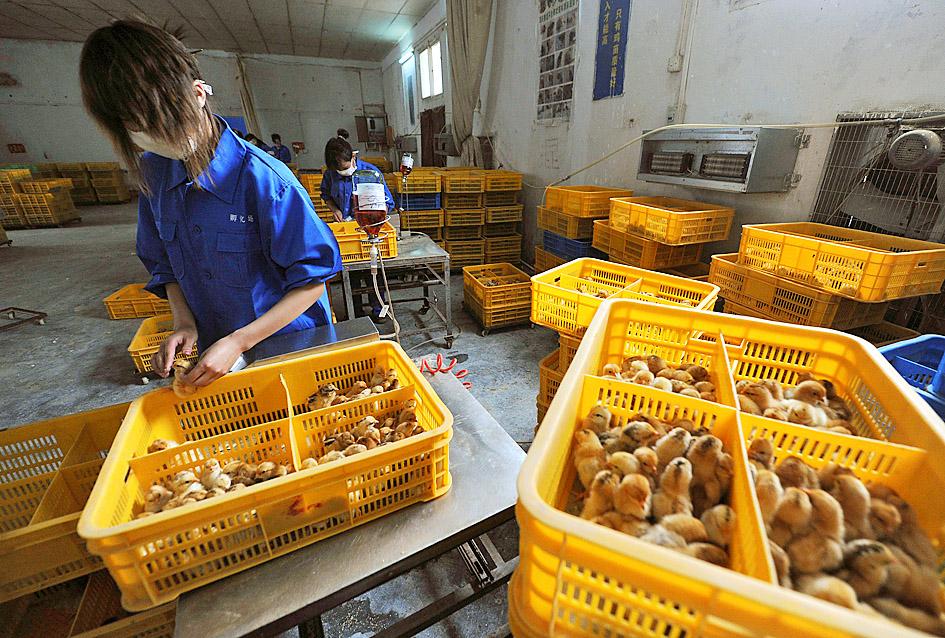
Photo: Reuters
“The increase in human cases in China this year is of concern. It’s a virus that causes high mortality,” said Thijs Kuiken, professor of comparative pathology at Erasmus University Medical Centre in Rotterdam, Netherlands.
Most of the cases had come into contact with poultry and there are no confirmed cases of human-to-human transmission, said the WHO, which highlighted the rise in cases in a statement on Oct. 4.
It said further investigation was “urgently” required to understand the risks and the increase in infections in people.
Since then, a 60-year-old woman in Hunan Province was admitted to hospital in a critical condition with H5N6 influenza on Oct. 13, a Hong Kong government statement said.
While human H5N6 cases have been reported, no outbreaks of H5N6 have been reported in poultry in China since February last year.
China is the world’s biggest poultry producer and the top producer of ducks, which act as a reservoir for flu viruses.
The Chinese Center for Disease Control and Prevention (CDC) could not be reached for comment on the rise in H5N6 cases in humans. However, a study published on its Web site last month said that the “increasing genetic diversity and geographical distribution of H5N6 pose a serious threat to the poultry industry and human health.”
Avian influenza viruses constantly circulate in domestic and wild birds, but rarely infect people. However, the evolution of the viruses, which have increased as poultry populations grow, is a major concern because they could change into a virus that spreads easily between people and cause a pandemic.
The largest number of H5N6 infections have been in Sichuan Province, although cases have also been reported in neighboring Chongqing and Guangxi, as well as Guangdong, Anhui and Hunan provinces.
At least 10 were caused by viruses genetically very similar to the H5N8 virus that ravaged poultry farms across Europe last year and also killed wild birds in China. That suggests the latest H5N6 infections in China might be a new variant.
“It could be that this variant is a little more infectious [to people] ... or there could be more of this virus in poultry at the moment and that’s why more people are getting infected,” Kuiken said.
China vaccinates poultry against avian influenza, but the vaccine used last year might only partially protect against emerging viruses, preventing large outbreaks, but allowing the virus to keep circulating, said Filip Claes, regional laboratory coordinator at the Emergency Centre for Transboundary Animal Diseases at the Food and Agriculture Organization.

PROVOCATIVE: Chinese Deputy Ambassador to the UN Sun Lei accused Japan of sending military vessels to deliberately provoke tensions in the Taiwan Strait China denounced remarks by Japan and the EU about the South China Sea at a UN Security Council meeting on Monday, and accused Tokyo of provocative behavior in the Taiwan Strait and planning military expansion. Ayano Kunimitsu, a Japanese vice foreign minister, told the Council meeting on maritime security that Tokyo was seriously concerned about the situation in the East China and South China seas, and reiterated Japan’s opposition to any attempt to change the “status quo” by force, and obstruction of freedom of navigation and overflight. Stavros Lambrinidis, head of the EU delegation to the UN, also highlighted South China Sea
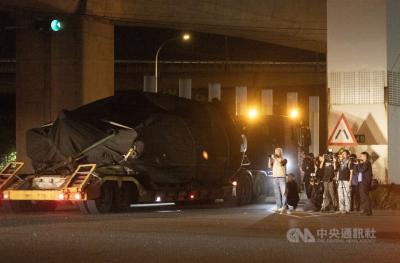
The final batch of 28 M1A2T Abrams tanks purchased from the US arrived at Taipei Port last night and were transported to the Armor Training Command in Hsinchu County’s Hukou Township (湖口), completing the military’s multi-year procurement of 108 of the tanks. Starting at 12:10am today, reporters observed more than a dozen civilian flatbed trailers departing from Taipei Port, each carrying an M1A2T tank covered with black waterproof tarps. Escorted by military vehicles, the convoy traveled via the West Coast Expressway to the Armor Training Command, with police implementing traffic control. The army operates about 1,000 tanks, including CM-11 Brave Tiger
Taiwan Semiconductor Manufacturing Co (TSMC, 台積電), the world’s largest contract chipmaker, said it expects its 2-nanometer (2nm) chip capacity to grow at a compound annual rate of 70 percent from this year to 2028. The projection comes as five fabs begin volume production of 2-nanometer chips this year — two in Hsinchu and three in Kaohsiung — TSMC senior vice president and deputy cochief operating officer Cliff Hou (侯永清) said at the company’s annual technology symposium in Silicon Valley, California, last week. Output in the first year of 2-nanometer production, which began in the fourth quarter of last year, is expected to

Taiwan’s drone exports surged past US$100 million in the first quarter, exceeding last year’s full-year total, with the Czech Republic emerging as the largest buyer, the Ministry of Economic Affairs said. Exports of complete drones reached US$115.85 million in the period, about 1.2 times the total recorded for all of last year, the ministry said in a report. Exports to the Czech Republic accounted for about US$100 million, far outpacing other markets. Poland, last year’s top destination, recorded about US$11.75 million in the first quarter. Taiwan’s drone exports have expanded rapidly in the past few years, with last year’s total


 RSS
RSS