

COVID-19 cases in eastern Europe are soon to surpass 20 million, according to a Reuters tally yesterday, as the region grapples with its worst outbreak since the pandemic started and inoculation efforts lag.
Countries in the region have the lowest vaccination rates in Europe, with less than half of the population having received a single dose.
Hungary tops the region’s vaccination rates with 62 percent of its population having received at least one shot, whereas Ukraine has given just 19 percent of its residents a single dose, according to Our World in Data.

Photo: Reuters
New infections in the region have steadily risen and average more than 83,700 new cases per day, the highest level since November last year, Reuters data through Friday showed.
Although it has just 4 percent of the world’s population, eastern Europe accounts for about 20 percent of all new cases reported globally.
More social gathering indoors after the lifting of restrictions just as winter sets in is driving a rise in COVID-19 infections in many countries across Europe, WHO Health Emergencies Program executive director Mike Ryan said on Thursday.
A European Commission poll, the Eurobarometer, has shown that at least one person in three in most countries in the EU’s east does not trust the healthcare system, compared with a bloc average of 18 percent.
More than 40 percent of all new cases reported in eastern Europe were in Russia, with 120 people testing positive every five minutes, according to a Reuters analysis.
Russia’s healthcare system is operating under great strain, Russian Minister of Health Mikhail Murashko said on Wednesday.
The nation on Friday reported record COVID-19 fatalities for the fourth straight day. So far, Russia has vaccinated about 36 percent of its population with one dose.
Moscow would next week shut down all businesses except essential stores, such as supermarkets and pharmacies, to stem the spread of the disease.
Slovakia reported 3,480 new COVID-19 cases on Tuesday, its highest daily tally since March, health ministry data showed on Wednesday.
The country has one of the lower vaccination rates in the EU, with just more than half the adult population fully inoculated in the country of 5.5 million. This has contributed to a faster rise in infections than in some neighboring countries.
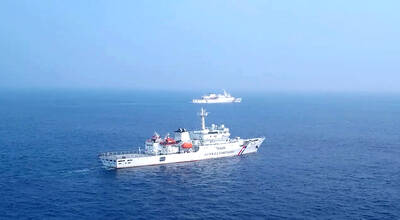
PATROL PARTNERS: The ‘Chiayi’ and the ‘Penghu’ departed for a two-day joint patrol of Palau’s exclusive economic zone, the CGA’s second diplomatic visit to the country The Coast Guard Administration (CGA) set a record for its southernmost deployment of a coast guard vessel as the vessels Chiayi and the Penghu reached Palau’s Pulo Anna Island on Saturday in a cooperative exercise between the two countries. The island, about 217 nautical miles (401km) southwest of Koror in the Palauan state of Sonsorol and 1,220 nautical miles from Taiwan’s southernmost point, Oluanpi (鵝鑾鼻), is the furthest south a CGA vessel has sailed. The two vessels are in Palau for the coast guard’s second diplomatic visit to the country. They docked at Malakal Harbor on Tuesday last week. The coast guard

The government is monitoring online rumors that a pneumonic plague outbreak has spread from Russia into China, and it might enhance quarantine measures, Premier Cho Jung-tai (卓榮泰) said yesterday. During a legislative meeting, Democratic Progressive Party Legislator Wang Ting-yu (王定宇) said that rumors had circulated that the disease had spread across several Chinese provinces. He asked Cho whether the government was prepared to prevent the disease spreading to Taiwan, given the volume of traffic between the two sides, and how concerned the government was about the alleged outbreak. The Ministry of Health and Welfare had implemented border quarantine measures after briefing the Executive
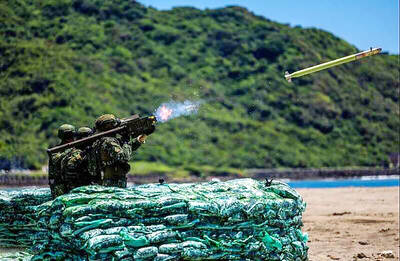
BATCH 1: The military has plans to assign the weapons to the army to defend Taiwan proper, as well as outlying islands and the navy for the Marine Corps, the official said Taiwan is to receive 500 Stinger missiles and 178 launchers from the US by the end of the year, the first batch under a planned two-stage acquisition totaling 2,621 missiles and 763 launchers, a defense official said yesterday on condition of anonymity. The portable missiles would play a vital role in the nation’s air defense capabilities, the source said. The army plans to deploy 2,235 missiles and 657 launchers to defend Taiwan proper and outlying islands, they said, citing military documents. The navy is allotted 295 missiles and 85 launchers to arm the Marine Corps and some surface vessels that lack air defense

RIGHT TO DIPLOMACY: Under the UN Charter, every state has the right to conduct foreign policy free from external pressure, Belize said in a statement Belize and Paraguay on Monday condemned Beijing sanctions over their countries’ ties with Taiwan, saying China’s actions create unnecessary tensions. Earlier on Monday, Beijing announced sanctions against Paraguayan Minister of Information and Communication Technologies Gustavo Villate and Belizean Minister of Foreign Affairs Francis Fonseca. The Paraguayan Ministry of Foreign Affairs said it rejected the sanctions, writing on X that they created unnecessary friction. It added that it reaffirmed its support for Taiwan and its commitment to democratic values and principles. Villate told the Spanish-language Paraguayan daily ABC Color the sanctions were “predictable” and linked them to several cooperation projects between Taiwan and Paraguay. The projects


 RSS
RSS