


Voters in Taichung yesterday recalled Taiwan Statebuilding Party Legislator Chen Po-wei (陳柏惟), making him the first legislator in the nation’s history to lose a recall election.
A total of 77,899 votes were cast to recall Chen, while 73,433 voted against, the Taichung City Election Commission said, adding that 51.72 percent of the city’s second electoral district turned out.
The Central Election Commission is to confirm the final figures within the next seven days, it said.
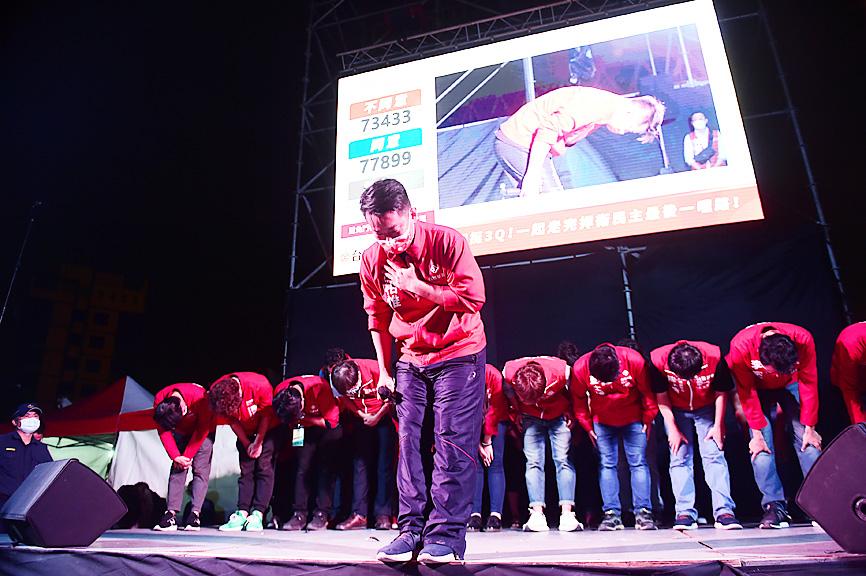
Photo: Liao Yao-tung, Taipei Times
Commission data showed that there are 294,976 eligible voters in the second district, comprised of Dadu (大肚), Shalu (沙鹿), Longjing (龍井), Wufong (霧峰) and Wurih (烏日) districts.
Chen won the seat in January last year in an election against then-incumbent Chinese Nationalist Party (KMT) legislator Yen Kuan-heng (顏寬恒), a member of a powerful political family in Taichung and the son of former Non-Partisan Solidarity Union legislator Yen Ching-piao (顏清標).
Under the Civil Servants Election and Recall Act (公職人員選舉罷免法), 25 percent of eligible voters — 73,744 for the second district — must vote in favor of a recall to meet a threshold for an election to be valid.
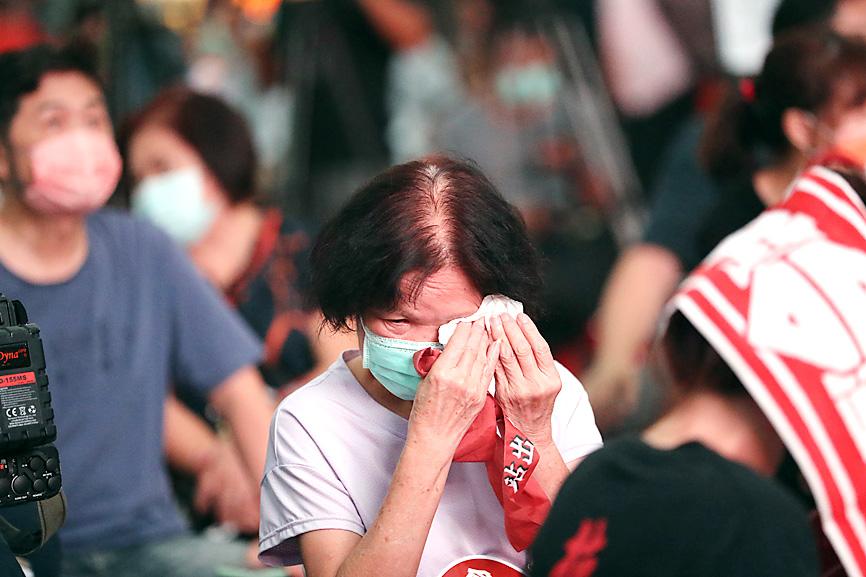
Photo: CNA
A by-election is to be held within three months to fill the legislative seat, the commission said.
After the outcome was announced, Chen thanked supporters gathered at his Taichung campaign headquarters, where he led other Taiwan Statebuilding Party officials and staff in a bow.
Chen said that it was not a total defeat, as “I had won last time, and had gained the working experience as a legislator for one year and nine months. Through this recall campaign, our party has also grown up. We are a small party, and it was hard to mobilize initially. Now our party has matured.”
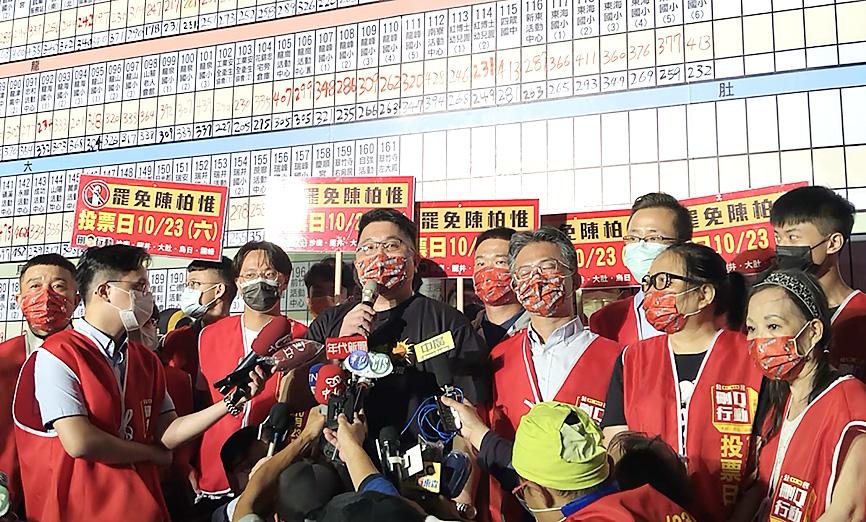
Photo: CNA
Referring to the 73,433 votes against the recall, Chen said that “we did not lose this battle,” as that number was quite close to the threshold.
“It means that through the past year and nine months that I served in the legislature, we gained the support of 73,433 local residents who identify with and approve of my work,” he said.
Taiwan Statebuilding Party Chairman Chen Yi-chi (陳奕齊) said Chen Po-wei was attacked by the combined forces of the Yen family, the KMT and the Chinese Communist Party.
“Despite the result, our party has not been knocked out, and we will work hard to safeguard Taiwan’s democracy,” he said.
Liu Kang-yen (劉康彥), spokesman for the Democratic Progressive Party, which supported Chen Po-wei in the recall, said the KMT should refrain from pursuing more “revenge recall” elections.
Yang Wen-yuan (楊文元), who initiated the recall election, claimed he voted for Chen Po-wei in January last year, but later regretted it.
“This is the most glorious moment for Taichung’s second electoral district,” Yang said. “It shows that Taiwan’s democracy has made progress, and it also serves as a warning to all elected politicians not to forget their pledges to voters.”
KMT Chairman Eric Chu (朱立倫) said that Chen Po-wei’s support for lifting an import ban on pork containing ractopamine was among the reasons voters sought “to oust an arrogant legislator.”
US-CHINA SUMMIT: MOFA welcomed US reassurance of no change in its Taiwan policy; Trump said he did not comment when Xi talked of opposing independence US President Donald Trump yesterday said he has not made a decision on whether to move forward with a major arms package for Taiwan after hearing concerns about it from Chinese President Xi Jinping (習近平). Trump’s comments on Taiwan came as he flew back to Washington after wrapping up critical talks in which both leaders said important progress was made in stabilizing US-China relations even as deep differences persist between the world’s two biggest powers on Iran and Taiwan. “I will make a determination,” Trump said, adding: “I’ll be making decisions. But, you know, I think the last thing we need right
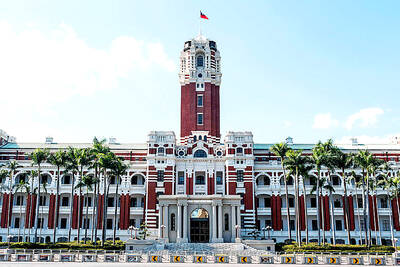
SECURITY: Taipei presses the US for arms supplies, saying the arms sales are not only a reflection of the US security commitment to Taiwan but also serve as a mutual deterrent against regional threats Taiwan is committed to preserving the cross-strait “status quo” and contributing to regional peace and stability, the Presidential Office said yesterday. “It is an undeniable fact that the Republic of China is a sovereign and independent democratic nation,” Presidential Office spokeswoman Karen Kuo (郭雅慧) reiterated, adding that Beijing has no right to claim sovereignty over Taiwan. The statements came after US President Donald Trump warned against Taiwanese independence. Trump wrapped up a state visit to Beijing on Friday, during which Chinese President Xi Jinping (習近平) had pressed him not to support Taiwan. Taiwan depends heavily on US security backing to deter China from carrying
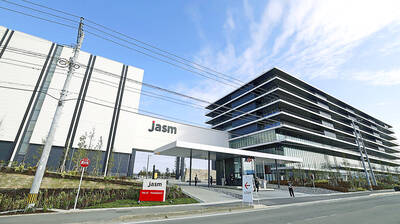
The subsidiary of Taiwan Semiconductor Manufacturing Co (TSMC, 台積電) in Kumamoto, Japan, turned a profit in the first quarter of this year, marking the first time the first fab of the unit has become profitable since mass production started at the end of 2024. According to the contract chipmaker’s financial statement released on Friday, Japan Advanced Semiconductor Manufacturing Inc (JASM), a joint venture running the fab in Kumamoto, posted NT$951 million (US$30.19 million) in profit in the January-to-March period, compared with a loss of NT$1.39 billion in the previous quarter, and a loss of NT$3.25 billion in the first quarter of
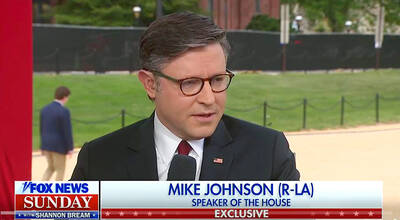
RESOLUTE BACKING: Two Republican senators are planning to introduce legislation that would impose immediate sanctions on China if it attempts to invade Taiwan US House of Representatives Speaker Mike Johnson on Sunday reaffirmed US congressional support for Taiwan, saying the US and “all freedom-loving people” have a stake in preventing China from seizing Taiwan by force. Johnson made the remarks in an interview with Fox News Sunday on US President Donald Trump’s summit with Chinese President Xi Jinping (習近平) last week. In an interview that aired on Friday on Fox News, just as Trump wrapped up a high-stakes visit to China, he said he has yet to green-light a new US$14 billion arms package to Taiwan and that it “depends on China.” “It’s a very good


 RSS
RSS