


Eight countries and the top EU diplomat yesterday urged the Burmese junta to let a regional special envoy meet ousted civilian leader Aung San Suu Kyi.
The call comes as concerns grow over the military government’s commitment to a “five-point consensus” agreed with regional bloc ASEAN to defuse the bloody crisis that erupted after Myanmar’s Feb. 1 coup.
ASEAN foreign ministers were to meet virtually last night to debate whether to exclude Burmese Army Senior General Min Aung Hlaing from an upcoming summit over his government’s intransigence.
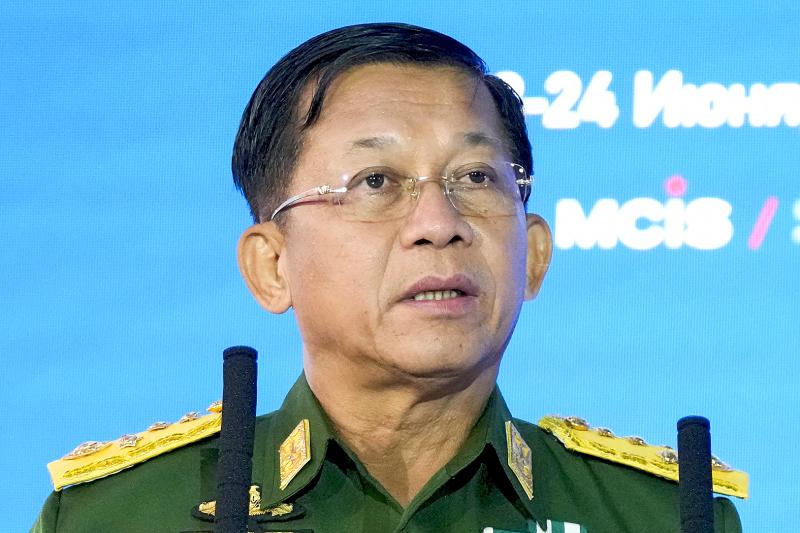
Photo: AP
The military authorities have said they would not allow ASEAN Special Envoy to Myanmar Erywan Yusof to meet anyone on trial, which includes Aung San Suu Kyi.
In a joint statement, Australia, Canada, East Timor, New Zealand, South Korea, the UK and the US said they are “deeply concerned about the dire situation in Myanmar” and urged Naypyidaw to “engage constructively” with the special envoy.
“We further call on the military to facilitate regular visits to Myanmar by the ASEAN special envoy, and for him to be able to engage freely with all stakeholders,” said the statement, endorsed by EU High Representative for Foreign Affairs and Security Policy Josep Borrell.
The last phrase is an apparent reference to the junta refusing Yusof, who is also Brunei’s second minister of foreign affairs, access to Aung San Suu Kyi.
Malaysian Minister of Foreign Affairs Saifuddin Abdullah yesterday said Malaysia does not want Min Aung Hlaing at the upcoming ASEAN summit if he fails to honor his commitment to a peace plan.
“This evening we will be looking at the details of the proposed visit,” he told a news conference.
“If there is no real progress then Malaysia’s stand would remain that we do not want the general to be attending the summit. No compromise on that.”
ASEAN members were due to meet virtually on Friday last week, but UN Secretary-General Antonio Guterres asked to postpone the meeting at the last minute to avoid signaling recognition of the junta by being in the same online meeting with Burmese Minister of Foreign Affairs Wunna Maung Lwin.
UN diplomats, speaking on condition of anonymity, said that Guterres does not want to get ahead of a decision by UN member states on who will sit in Myanmar’s seat at the world body after rival claims were made by the junta and Burmese Ambassador to the UN Kyaw Moe Tun, who was appointed by the elected government.
Myanmar has been one of ASEAN’s most divisive issues since it joined the bloc in 1997 as a military dictatorship lambasted by the West for its iron-fisted rule, testing ASEAN’s unity and denting its international credibility.
Additional reporting by Reuters
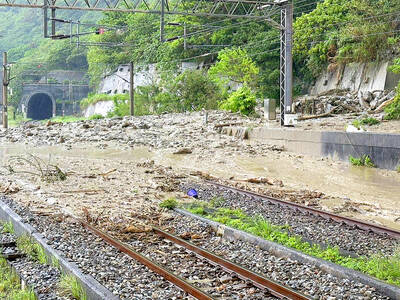
ROLLER-COASTER RIDE: More than five earthquakes ranging from magnitude 4.4 to 5.5 on the Richter scale shook eastern Taiwan in rapid succession yesterday afternoon Back-to-back weather fronts are forecast to hit Taiwan this week, resulting in rain across the nation in the coming days, the Central Weather Administration said yesterday, as it also warned residents in mountainous regions to be wary of landslides and rockfalls. As the first front approached, sporadic rainfall began in central and northern parts of Taiwan yesterday, the agency said, adding that rain is forecast to intensify in those regions today, while brief showers would also affect other parts of the nation. A second weather system is forecast to arrive on Thursday, bringing additional rain to the whole nation until Sunday, it
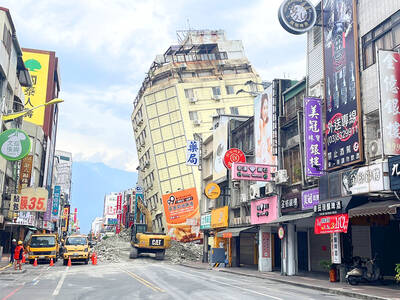
LANDSLIDES POSSIBLE: The agency advised the public to avoid visiting mountainous regions due to more expected aftershocks and rainfall from a series of weather fronts A series of earthquakes over the past few days were likely aftershocks of the April 3 earthquake in Hualien County, with further aftershocks to be expected for up to a year, the Central Weather Administration (CWA) said yesterday. Based on the nation’s experience after the quake on Sept. 21, 1999, more aftershocks are possible over the next six months to a year, the agency said. A total of 103 earthquakes of magnitude 4 on the local magnitude scale or higher hit Hualien County from 5:08pm on Monday to 10:27am yesterday, with 27 of them exceeding magnitude 5. They included two, of magnitude

CONDITIONAL: The PRC imposes secret requirements that the funding it provides cannot be spent in states with diplomatic relations with Taiwan, Emma Reilly said China has been bribing UN officials to obtain “special benefits” and to block funding from countries that have diplomatic ties with Taiwan, a former UN employee told the British House of Commons on Tuesday. At a House of Commons Foreign Affairs Committee hearing into “international relations within the multilateral system,” former Office of the UN High Commissioner for Human Rights (OHCHR) employee Emma Reilly said in a written statement that “Beijing paid bribes to the two successive Presidents of the [UN] General Assembly” during the two-year negotiation of the Sustainable Development Goals. Another way China exercises influence within the UN Secretariat is

Taiwan’s first drag queen to compete on the internationally acclaimed RuPaul’s Drag Race, Nymphia Wind (妮妃雅), was on Friday crowned the “Next Drag Superstar.” Dressed in a sparkling banana dress, Nymphia Wind swept onto the stage for the final, and stole the show. “Taiwan this is for you,” she said right after show host RuPaul announced her as the winner. “To those who feel like they don’t belong, just remember to live fearlessly and to live their truth,” she said on stage. One of the frontrunners for the past 15 episodes, the 28-year-old breezed through to the final after weeks of showcasing her unique


 RSS
RSS