


Premier Su Tseng-chang (蘇貞昌) yesterday spoke briefly at the Legislative Yuan in Taipei in his first policy address to the new legislative session amid a boycott by Chinese Nationalist Party (KMT) legislators over the government’s handling of a domestic COVID-19 outbreak.
Accompanied by other Executive Yuan officials, Su arrived at the legislature shortly before the session began at 9am. Several KMT legislators were already occupying the seats reserved for government officials.
KMT legislators then shouted slogans demanding that Su apologize for the Democratic Progressive Party (DPP) government’s COVID-19 policies in an attempt to stop him from reporting to lawmakers.
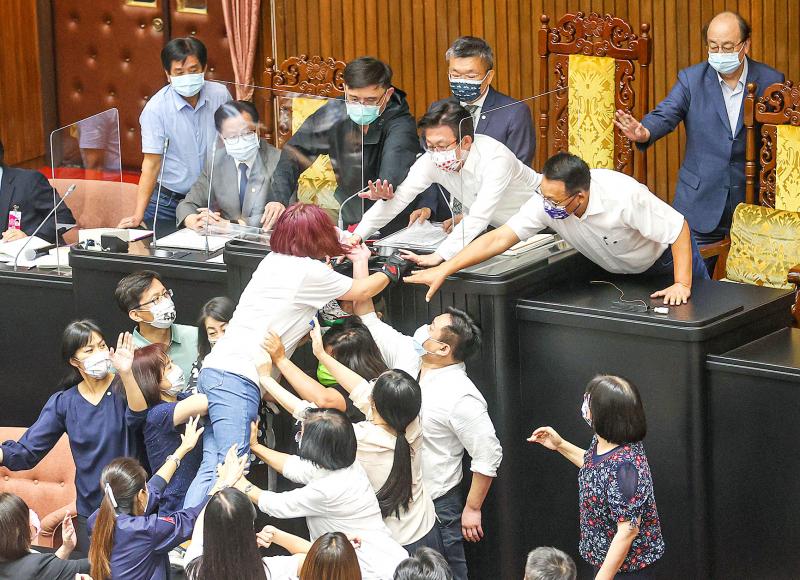
Photo: CNA
A number of DPP legislators then surrounded the speaker’s seat, and pushing and shoving between rival lawmakers ensued.
With the help of DPP lawmakers, Su was able to step up to the podium and make a policy report that lasted less than two minutes to fulfill his duty as stipulated in the Constitution.
After his remarks, Su fielded questions, as required by law.
The session was interrupted after the first lawmaker to ask a question, New Power Party Legislator Chiu Hsien-chih (邱顯智), complained about KMT lawmakers being too loud with their protests.
Deputy Legislative Speaker Tsai Chi-chang (蔡其昌), the convener of the session, decided to suspend the session and hold a cross-party negotiation to decide when it would continue.
Su was supposed to make his first policy address on Friday last week, but was forced to postpone that report to yesterday due to the KMT boycott.
Article 3, Section 1 of the Additional Articles of the Constitution of the Republic of China stipulates that the nation’s premier has a duty to present a policy report from their administration to the Legislative Yuan and answer lawmakers’ questions.
The KMT boycott is a protest over the government’s policy changes in mid-April that allowed cabin crew of the nation’s airlines to quarantine for only three days after flying back to Taiwan and what the KMT criticizes as its refusal to address the consequences of those changes.
Shortly after the three-day quarantine policy was introduced, two China Airlines Ltd (中華航空) pilots who had just returned to Taiwan tested positive for COVID-19 on April 20.
The number of infections involving airline employees and their families then surged.
The airline cluster expanded in late April to include employees of the Novotel Taipei Taoyuan International Airport hotel, which is owned by the airline and had served as a quarantine hotel for its employees.
From May 11, domestic infections emerged in northern Taiwan, especially in Taipei’s Wanhua District (萬華), which eventually led to more than 10,000 COVID-19 cases and 800 deaths nationwide in the following two months.
Many, including the KMT, have linked those cases to the China Airlines and Novotel hotel cluster infection in late April.
Minister of Health and Welfare Chen Shih-chung (陳時中) even seemed to confirm the link on May 13, saying that the genetic sequence of the virus in some China Airlines and Novotel cases was identical to a case in New Taipei City’s Lujhou District (蘆洲) and by extension an early Wanhua case.
However, the government was not able to identify a chain of transmission.
KMT lawmakers repeated the charge again yesterday and criticized the government’s “lack of remorse for its missteps.” They demanded that Su apologize, both verbally at the legislature and in his report.
Su previously apologized over the loss of 800 lives due to the outbreak, but the government says that the China Airlines and Novotel cluster and the outbreak were unrelated.
It has failed to provide an explanation of how the mid-May outbreak began.

The Tourism Administration yesterday announced that it would reward repeat international visitors with incentives of up to NT$8,000 to boost inbound tourism. The incentives are available to all international tourists, it said, adding that repeat visitors would be rewarded with NT$5,000 and would receive an additional NT$3,000 if they bring travel companions. The nation received 2,990,657 inbound visitors during the first quarter, marking a 3.8 percent increase from the same period last year, agency data showed. Japanese nationals are among groups visiting Taiwan the most. About 1.48 million Japanese tourists arrived last year, a year-on-year increase of more than 12
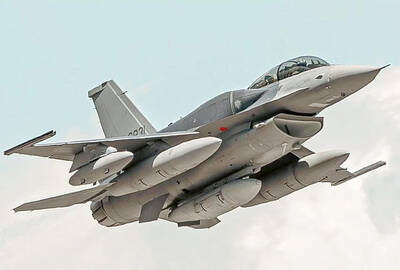
66 FIGHTER JETS: The aircraft is likely undergoing preparations for its transfer to Taiwan — a significant step forward in the nation’s modernization program, a lawmaker said The first of Taiwan’s order of F-16V Block 70 aircraft has been sighted in Texas ahead of delivery, Democratic Progressive Party (DPP) Legislator Wang Ting-yu (王定宇) said. Taiwan’s first F-16V Block 70 two-seat aircraft, tail number 6831, was seen flying from Lockheed Martin’s production facility in Greenville, South Carolina, to Naval Air Station Joint Reserve Base Fort Worth in Texas, Wang wrote on Facebook yesterday. The plane is likely undergoing preparations for its transfer to Taiwan, marking a significant step forward in the Republic of China Air Force’s modernization program, Wang said, citing military analysts. The F-16V Block 70 is a new-build version
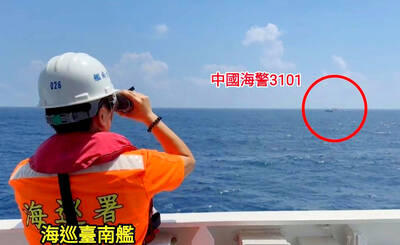
‘BRAZEN’: The holiday did not stop China from activities that infringe on Taiwan’s maritime jurisdiction, but the CGA is ready to defend the nation, Kuan Bi-ling said Beijing is intensifying maritime pressure on Taiwan, but the nation will never yield, Ocean Affairs Council Deputy Minister Sung Chen-en (宋承恩) said. The Coast Guard Administration (CGA) has adopted a “shadowing and monitoring” approach to avoid falling into a Chinese trap to escalate tensions and deepen the conflict, Sung said in an interview published yesterday in the Chinese-language Liberty Times (the Taipei Times’ sister newspaper). China Coast Guard formations patrolling waters east of Taiwan, as well as official Chinese vessels entering areas around Itu Aba Island (Taiping Island, 太平島) and Pratas Islands (Dongsha Islands, 東沙群島) show Beijing’s attempts to significantly step up
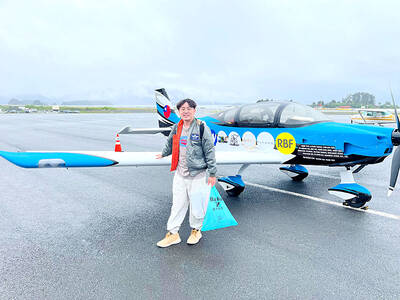
Taiwanese aviator Roger Lin (林睿哲) returned to Taiwan on Saturday after completing a nine-day round-the-world journey in a single-engine aircraft, becoming the first Taiwanese pilot to achieve the feat. Lin departed on June 5 from Los Angeles, California, and continued through Alaska, Japan, Taiwan, the Philippines, Indonesia, Malaysia, Thailand, Nepal, Jordan, Norway, Iceland and Canada before landing at the Taipei International Airport (Songshan) via Los Angeles and Japan. Lin shared numerous photos and videos of his journey on a Facebook page titled “Pilot Roger’s Around the World Flight,” including a video showing his aircraft flying over the Danjiang Bridge and


 RSS
RSS