


Emergency landing and takeoff drills for military aircraft were held on a provincial highway for the first time early yesterday as part of Taiwan’s Han Kuang military exercises, testing the ability of pilots and aircraft to land on narrow roads were airstrips to be damaged.
The drill began at 6:30am on a 2.26km section of Provincial Highway No. 1 linking Pingtung County’s Jiadong (佳冬) and Fangliao (枋寮) townships.
An Indigenous Defense Fighter, an F-16V, a Mirage 2000-5 and an E-2K early warning aircraft participated.
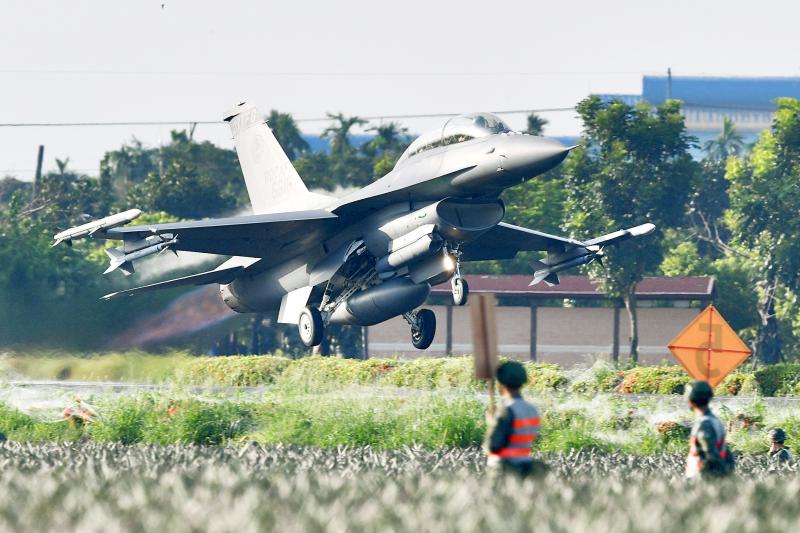
Photo: Sam Yeh, AFP
The planes landed on the highway in that order at 6:30am, 6:32am, 6:34am and 6:36am before taking off at two-minute intervals in the same order starting at 7:02am.
The drill tested the pilots’ ability to land on the 24m-wide road, preparing for a scenario in which the airstrips at Pingtung Air Base about 30km away are damaged by enemy forces, military officials said.
It marked the first time such a drill was conducted on a provincial highway, a regular roadway with traffic lights and intersections that runs between cities.
Photo: CNA
The Jiadong-Fangliao stretch of road is one of five in Taiwan to accommodate emergency military jet landings and takeoffs in the event of war.
The others are all on Sun Yat-sen Freeway (Freeway No. 1), with two in Tainan — on the Madou (麻豆) and Rende (仁德) district sections — on the Huatan Township (花壇) section in Changhua County and on the Minsyong Township (民雄) section in Chiayi County.
Exercises have previously been conducted on the freeway sections.
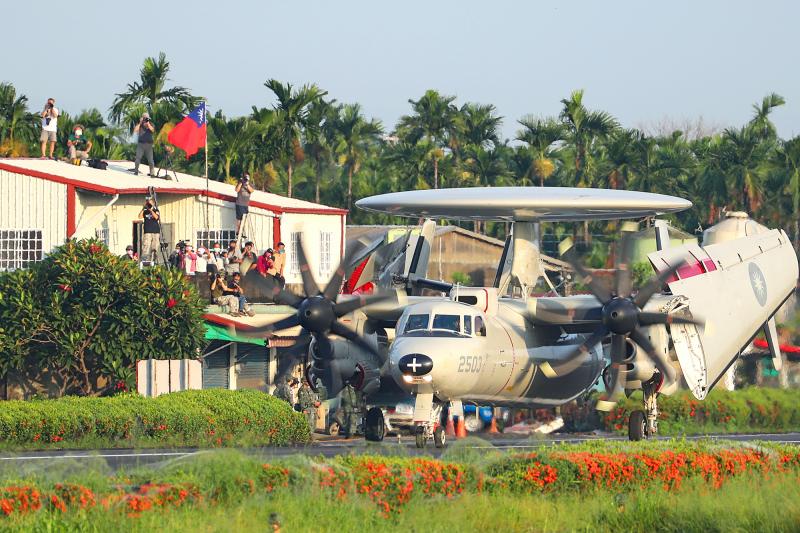
Photo: CNA
Drills planned for the Jiadong-Fangliao section in 2011 were canceled due to poor weather.
The drill was watched by President Tsai Ing-wen (蔡英文), Minister of National Defense Chiu Kuo-cheng (邱國正), senior government and military officials, as well as the media.
Institute for National Defense and Security Research analyst Shu Hsiao-huang (舒孝煌) said that yesterday’s drills were important, as the freeway sections are easy targets for enemy fire and thus more likely to be destroyed during wartime.
Moreover, landing on regular roads makes logistics and resupplying easier during a battle, Shu said.
It is important that the air force ensures its pilots can land on regular roads, he said.
Institute researcher Su Tzu-yun (蘇紫雲) said that compared with landing on freeways, landing on regular roads is much more challenging for aircraft, pilots and ground control crews, because they are narrower and closer to civilian buildings.
The drill was a pressure test for all of the military personnel involved and mimics actual combat experience, Su said.
Yesterday’s drill was part of the postponed live-fire component of this year’s Han Kuang military exercises, which began on Monday and are to conclude tomorrow.
In related news, the Wanan air defense drill was held across Taiwan, although civilians were not required to shelter in place.
The 30-minute drill, designated No. 44 this year, began at 1:30pm with the sounding of air-raid sirens.
The usual suspension of vehicular and pedestrian traffic was not imposed this year, with people allowed to go about their daily routines, the ministry said, citing COVID-19 guidelines issued by the Central Epidemic Command Center to prevent large gatherings.
The drill was aimed mainly at raising awareness of emergency warnings to reduce the possibility of casualties and damage, particularly in the event of an air attack, the ministry said.
People received text messages at the start and end of the drill, which were to stress-test “defense updates,” “air-raid warnings” and “text message delivery capabilities,” it said.

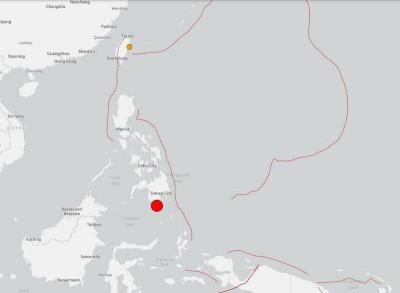
A magnitude 7.8 earthquake struck off the southern coast of Mindanao in the Philippines at 7:38am today, prompting the US Tsunami Warning System to issue an alert for neighboring countries, including Taiwan. The system issued a purple alert indicating a "tsunami threat." The potential threat zone includes Taiwan, the Philippines, Papua New Guinea, Yap and Palau. Philippine authorities were assessing the damage from the quake, with the office of civil defense seeking to verifying initial reports that 15 people had been killed and 129 injured in the region, mostly from falling debris. Arlene Hollero, disaster chief of Maasim town in the Philippines' Sarangani Province,
RESILIENCE: Taiwan plays a key role in semiconductors, energy, information infrastructure and advanced manufacturing, AIT Director Raymond Greene said Taiwan’s continued investment in deterrence and resilience remains vital, especially in uncrewed systems and other emerging technologies, American Institute in Taiwan (AIT) Director Raymond Greene said yesterday. Greene made the remarks at the annual National Strategic Summit on Supply Chain Resilience held by the Research Institute for Democracy, Society and Emerging Technology (DSET), a government-backed think tank. As Taiwan last year became the US’ fourth-largest trading partner and supply chain security is becoming more important, cooperation in emerging technologies continues to deepen between the two countries, he said. The US is committed to accelerating innovation, building key infrastructure, strengthening cooperation

The National Chungshan Institute of Science and Technology yesterday showcased its locally developed variants of the Vision 60 robotic patrol dog, which it plans to deploy on the nation’s outlying territories in the South China Sea. The variants were produced under the Joint Lab project — created by the institute and domestic companies — and assembled with domestically produced motors, lenses and artificial intelligence (AI) systems alongside licensed tech from the US, Missile and Rocket Systems Research Division deputy director Jen Kuo-kang (任國光) told the media event at a military base in Taipei’s Dazhi (大直) area. Taiwan has built up its strengths

RIGHT DIRECTION: Taiwan’s efforts to prevent forced labor include a proposal to ‘fully prohibit’ employers from withholding workers’ documents, an official said Taiwan is to establish a mechanism to restrict imports of goods linked to forced labor, the Executive Yuan said yesterday, after the US proposed imposing additional tariffs on Taiwanese goods over labor concerns. “The Ministry of Labor and the Ministry of Economic Affairs are to establish an interministerial review procedure,” Executive Yuan spokesperson Michelle Lee (李慧芝) said at a news briefing in Taipei. “The government is to use the Foreign Trade Act [貿易法] as the legal basis to restrict imports of goods produced with forced labor” and bring its supply chain governance more in line with international standards on human rights, resilience


 RSS
RSS