


Approximately 167,000 people received a dose of the Medigen COVID-19 vaccine on Monday, the first day that the Taiwan-made vaccine was administered, the Central Epidemic Command Center said yesterday, as it reported one locally transmitted infection, five imported cases and one death.
Minister of Health and Welfare Chen Shih-chung (陳時中), who heads the center, said that about 187,000 people booked an appointment to get vaccinated on Monday, with about 167,000 people receiving the Medigen vaccine.
“The appointment attendance rate was about 90 percent, but some vaccination stations might not have uploaded their data to our system yet,” Chen said. “The attendance rate is considered high, so we are quite satisfied.”
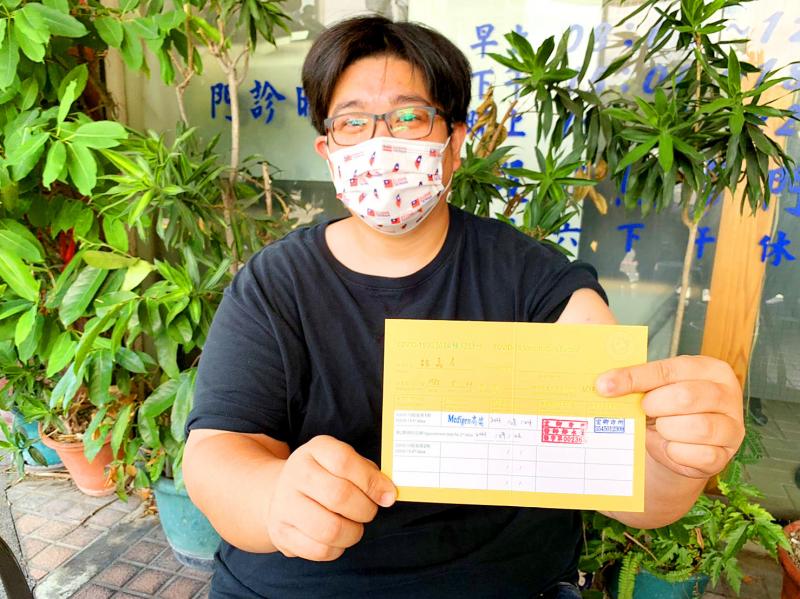
Photo: Wang Chun-chi, Taipei Times
As of Monday, the COVID-19 vaccination coverage of people who have received at least one dose of a vaccine was 40.32 percent, or 43.66 doses administered per 100 people, he said.
The center also received confirmation of the first death following vaccination with the Medigen vaccine.
The man was inoculated on Monday and died yesterday morning. The preliminary hypothesis is that he had an acute myocardial infarction (heart attack).
The man died before arriving at hospital, and the case is being investigated by a prosecutor.
Separately, Shin-Kong Wu Ho-Su Memorial Hospital reported a second case, a 39-year-old man who received the Medigen vaccine on Monday and who was sent to the hospital after a cardiac arrest at noon yesterday.
The man had visited the hospital’s emergency room four times this year after fainting, the hospital said, adding that he had tested positive for illicit drugs twice.
The only domestic COVID-19 infection case reported yesterday was a New Taipei City resident in his 70s, who sought treatment for another illness in Taipei on Sunday and tested positive at the hospital, Chen said.
The five imported cases were all males aged 10 to 50, who arrived from India, Japan and Turkey, data showed.
The sole death case was a woman in her 80s who had underlying health conditions and had been exposed to a confirmed case.
She tested positive after her death, the data showed.
Chen also announced that starting from midnight on Friday, international travelers who arrive in Taiwan would be required to take a disease prevention vehicle to a quarantine facility, and that driving by themselves would no longer be allowed.
“The new restriction is to prevent arriving travelers from staying in their own vehicle or outside for too long,” he said.
Arrivals should be quarantined as soon as possible to reduce the risk of them having contact with other people during their trip from the airport to a quarantine facility, he added.
Chen was asked to comment on a CNN article published yesterday, which said that “Taiwan could become increasingly isolated if it keeps pursuing a “COVID zero” strategy, while Australia and New Zealand have hinted that they might abandon the approach once vaccinations reach a certain level.”
The article also said that Taiwan had been largely successful in containing COVID-19, because it sealed its borders to most travelers and enacted strict disease prevention measures.
“‘COVID zero’ is not our goal, but our policy direction has not changed, which is trying our best to find as many infected individuals as we can, to treat their disease and also avoid community spread,” Chen said.
A mandatory 14-day quarantine for all arriving travelers remains in place, and so far it has not affected Taiwan’s economy, which has performed well in the past two years, he said.
Tight border controls, along with contact tracing and other measures to bring COVID-19 under control, have increased domestic demand, perking up the local economy, as they have allowed the public to live a relatively normal daily life, Chen said, adding that exports have continued to grow.

AGING: As of last month, people aged 65 or older accounted for 20.06 percent of the total population and the number of couples who got married fell by 18,685 from 2024 Taiwan has surpassed South Korea as the country least willing to have children, with an annual crude birthrate of 4.62 per 1,000 people, Ministry of the Interior data showed yesterday. The nation was previously ranked the second-lowest country in terms of total fertility rate, or the average number of children a woman has in her lifetime. However, South Korea’s fertility rate began to recover from 2023, with total fertility rate rising from 0.72 and estimated to reach 0.82 to 0.85 by last year, and the crude birthrate projected at 6.7 per 1,000 people. Japan’s crude birthrate was projected to fall below six,
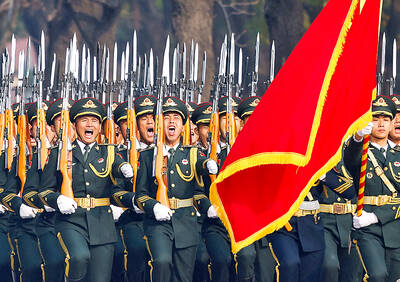
Conflict with Taiwan could leave China with “massive economic disruption, catastrophic military losses, significant social unrest, and devastating sanctions,” a US think tank said in a report released on Monday. The German Marshall Fund released a report titled If China Attacks Taiwan: The Consequences for China of “Minor Conflict” and “Major War” Scenarios. The report details the “massive” economic, military, social and international costs to China in the event of a minor conflict or major war with Taiwan, estimating that the Chinese People’s Liberation Army (PLA) could sustain losses of more than half of its active-duty ground forces, including 100,000 troops. Understanding Chinese
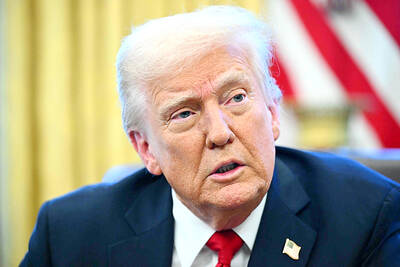
US President Donald Trump in an interview with the New York Times published on Thursday said that “it’s up to” Chinese President Xi Jinping (習近平) what China does on Taiwan, but that he would be “very unhappy” with a change in the “status quo.” “He [Xi] considers it to be a part of China, and that’s up to him what he’s going to be doing, but I’ve expressed to him that I would be very unhappy if he did that, and I don’t think he’ll do that. I hope he doesn’t do that,” Trump said. Trump made the comments in the context
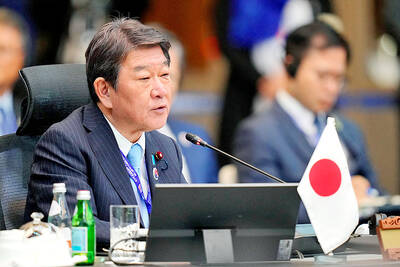
SELF-DEFENSE: Tokyo has accelerated its spending goal and its defense minister said the nation needs to discuss whether it should develop nuclear-powered submarines China is ramping up objections to what it sees as Japan’s desire to acquire nuclear weapons, despite Tokyo’s longstanding renunciation of such arms, deepening another fissure in the two neighbors’ increasingly tense ties. In what appears to be a concerted effort, China’s foreign and defense ministries issued statements on Thursday condemning alleged remilitarism efforts by Tokyo. The remarks came as two of the country’s top think tanks jointly issued a 29-page report framing actions by “right-wing forces” in Japan as posing a “serious threat” to world peace. While that report did not define “right-wing forces,” the Chinese Ministry of Foreign Affairs was


 RSS
RSS