


A Taiwan Railways Administration (TRA) contractor whose truck slid onto a railway track, leading to a fatal derailment of a Taroko Express train on April 2, had experienced a battery failure on his way to work, an investigation by the Taiwan Transportation Safety Board showed yesterday.
The train driver had only seven seconds to respond before the train crashed into the truck and derailed inside the Cingshuei Tunnel (清水隧道), it said.
The crash killed 49 people and injured 213.
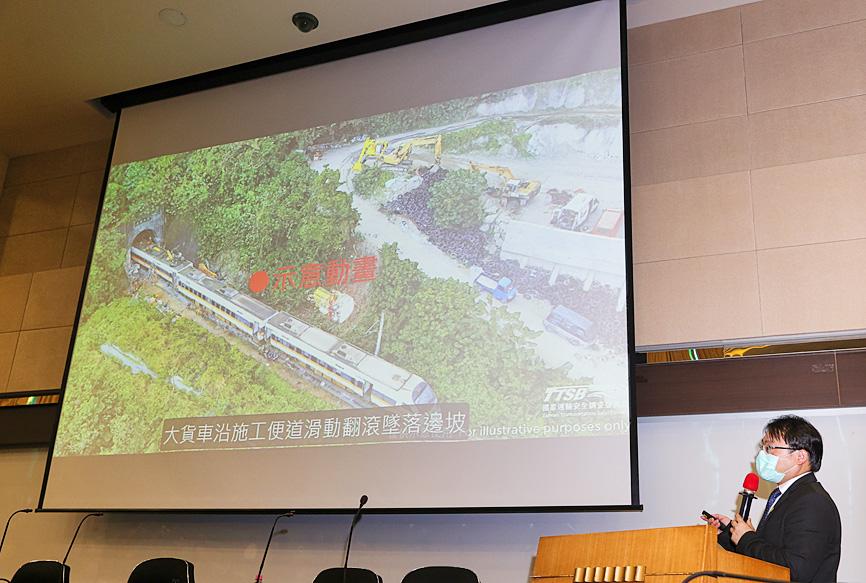
Photo: CNA
The board published a 278-page report on the facts of the accident following a four-month investigation.
The final investigation report is to be released in April next year, in which the board would identify the main causes of the accident and make safety suggestions to all concerned parties, board chairman Young Hong-tsu (楊宏智) said.
Board investigators previously suspected that Lee Yi-hsiang (李義祥), onsite director of a TRA side slope stabilization project, was using an excavator to help it move his truck, which was stuck in the trees when it fell after making a turn on a curve on the construction site.
However, the investigation found that Lee could not start the truck’s engine on his way to work and asked a mechanic to charge the battery for him. Lee was told the battery might have malfunctioned, but instead of changing the battery, he tried and managed to restart the engine and drove the truck to the construction site at about 8am.
“The engine shut down again when Lee tried to drive through a curve on the construction site. To charge the battery, Lee used a suspension strap to tie the truck to an excavator, hoping to use it to restart the truck. He operated the excavator himself to pull the truck closer,” Rail Occurrence Investigation Division convener Li Gang (李綱) said.
“However, the suspension strap broke loose from the truck at about 9:27am after Lee unsuccessfully tried to pull the truck twice, causing the truck to slide down a side slope and fall onto the tracks,” Li added.
The suspension strap that Lee used can only hold up to 3 tonnes, but the truck weighed about 7 tonnes, Li said.
Young previously told reporters that the driver had about 17 seconds to stop the train, but yesterday’s report showed he had only seven seconds to halt it.
Li said that the train was traveling at 126kph when it came out of the Heren Tunnel (和仁隧道) at 9:28:27am. It hit the truck at 9:28:34am, with speed reduced to 123kph. Its speed dropped further to 117kph when it was entering the Cingshuei Tunnel at 9:28:35am, he said.
Before the accident, the TRA had assigned a worker from its construction crew in Hualien to monitor landslides at a tunnel construction nearby. The assignment was canceled on March 15 after the tunnel was partly completed, the report said.
Dong Shin Construction Co (東新營造) was the contractor for the side slope construction, which hired Lee as the construction site director. United Geotech (聯合大地工程顧問) designed and supervised the construction, while C.Y.L Engineering Consulting (中棪工程) managed the entire project, the board said.
Lee brought a migrant worker to work on the construction site, despite the TRA banning all work during the Tomb Sweeping holiday, Li said, adding that there were four other Dong Shin workers in the tunnel construction site.
The TRA, Dong Shin and United did not have any plan or records to show that they had strictly controlled access to the construction sites, Li said.
Dong Shin was found to have hired illegal migrant workers and did not give them training on occupational health and safety issues, he said, adding that neither Lee nor a migrant worker at the site at the time are licensed excavator operators.
“The TRA did not require the contractor to report to the agency whenever they entered the construction site. The agency’s on-site inspector also found that the contractor had used excavators for suspension work prior to the accident,” Li said.
Neither the TRA nor the United Geotech required the contractor to install barriers on roads in the construction site, he added.
Although Dong Shin had borrowed walkie-talkies from the TRA, investigators did not find emergency contact information on the construction site, Lee said.
Among the deceased, 30 of them were passengers with standing-room-only tickets, the investigation found, adding that 82.1 percent of casualties were in cars 5 to 8.
“In our final report, we might ask the TRA to reconsider the policy of allowing passengers to board Taroko Express or other tilting trains without reserved seats, given the high risks involved,” he said.
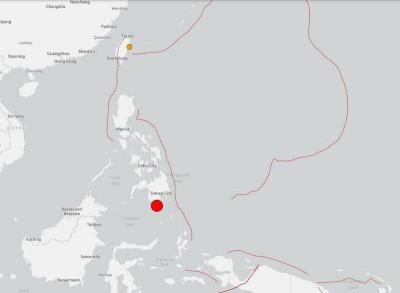
A magnitude 7.8 earthquake struck off the southern coast of Mindanao in the Philippines at 7:38am today, prompting the US Tsunami Warning System to issue an alert for neighboring countries, including Taiwan. The system issued a purple alert indicating a "tsunami threat." The potential threat zone includes Taiwan, the Philippines, Papua New Guinea, Yap and Palau. Philippine authorities were assessing the damage from the quake, with the office of civil defense seeking to verifying initial reports that 15 people had been killed and 129 injured in the region, mostly from falling debris. Arlene Hollero, disaster chief of Maasim town in the Philippines' Sarangani Province,
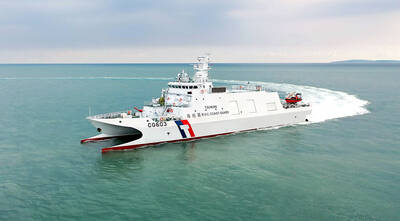
‘GRAY ZONE’ PRESSURE: Beijing’s activities are intended to create the deceitful impression that China has jurisdiction over the area around Taiwan, the CGA said Taiwan’s rights over its territorial waters and exclusive economic zone must not be violated by any country, the Mainland Affairs Council said yesterday, adding that it will not accept any unprovoked actions. The council issued the remarks in response to the China Coast Guard conducting maritime enforcement drills near eastern Taiwan and claiming to fully exercise China’s maritime administrative law enforcement authority. The Coast Guard Administration (CGA) has been closely monitoring the situation and is taking concrete steps to defend the nation’s sovereignty and secure its waters, the council said. China has no sovereign rights over the waters off eastern
RESILIENCE: Taiwan plays a key role in semiconductors, energy, information infrastructure and advanced manufacturing, AIT Director Raymond Greene said Taiwan’s continued investment in deterrence and resilience remains vital, especially in uncrewed systems and other emerging technologies, American Institute in Taiwan (AIT) Director Raymond Greene said yesterday. Greene made the remarks at the annual National Strategic Summit on Supply Chain Resilience held by the Research Institute for Democracy, Society and Emerging Technology (DSET), a government-backed think tank. As Taiwan last year became the US’ fourth-largest trading partner and supply chain security is becoming more important, cooperation in emerging technologies continues to deepen between the two countries, he said. The US is committed to accelerating innovation, building key infrastructure, strengthening cooperation

RIGHT DIRECTION: Taiwan’s efforts to prevent forced labor include a proposal to ‘fully prohibit’ employers from withholding workers’ documents, an official said Taiwan is to establish a mechanism to restrict imports of goods linked to forced labor, the Executive Yuan said yesterday, after the US proposed imposing additional tariffs on Taiwanese goods over labor concerns. “The Ministry of Labor and the Ministry of Economic Affairs are to establish an interministerial review procedure,” Executive Yuan spokesperson Michelle Lee (李慧芝) said at a news briefing in Taipei. “The government is to use the Foreign Trade Act [貿易法] as the legal basis to restrict imports of goods produced with forced labor” and bring its supply chain governance more in line with international standards on human rights, resilience


 RSS
RSS