


Tropical Depression brought torrential rains to large parts of the country yesterday, causing landslides and flooding that blocked roads in mountainous areas, the Central Weather Bureau (CWB) said.
A section of a 100m bridge in New Taipei City’s Chajiao Borough (插角) near Dongyanshan (東眼山) collapsed after several days of rain and flooding, trapping about 300 people in the borough, the New Taipei City Government said.
The bridge’s pillars had been reinforced with steel plates by the New Taipei City Maintenance Office, but continuous rain and recent earthquakes caused the collapse of a 5m section, the city government said.
The rain also caused landslides in Nantou County’s Renai Township (仁愛), cutting off transportation between Cueiluan (翠巒) and Rueiyan (瑞岩) villages, local authorities said, adding that a road between Wujie (武界) and Wanfeng (萬豐) villages had also been blocked by a landslide.
The Kaohsiung City Government said that it had ordered 2,035 people to evacuate from flood-prone mountainous areas, adding that a large section of the Minbaklu Bridge in Taoyuan District (桃源) had collapsed due to flooding, effectively cutting off the district.
The bridge was rebuilt in 2017 for more than NT$100 million (US$3.6 million at the current exchange rate) after the former structure was destroyed by Typhoon Morakot in 2009.
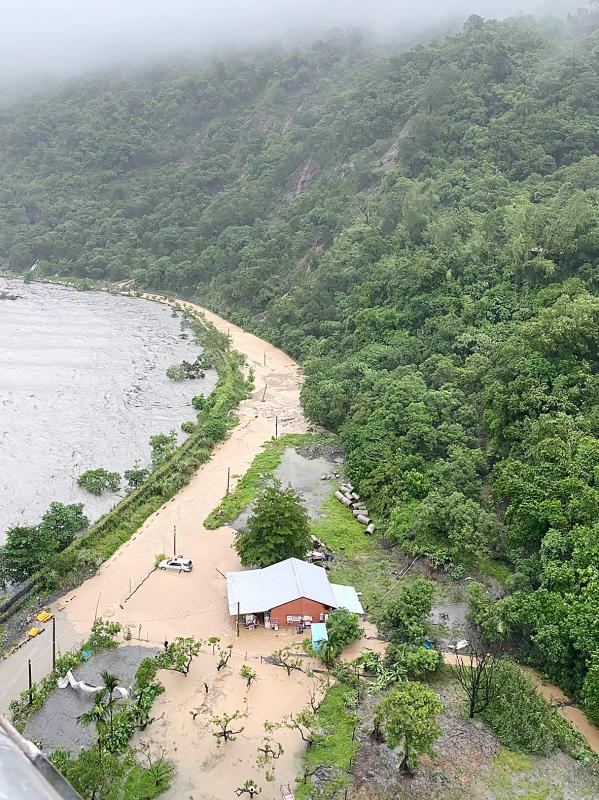
Photo courtesty of a member of the public via CNA
“That bridge is very important to the community, and visitors use it to reach the Yusui Hot Spring (玉穗溫泉),” a local resident said, adding that “minbaklu” means “hope” and “new life” in the Bunun language.
Pingtung County’s Wutai Township (霧台) recorded 693mm of rain between midnight Friday and 3:30pm yesterday, the highest accumulated rainfall in Taiwan, the CWB said.
The second-highest precipitation was recorded in Pingtung’s Majia Township (瑪家) with 648mm, followed by Kaohsiung’s Maolin District (茂林) with 542mm, the bureau said, adding that all three locations received more than 1m of rainfall over the past three days.
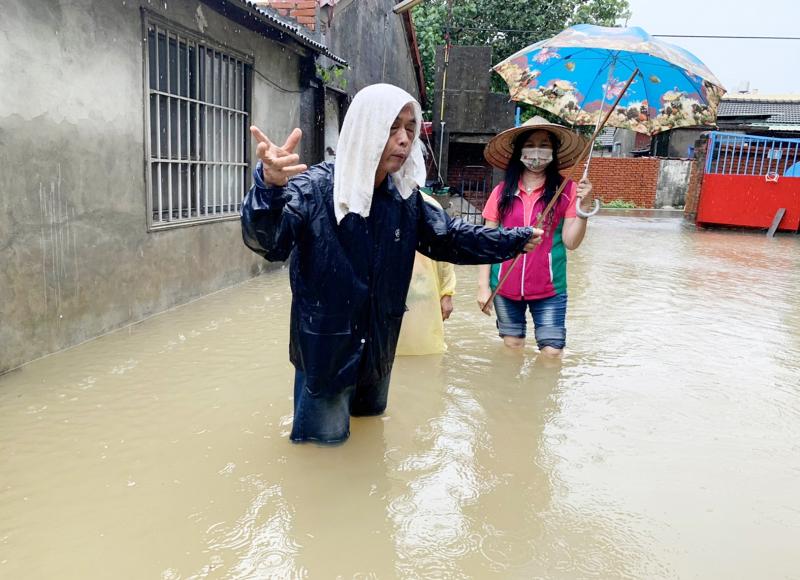
Photo: Tang Shih-ming, Taipei Times
Affected by flooding and landslides, 600 residents in Wutai and Majia had been evacuated, the CWB added.
The CWB said that its weather station on Alishan (阿里山) in Chiayi County at 12:40pm yesterday registered 422mm of rain during the previous 24 hours, while stations in Fencihu (奮起湖) and Lijia (里佳) townships reported 347mm and 302.5mm respectively.
The county also reported landslides, large rocks falling on roads, road collapses and sinkholes in 59 areas, the Chiayi County Government said.
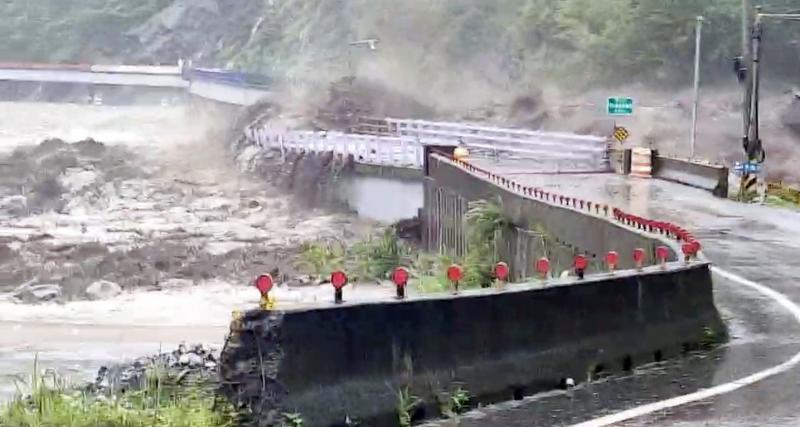
Photo courtesy of a reader
Meanwhile, a rockslide, likely triggered by heavy rain, halted high-speed rail services between Miaoli County and Taichung.
Taiwan High Speed Rail Corp’s (THSRC, 台灣高鐵) sensors detected the rockslide in Miaoli at about 8am, the company said in a statement.
It later decided to suspend service in both directions, as it expected that debris on the tracks might pose risks, the firm said.
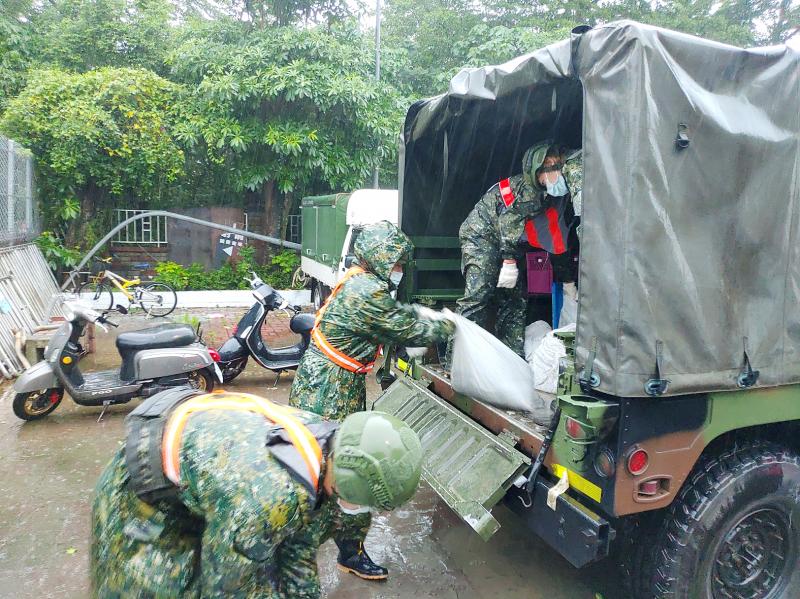
Photo courtesy of the armed forces via CNA
High-speed rail passengers departing from Taipei’s Nangang Station after noon and passengers departing from Kaohsiung’s Zuoying Station after 12:15pm had to take shuttle buses between Miaoli and Taichung, it said.
The railway operator did not provide a time frame for when service would be restored, but said that people can change or cancel their tickets without charge.
Lupit also forced the cancelation of flights and ferry services in Taiwan.
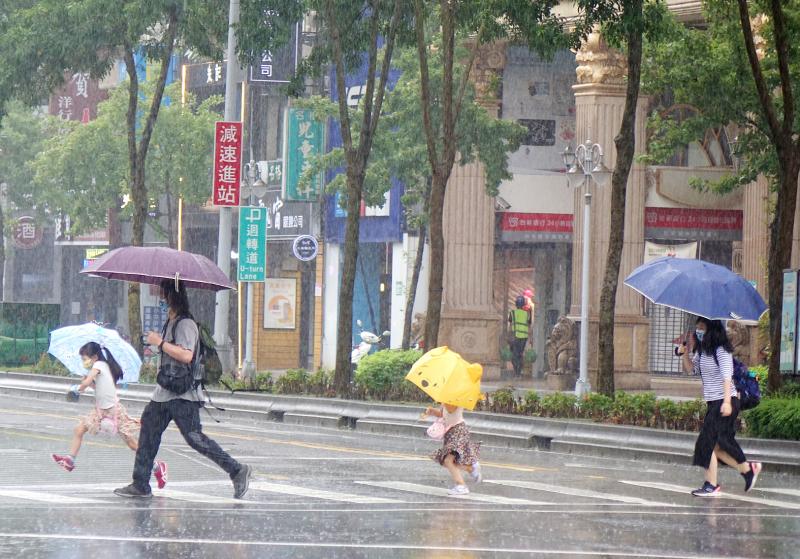
Photo: Wang Yi-sung, Taipei Times
The Maritime and Port Bureau said that 39 scheduled ferries on four routes had been canceled due to hazardous sea conditions.
Civil Aeronautics Administration data showed that 25 domestic flights had been canceled through 2pm, while another six were delayed.
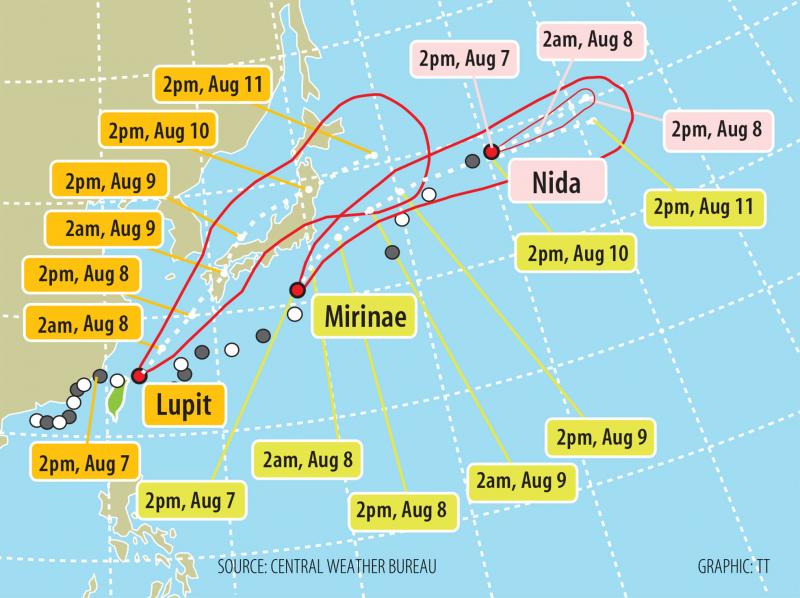
The CWB said the heavy rains had been caused by a combination of seasonal southwesterly winds and a system comprised of the former Tropical Storm Lupit, the center of which made landfall in Hsinchu and Miaoli counties in the morning.
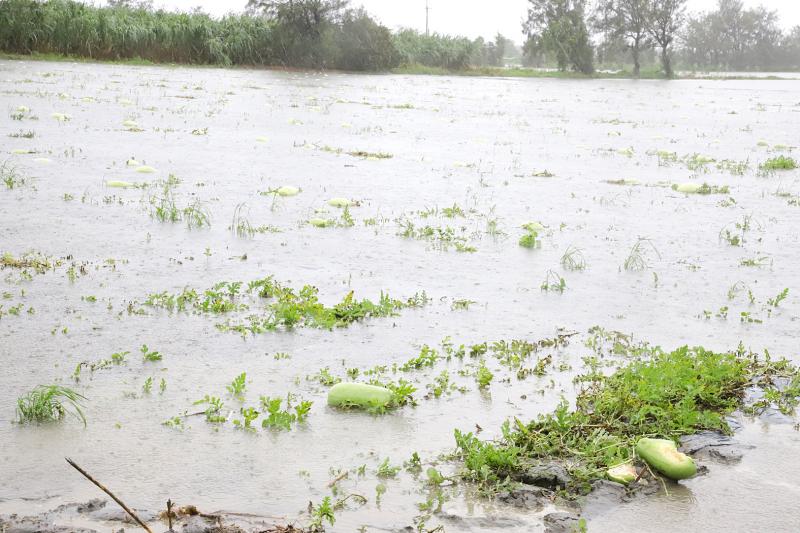
Photo: Lin Kuo-hsien, Taipei Times
The CWB said it expects the rains to ease slightly today, before gradually tapering off tomorrow and on Thursday.
Additional reporting by Peng Chien-li, Tung Chen-kuo Wang Shan-yan and Huang Hsu-lei
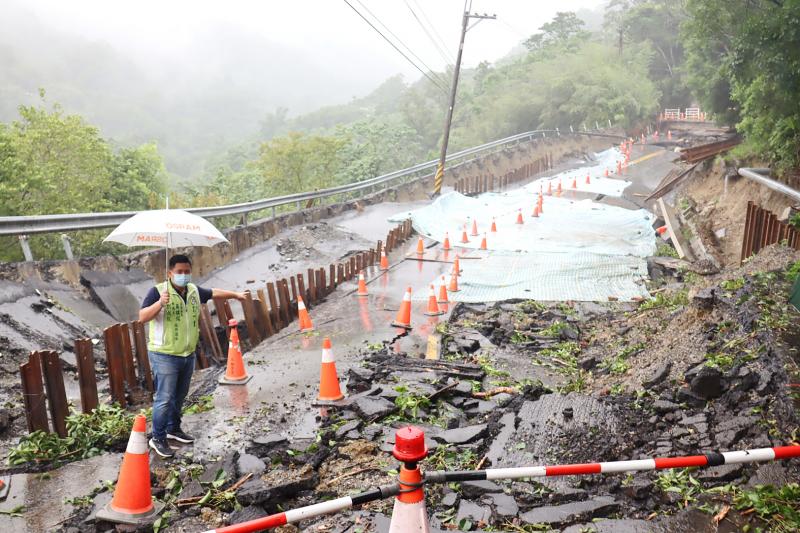
Photo: Weng Yu-huang, Taipei Times

‘NO SECURITY RISK’: The Railway Bureau reassured the public that the technicians’ activities were limited to technical guidance and did not involve sensitive systems The Railway Bureau yesterday said it had invited eight Chinese technicians to assist with an airport MRT construction project. The bureau issued the confirmation after an Internet user said Chinese nationals had entered the construction zone of Taiwan Taoyuan International Airport’s Terminal 3 project. They asked why “individuals from an enemy state” were allowed access to such a major national infrastructure project, which raised serious concerns over Taiwan’s industrial safety, sensitive systems and information security. The bureau’s Northern Region Engineering Branch Office said subcontractor Taiwan Handle Industrial Co (台灣手把工業) of the Taoyuan airport MRT’s “Contract No. CU05 Project A14 Station Civil, MEP &

A US uncrewed surface vessel (USV) encountered multiple Chinese warships during an autonomous transit of the Taiwan Strait, US defense company Seasats said in a statement on Wednesday. Seasats announced that a Lightfish USV had completed the first autonomous transit of the Taiwan Strait. Over five days, the USV traversed the entire length of the Strait while constantly monitoring surface vessel traffic, the company said. The Lightfish encountered multiple Chinese warships, one of which was a Chinese People’s Liberation Army Navy (PLAN) Type 056 corvette, it said. The Chinese vessels were operating “well within Taiwan’s exclusive economic zone without transmitting their identity via the
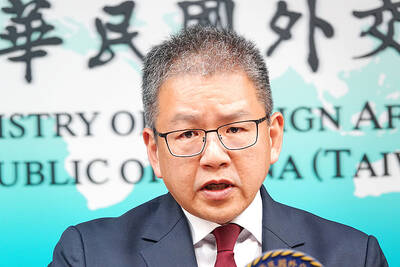
Taiwan is still in the process of assessing the possibility of recruiting workers from Eswatini, the Ministry of Foreign Affairs said yesterday, adding that its goal is to help Eswatini upgrade its vocational training centers. If there are plans to recruit workers from Eswatini, safeguarding national security, protecting public health and ensuring the employment rights of Taiwanese would be prerequisites, Department of West Asian and African Affairs Director-General Yen Chia-liang (顏嘉良) told a news conference. Key considerations would also include filling labor shortages in specific industries, and fostering bilateral professional and technical exchanges, he said. Yen was asked about the progress of labor
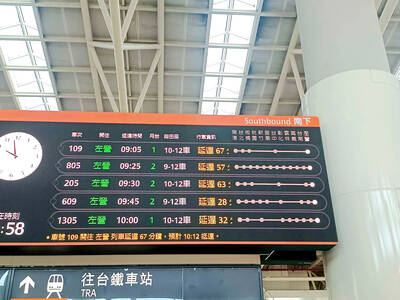
The nation’s usually punctual high-speed rail system yesterday was hit by major disruptions after all scheduled services were canceled and replaced with three hourly trains offering only non-reserved seating, affecting more than 200,000 passengers. Preliminary findings indicate the disruption was caused by a faulty power module in a track switch control cabinet, Taiwan High-Speed Rail Corp (THSRC) said, adding that as a full system inspection could only be conducted after operations end for the day, a decision on whether normal service would resume today would be announced before the first train departs. During a routine inspection early yesterday, a switch signal abnormality


 RSS
RSS