


The first strategic forum for Taiwanese, US and Japanese lawmakers took place virtually yesterday, with former Japanese prime minister Shinzo Abe appearing as a special guest.
Initiated by Japan-ROC Diet Members’ Consultative Council chairman Keiji Furuya, the first edition of the forum was mainly organized by Japan, the Ministry of Foreign Affairs said in a news release.
The forum is a historically and strategically significant tool for reinforcing ties between the countries, it said, adding that discussions covered regional security, economic issues and cooperation among like-minded partners.
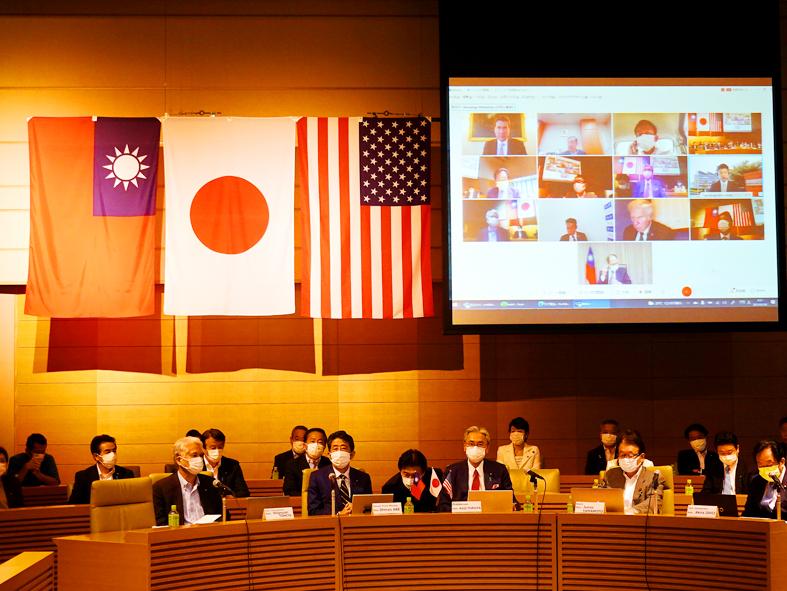
Photo: CNA
Participants agreed on the importance of improving multilateral cooperation to maintain security across the Taiwan Strait, supporting Taiwan’s bid to join the Comprehensive and Progressive Agreement for Trans-Pacific Partnership (CPTPP) and holding the forum in coming years, it said.
Finding ways to deal with a rising China is the primary lesson for the international community in this century, Abe said.
China’s rise could have been a big opportunity for other countries had Beijing complied with WTO regulations, he said.
However, China has unnerved other countries with its military spending — which has increased 42 times in 30 years — while Beijing has been attempting to change the “status quo” in the South China and East China seas, he added.
Taiwan’s role is crucial to maintaining a free and open Indo-Pacific region, Abe said.
Japan, the US and many other countries are worried about Hong Kong, and “we firmly believe that Hong Kong’s situation must never happen in Taiwan,” he said.
Abe voiced support for Taiwan to join the World Health Assembly, the decisionmaking body of the WHO, as well as the CPTPP, while calling on the US to rejoin the trade bloc.
Six Japanese lawmakers participated in the forum, while 18 more observed.
Japan is focusing more on Taiwan, even underlining the importance of its stability in this year’s Defense of Japan white paper and other official statements, Japanese Minister of Defense Nobuo Kishi said in a statement, adding that he hoped the trilateral strategic forum would play a new role in the global community.
Taiwan’s delegation was led by Legislative Speaker You Si-kun (游錫堃), who is also chairman of the legislature’s Taiwan-Japan Parliament Members Friendship Association.
He was excited to again meet “old friend” Abe at the forum, You wrote on Facebook afterward.
In his speech at the forum, You thanked Washington and Tokyo for donating COVID-19 vaccine doses to Taiwan, while calling on the two countries to engage other allies in defending the region’s peace and stability against China’s expansionism.
The US and Japan should recruit allies to warn China that if it used force, they would immediately recognize Taiwan’s diplomatic status, he said.
He expressed the hope that Taiwan could join the Quadrilateral Security Dialogue comprised of the US, India, Australia and Japan, known as the Quad.
He also urged the US and Japan to sign a bilateral trade agreement or free-trade agreement with Taiwan and to support Taiwan’s bid to join the CPTPP.
Washington was represented by US senators Bill Hagerty and Edward Markey, and US Representative Steve Chabot.
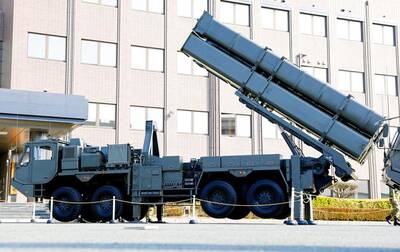
Japan has deployed long-range missiles in a southwestern region near China, the Japanese defense minister said yesterday, at a time when ties with Beijing are at their lowest in recent years. The missiles were installed in Kumamoto in the southern region of Kyushu, as Japan is attempting to shore up its military capacity as China steps up naval activity in the East China Sea. “Standoff defense capabilities enable us to counter the threat of enemy forces attempting to invade our country ... while ensuring the safety of our personnel,” Japanese Minister of Defense Shinjiro Koizumi said. “This is an extremely important initiative for
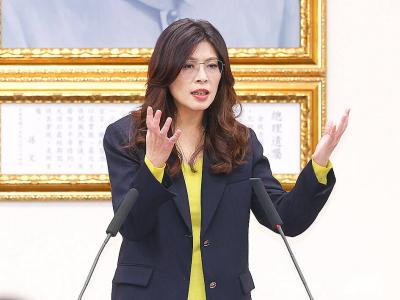
Chinese Nationalist Party (KMT) Chairwoman Cheng Li-wun (鄭麗文) today accepted an invitation from Chinese President Xi Jinping (習近平) to lead a delegation to China next month, saying she hopes to promote the peaceful development of cross-strait relations and bring stability to the Taiwan Strait. “I am grateful and happy to accept this invitation,” Cheng said in a statement from the KMT chairperson’s office. Cheng said she hopes both sides can work together to promote the peaceful development of cross-strait relations, enhance exchange and cooperation, bring stability to the Taiwan Strait and improve people’s livelihoods. At today's news conference, Cheng said any efforts to
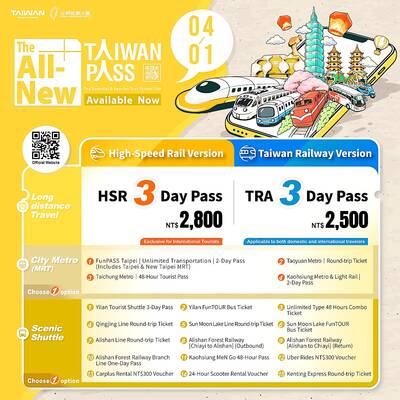
MORE POPULAR: Taiwan Pass sales increased by 59 percent during the first quarter compared with the same period last year, the Tourism Administration said The Tourism Administration yesterday said that it has streamlined the Taiwan Pass, with two versions available for purchase beginning today. The tourism agency has made the pass available to international tourists since 2024, allowing them to access the high-speed rail, Taiwan Railway Corp services, four MRT systems and four Taiwan Tourist Shuttles. Previously, five types of Taiwan Pass were available, but some tourists have said that the offerings were too complicated. The agency said only two types of Taiwan Pass would be available, starting from a three-day pass with the high-speed rail and a three-day pass with Taiwan Railway Corp. The former costs NT$2,800

The nation’s fastest supercomputer, Nano 4 (晶創26), is scheduled to be launched in the third quarter, and would be used to train large language models in finance and national defense sectors, the National Center for High-Performance Computing (NCHC) said. The supercomputer, which would operate at about 86.05 petaflops, is being tested at a new cloud computing center in the Southern Taiwan Science Park in Tainan. The exterior of the server cabinet features chip circuitry patterns overlaid with a map of Taiwan, highlighting the nation’s central position in the semiconductor industry. The center also houses Taiwania 2, Taiwania 3, Forerunner 1 and


 RSS
RSS