


An Israeli firm accused of supplying spyware to governments has been linked to a list of tens of thousands of smartphone numbers, including those of rights advocates, journalists, business executives and politicians around the world, according to reports.
NSO Group and its Pegasus malware — capable of switching on a phone’s camera or microphone, and harvesting its data — have been in the headlines since 2016, when researchers accused it of helping spy on a dissident in the United Arab Emirates.
Sunday’s revelations — part of a collaborative investigation by the Washington Post, the Guardian, Le Monde and other media outlets — raise privacy concerns and reveal the far-reaching extent to which the private firm’s software could be misused.
The leak consists of more than 50,000 phone numbers believed to have been identified as connected to people of interest by NSO clients since 2016, the news organizations said, although it was unclear how many devices were actually targeted or surveilled.
NSO denied any wrongdoing, labeling the allegations “false.”
On the list were 15,000 numbers in Mexico — among them reportedly a number linked to a murdered reporter — and 300 in India, including politicians and prominent journalists.
Last week, the Indian government — which in 2019 denied using the malware to spy on its citizens, following a lawsuit — reiterated that “allegations regarding government surveillance on specific people has no concrete basis or truth associated with it whatsoever.”
The Post said a forensic analysis of 37 of the smartphones on the list showed there had been “attempted and successful” hacks of the devices, including those of two women close to Saudi Arabian journalist Jamal Khashoggi, who was murdered in 2018 by a Saudi Arabian hit squad.
The use of the Pegasus software to hack the phones of al-Jazeera reporters and a Moroccan journalist has been reported previously by Citizen Lab, a research center at the University of Toronto, and Amnesty International.
Forbidden Stories, a Paris-based journalism non-profit organization, and Amnesty originally shared the leak with the newspapers.
The Post said the numbers on the list were unattributed, but other media outlets participating in the project were able to identify more than 1,000 people in more than 50 nations.
They included several members of Arab royal families, at least 65 business executives, 85 human rights advocates, 189 journalists, and more than 600 politicians and government officials — including heads of state, prime ministers and Cabinet ministers.
Many numbers on the list were clustered in 10 nations: Azerbaijan, Bahrain, Hungary, India, Kazakhstan, Mexico, Morocco, Rwanda, Saudi Arabia and the United Arab Emirates.
Pegasus is a highly invasive tool that can switch on a target’s phone camera and microphone, as well as access data on the device, effectively turning a phone into a pocket spy. In some cases, it can be installed without the need to trick a user into initiating a download.
NSO issued a denial on Sunday that focused on the report by Forbidden Stories, calling it “full of wrong assumptions and uncorroborated theories,” and threatening a defamation lawsuit.
It said it was “not associated in any way” with the Khashoggi murder, adding that it sells “solely to law enforcement and intelligence agencies of vetted governments.”
Roughly three dozen journalists at Qatar’s al-Jazeera network had their phones targeted by Pegasus malware, Citizen Lab reported in December last year, while Amnesty said last month that the software was used by Moroccan authorities on the phone of Omar Radi, a journalist convicted over a social media post.
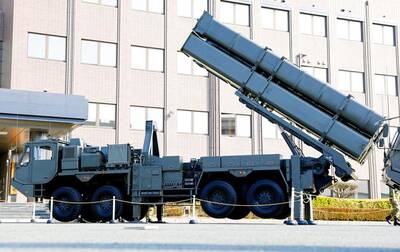
Japan has deployed long-range missiles in a southwestern region near China, the Japanese defense minister said yesterday, at a time when ties with Beijing are at their lowest in recent years. The missiles were installed in Kumamoto in the southern region of Kyushu, as Japan is attempting to shore up its military capacity as China steps up naval activity in the East China Sea. “Standoff defense capabilities enable us to counter the threat of enemy forces attempting to invade our country ... while ensuring the safety of our personnel,” Japanese Minister of Defense Shinjiro Koizumi said. “This is an extremely important initiative for

The nation’s fastest supercomputer, Nano 4 (晶創26), is scheduled to be launched in the third quarter, and would be used to train large language models in finance and national defense sectors, the National Center for High-Performance Computing (NCHC) said. The supercomputer, which would operate at about 86.05 petaflops, is being tested at a new cloud computing center in the Southern Taiwan Science Park in Tainan. The exterior of the server cabinet features chip circuitry patterns overlaid with a map of Taiwan, highlighting the nation’s central position in the semiconductor industry. The center also houses Taiwania 2, Taiwania 3, Forerunner 1 and

MORE POPULAR: Taiwan Pass sales increased by 59 percent during the first quarter compared with the same period last year, the Tourism Administration said The Tourism Administration yesterday said that it has streamlined the Taiwan Pass, with two versions available for purchase beginning today. The tourism agency has made the pass available to international tourists since 2024, allowing them to access the high-speed rail, Taiwan Railway Corp services, four MRT systems and four Taiwan Tourist Shuttles. Previously, five types of Taiwan Pass were available, but some tourists have said that the offerings were too complicated. The agency said only two types of Taiwan Pass would be available, starting from a three-day pass with the high-speed rail and a three-day pass with Taiwan Railway Corp. The former costs NT$2,800

FIRST TRIAL: Ko’s lawyers sought reduced bail and other concessions, as did other defendants, but the bail judge denied their requests, citing the severity of the sentences Former Taipei mayor Ko Wen-je (柯文哲) was yesterday sentenced to 17 years in prison and had his civil rights suspended for six years over corruption, embezzlement and other charges. Taipei prosecutors in December last year asked the Taipei District Court for a combined 28-year, six-month sentence for the four cases against Ko, who founded the Taiwan People’s Party (TPP). The cases were linked to the Core Pacific City (京華城購物中心) redevelopment project and the mismanagement of political donations. Other defendants convicted on separate charges included Chinese Nationalist Party (KMT) Taipei City Councilor Angela Ying (應曉薇), who was handed a 15-year, six-month sentence; Core Pacific


 RSS
RSS