


The Central Epidemic Command Center (CECC) yesterday extended a nationwide level 3 COVID-19 alert to July 26, although some measures are to be relaxed on Tuesday next week.
The alert was first issued on May 15 in Taipei and New Taipei City, before being expanded nationwide four days later. It was to expire on Monday next week, but was extended for a fourth time yesterday.
The nation is “very close” to having indicators fall below the criteria for a level 3 alert, Minister of Health and Welfare Chen Shih-chung (陳時中), who heads the center, told a daily news briefing in Taipei.
Photo: Chen Feng-li, Taipei Times
According to CECC guidelines, a level 3 COVID-19 alert is activated when there have been more than three community clusters in a single week, or more than 10 domestic cases with unknown sources of infection in a single day.
“We think we should still be cautious,” Chen said.
Although the alert would remain in effect, restrictions are to be eased moderately and on a conditional basis, he said.
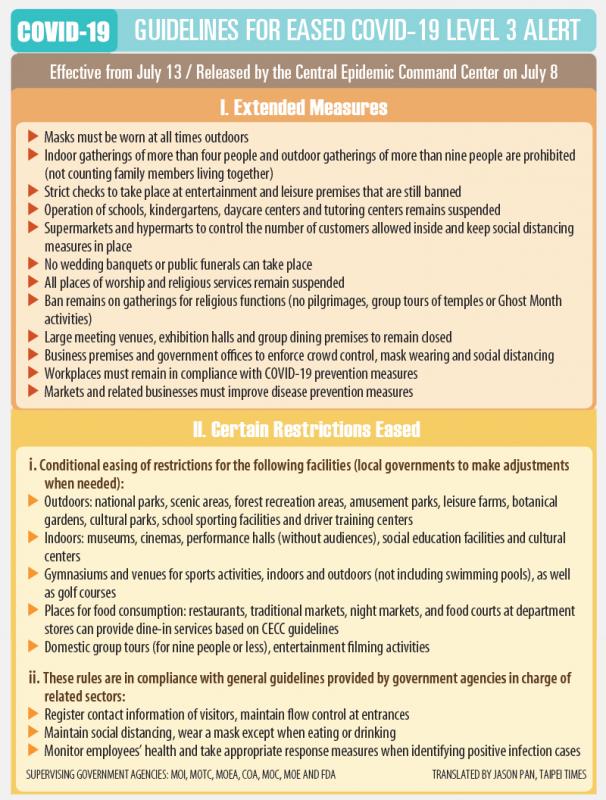
Local governments are to be allowed to make adjustments, he said.
Prohibitions on wedding banquets and public funerals would remain, said Deputy Minister of the Interior Chen Tsung-yen (陳宗彥), the CECC’s deputy head.
Religious sites can apply with local authorities to reopen, as long as they cap attendance at 99 people and follow ministry guidelines, Chen Tsung-yen said.
Other religious activities, including Ghost Festival celebrations, remain suspended, he said.
National parks would enforce crowd controls and operate at 40 percent capacity, calculated based on the number of parking spaces, he said.
Mountain lodges and protected areas in national parks, as well as beaches within the jurisdiction of Kenting National Park, would remain closed to the public, he said.
Public libraries are to be allowed to lend books at a single counter, although members of the public would generally not be permitted inside, Deputy Minister of Education Lio Mon-chi (劉孟奇) said.
Outdoor fields at elementary, junior high and high schools may open for exercise activities while abiding by local authorities’ measures, Lio said.
However, sports facilities and other installations at fields may not be used, he said, adding that eating and drinking are also prohibited.
Indoor and outdoor exercise and sports venues may function at up to 25 percent capacity, he said.
People may not share equipment, and must avoid physical contact and competitions, he said.
Restrooms and changing rooms may be used if they are properly cleaned and disinfected, Lio said.
Swimming pools, showers, saunas and steam rooms would not be open, he added.
Group and one-on-one instructors must undergo a rapid antigen test before restarting classes and be tested every seven days thereafter, he said.
Class sizes must be reduced and scheduled at least one hour apart to allow for cleaning and disinfection, Lio said.
Exhibition venues may open to visitors with appointments, with no more than 100 people allowed in at a time, Deputy Minister of Culture Hsiao Tsung-huang (蕭宗煌) said.
Performance venues may hold closed-door rehearsals, Hsiao said.
Movie theaters are advised to use advance booking systems, he said, adding that audiences would not be allowed to eat or drink.
Film crews must fill out health declaration forms and are recommended to undergo rapid screening for COVID-19 three days before shooting begins, he said.
During filming, they should be screened for COVID-19 at least once a week, Hsiao said.
While unexpected issues are bound to arise as restrictions are relaxed, the center would review the measures on a rolling basis, Chen Shih-chung said.
The goal is to lower the COVID-19 alert level after July 26, he said, urging the nation to work together to achieve the goal.
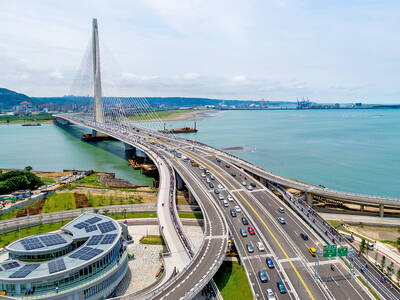
The Ministry of Transportation and Communications yesterday inaugurated the Danjiang Bridge across the Tamsui River in New Taipei City, saying that the structure would be an architectural icon and traffic artery for Taiwan. Feted as a major engineering achievement, the Danjiang Bridge is 920m long, 211m tall at the top of its pylon, and is the longest single-pylon asymmetric cable-stayed bridge in the world, the government’s Web site for the structure said. It was designed by late Iraqi-British architect Zaha Hadid. The structure, with a maximum deck of 70m, accommodates road and light rail traffic, and affords a 200m navigation channel for boats,
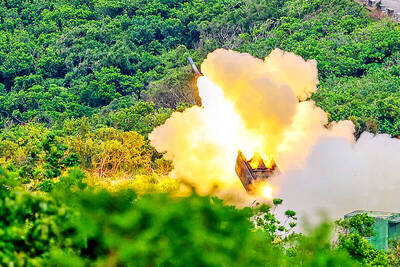
PRECISION STRIKES: The most significant reason to deploy HIMARS to outlying islands is to establish a ‘dead zone’ that the PLA would not dare enter, a source said A High Mobility Artillery Rocket System (HIMARS) would be deployed to Penghu County and Dongyin Island (東引) in Lienchiang County (Matsu) to force the Chinese military to retreat at least 100km from the coastline, a military source said yesterday. Taiwan has been procuring HIMARS and Army Tactical Missile Systems (ATACMS) from the US in batches. Once all batches have been delivered, Taiwan would possess 111 HIMARS units and 504 ATACMS, which have a range of 300km. Considering that “offense is the best defense,” the military plans to forward-deploy the systems to outlying islands such as Penghu and Dongyin so that
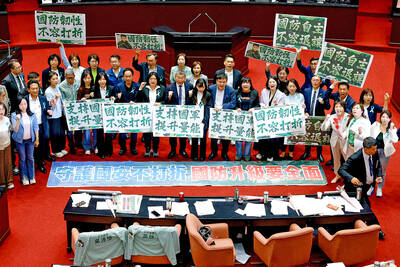
WHAT WAS ALL THAT FOR? Jaw Shaw-kong said that Cheng Li-wen had pushed for more drastic cuts and attacked him, just for the outcome to be nearly identical to his bill The legislature yesterday passed a supplementary budget bill to fund the purchase of separate packages of US military equipment, with the combined amount of spending capped at NT$780 billion (US$24.8 billion). The Chinese Nationalist Party (KMT) and Taiwan People’s Party (TPP) used their legislative majority to pass the bill, which runs until 2033 and has two main funding provisions. One was for NT$300 billion of arms sales already approved by the US for Taiwan on Dec. 17 last year, the other was for NT$480 billion for another arms package expected to be announced by Washington. The bill, which fell short of the NT$1.25
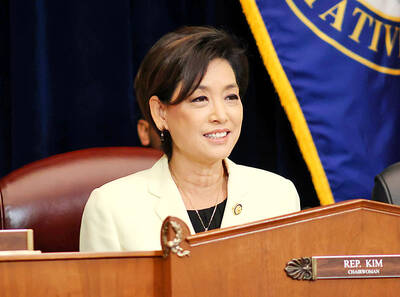
‘CLEAR MESSAGE’: The bill would set up an interagency ‘tiger team’ to review sanctions tools and other economic options to help deter any Chinese aggression toward Taiwan US Representative Young Kim has introduced a bill to deter Chinese aggression against Taiwan, calling for an interagency “tiger team” to preplan coordinated sanctions and economic measures in response to possible Chinese military or political action against Taiwan. “[Chinese President] Xi Jinping [習近平] has directed the People’s Liberation Army to be ready to invade Taiwan by 2027. China has a plan. America should have one too,” Kim said in a news release on Thursday last week. She introduced the “Deter PRC [People’s Republic of China] aggression against Taiwan act” to “ensure the US has a coordinated sanctions strategy ready should


 RSS
RSS