


Hong Kong newspaper the Apple Daily yesterday announced that it is to print its final edition after authorities froze its assets using the National Security Law, silencing the territory’s most China critical media firm.
Journalists outside the paper’s headquarters said that they planned to print 1 million copies overnight — a staggering number given Hong Kong’s population of 7.5 million.
They spoke of their heartbreak at the paper’s closure and loss of about 1,000 jobs.
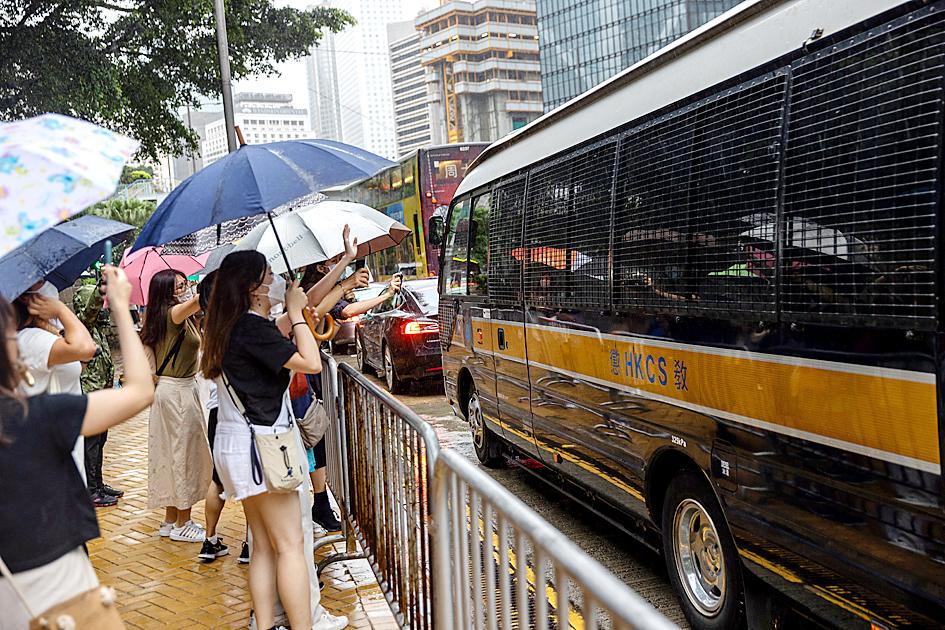
Photo: EPA-EFE
“I have tens of thousands of words in my heart, but I am speechless at this moment,” said Ip Yut-kin (葉一堅), chairman of the paper’s parent company, Next Digital Ltd (壹傳媒).
The Apple Daily has long been a thorn in Beijing’s side, with unapologetic support for Hong Kong’s democracy movement and criticism of China’s authoritarian leaders.
Those same leaders have used the security legislation to bring about its rapid demise.
Owner Jimmy Lai (黎智英), who is in jail for attending democracy protests, was among the first to be charged under the law after its imposition last year.
The final chapter of the 26-year-old paper was written over the past week, when authorities deployed the security law to raid the newsroom, arrest senior executives and freeze its assets.
That last move crippled the paper’s ability to conduct business and pay staff.
Apple Daily announced its closure “out of consideration for the safety of its staff.”
Its Web site was to go offline overnight.
Lai, editor-in-chief Ryan Law (羅偉光) and Next Digital chief executive officer Cheung Kim-hung (張劍虹) have been charged with colluding with foreign forces to undermine China’s national security and remanded into custody.
Yeung Ching-kee (楊清奇), one of the paper’s top columnists, was arrested yesterday on the same charge.
“Every journalist in Hong Kong now has a metaphorical gun pointed at their heads,” said Sharron Fast, a lecturer at the University of Hong Kong’s journalism school.
“When the result of your writing can lead to lifetime imprisonment — you are being censored. Apple will not be the last — just the latest,” Fast said.
Meanwhile, the first trial under the National Security Law began without a jury.
Prosecutors started presenting their case against Tong Ying-kit (唐英杰), 24, who was arrested the day after the law came into effect.
He allegedly drove his motorcycle into a group of police officers during protests on July 1 last year.
Footage showed his motorcycle was flying a flag that read “Liberate Hong Kong, revolution of our times.”
Prosecutor Anthony Chau (周天行) said his team would show that the phrase meant separating Hong Kong from China, or seeking “regime change.”

‘NO SECURITY RISK’: The Railway Bureau reassured the public that the technicians’ activities were limited to technical guidance and did not involve sensitive systems The Railway Bureau yesterday said it had invited eight Chinese technicians to assist with an airport MRT construction project. The bureau issued the confirmation after an Internet user said Chinese nationals had entered the construction zone of Taiwan Taoyuan International Airport’s Terminal 3 project. They asked why “individuals from an enemy state” were allowed access to such a major national infrastructure project, which raised serious concerns over Taiwan’s industrial safety, sensitive systems and information security. The bureau’s Northern Region Engineering Branch Office said subcontractor Taiwan Handle Industrial Co (台灣手把工業) of the Taoyuan airport MRT’s “Contract No. CU05 Project A14 Station Civil, MEP &

The National Chungshan Institute of Science and Technology yesterday showcased its locally developed variants of the Vision 60 robotic patrol dog, which it plans to deploy on the nation’s outlying territories in the South China Sea. The variants were produced under the Joint Lab project — created by the institute and domestic companies — and assembled with domestically produced motors, lenses and artificial intelligence (AI) systems alongside licensed tech from the US, Missile and Rocket Systems Research Division deputy director Jen Kuo-kang (任國光) told the media event at a military base in Taipei’s Dazhi (大直) area. Taiwan has built up its strengths

TIT-FOR-TAT: The US allegedly revoked the visa of a Chinese national working at Xinhua News Agency in the US in response to Beijing’s expulsion of Vivian Wang The Presidential Office yesterday condemned China for expelling a New York Times correspondent from Beijing following the newspaper’s interview with President William Lai (賴清德), saying the move highlighted Beijing’s suppression of press freedom and its threat to international news media. Taiwan has noted a series of recent incidents in which Beijing used similar tactics to “threaten and pressure international media outlets and journalists,” Presidential Office spokeswoman Karen Kuo (郭雅慧) said in a statement. “This concerns not only press freedom and freedom of expression, but also the safety of journalists, and Taiwan and relevant partners are paying close attention to the situation,” she
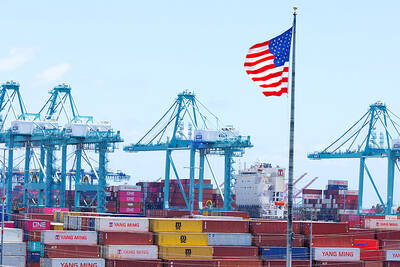
NOT IMMEDIATE: Taiwan has a chance to appeal the proposed 10 percent tariff before it starts, while other countries face a 12.5 percent tariff from the trade office Taiwan is among 60 economies determined by the US to have failed to impose or enforce a ban on the importation of goods produced with forced labor, according to a notice released on Tuesday by the Office of the US Trade Representative (USTR), which proposed imposing an additional 10 percent or more tariff on them. The USTR in a statement said that following an investigation, it had determined under Section 301 of the Trade Act of 1974 that the failure of the 60 economies to impose and effectively enforce a prohibition on the importation of goods produced with forced labor is


 RSS
RSS