


The Philippines has rejected an annual summer fishing ban imposed by China in the disputed South China Sea and encouraged its boats to keep fishing in the country’s territorial waters.
The fishing moratorium imposed by China since 1999 runs from May 1 to Aug. 16 and covers areas of the South China Sea — which the Philippines refers to as the West Philippine Sea (WPS) — as well as other waters off China.
“This fishing ban does not apply to our fishermen,” the Philippine National Task Force on the West Philippine Sea said in a statement late on Tuesday.
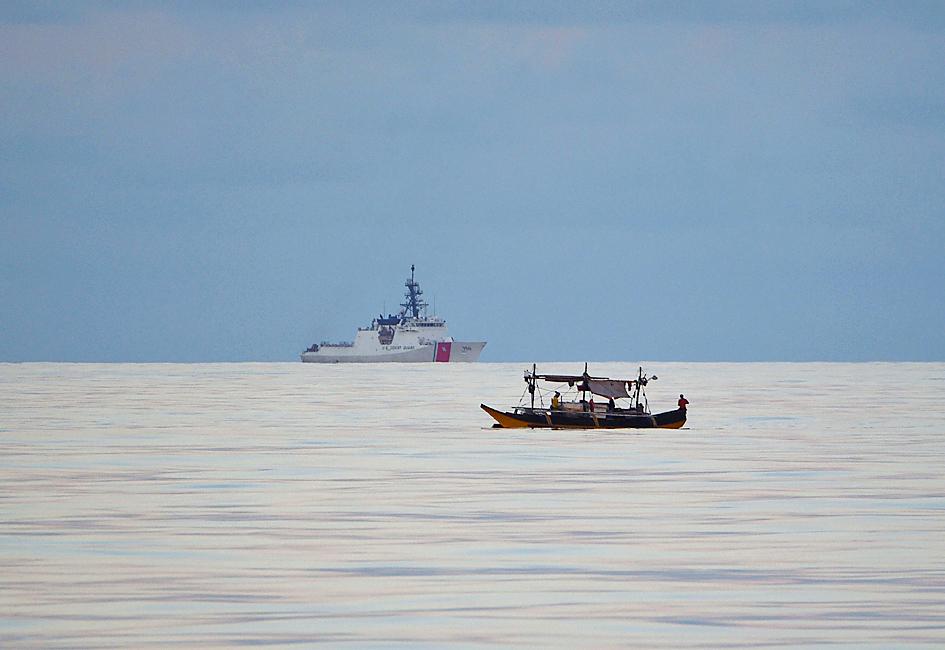
Photo: AFP
“Our fisher folk are encouraged to go out and fish in our waters in the WPS,” the task force said, as it voiced its opposition to China’s ban imposed over areas within the territory and jurisdiction of the Philippines.
The Chinese embassy in Manila did not immediately respond to a request for comment.
Manila has for years been embroiled in a dispute over Beijing’s sweeping claims of sovereignty over the South China Sea, most of which is also claimed by Taiwan.
An international tribunal in 2016 invalidated China’s claims, but Beijing has rejected the ruling.
Tensions between the two countries recently escalated after Manila accused China of territorial incursions by hundreds of its vessels in the resource-rich waterway.
The Philippines has filed diplomatic protests against China over what it calls the “illegal” presence of the Chinese vessels, which it has said are crewed by militia.
Chinese diplomats have said that the boats are just sheltering from rough seas and have no militia aboard.
The task force said that it had spotted seven “Chinese Maritime Militia” at the Sabina shoal in the Spratly Islands (Nansha Islands, 南沙群島) on Tuesday last week, which dispersed after being challenged by the Philippine Coast Guard.
Five returned two days later, but left after the coast guard returned, it said.
The Sabina shoal is about 130 nautical miles (240km) from the western Philippine island of Palawan.
Itu Aba Island (Taiping Island, 太平島) — the largest island in the Spratlys — has been administered by Taiwan since 1956.
“The Philippines is not deterred from defending our national interest, patrimony and our dignity as a people with all that we have,” the task force said.

‘NO SECURITY RISK’: The Railway Bureau reassured the public that the technicians’ activities were limited to technical guidance and did not involve sensitive systems The Railway Bureau yesterday said it had invited eight Chinese technicians to assist with an airport MRT construction project. The bureau issued the confirmation after an Internet user said Chinese nationals had entered the construction zone of Taiwan Taoyuan International Airport’s Terminal 3 project. They asked why “individuals from an enemy state” were allowed access to such a major national infrastructure project, which raised serious concerns over Taiwan’s industrial safety, sensitive systems and information security. The bureau’s Northern Region Engineering Branch Office said subcontractor Taiwan Handle Industrial Co (台灣手把工業) of the Taoyuan airport MRT’s “Contract No. CU05 Project A14 Station Civil, MEP &

A signaling system malfunction disrupted high-speed rail (HSR) services beginning at 8am today, with trains temporarily reduced to three northbound and three southbound trains per hour as authorities conduct inspections. The malfunction occurred on a section of track in Miaoli County during pre-operation checks early this morning, forcing northbound and southbound trains to use a single track, the HSR operator said. The regular schedule has been replaced with three hourly trains offering only nonreserved seating in each direction, stopping at every station, it said, adding that business class cars would still have reserved seating. Departures from terminal stations are scheduled at the top

Taiwan is still in the process of assessing the possibility of recruiting workers from Eswatini, the Ministry of Foreign Affairs said yesterday, adding that its goal is to help Eswatini upgrade its vocational training centers. If there are plans to recruit workers from Eswatini, safeguarding national security, protecting public health and ensuring the employment rights of Taiwanese would be prerequisites, Department of West Asian and African Affairs Director-General Yen Chia-liang (顏嘉良) told a news conference. Key considerations would also include filling labor shortages in specific industries, and fostering bilateral professional and technical exchanges, he said. Yen was asked about the progress of labor

A US uncrewed surface vessel (USV) encountered multiple Chinese warships during an autonomous transit of the Taiwan Strait, US defense company Seasats said in a statement on Wednesday. Seasats announced that a Lightfish USV had completed the first autonomous transit of the Taiwan Strait. Over five days, the USV traversed the entire length of the Strait while constantly monitoring surface vessel traffic, the company said. The Lightfish encountered multiple Chinese warships, one of which was a Chinese People’s Liberation Army Navy (PLAN) Type 056 corvette, it said. The Chinese vessels were operating “well within Taiwan’s exclusive economic zone without transmitting their identity via the


 RSS
RSS