


A newly confirmed COVID-19 case might indicate person-to-person transmission within a Taoyuan hotel, the Central Epidemic Command Center (CECC) said yesterday, as 412 people were moved from the facility to government quarantine centers.
The center announced three more cases linked to China Airlines Ltd (CAL, 華航), two of which were domestically transmitted, while the source of the third is unknown.
One of the domestic cases is a senior housekeeping employee at Novotel Taipei Taoyuan International Airport, where many CAL flight crew members stay for quarantine after arriving in Taiwan, the CECC said.
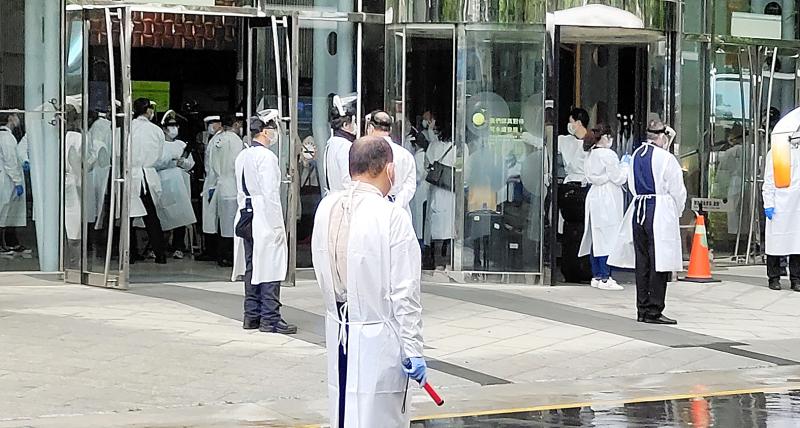
Photo: Tony Yao, Taipei Times
The man in his 40s developed symptoms on April 17 and sought treatment at a clinic three times from Monday last week to Monday, but his condition did not improve, it said.
On Tuesday, he went to a local hospital, where he was diagnosed with pneumonia, and he tested positive for COVID-19 yesterday, the CECC said, adding that he is in an intensive care unit.
The man was in charge of checking the cleanliness of the rooms and helped deliver items to people in quarantine there, said Minister of Health and Welfare Chen Shih-chung (陳時中), who heads the CECC.
The man reportedly wore a mask and gloves while on the job, Chen added.
The possibility that he was infected through environmental transmission is minimal, he said, but added that it was possibly spread through contact between cleaning staff.
According to CECC guidelines, after a guest checks out of a quarantine hotel, a team disinfects their room wearing full protective gear, Chen said.
Thirty minutes after the room is disinfected, sanitation workers enter to clean without wearing medical gowns, he added.
If any area was not properly sanitized, it is the second group of cleaners who would face risk of infection, he said.
Yesterday’s confirmed case inspected rooms after they were cleaned by this second group, meaning he likely contracted the virus from a coworker, Chen said.
Three other employees at the hotel have developed fevers and are being tested for COVID-19, two of whom are cleaning staff, he added.
Since there is a possibility of person-to-person transmission, the highest level of containment measures have been activated, Chen said, meaning that all 412 people at the hotel have been moved to government quarantine centers.
Of them, 207 are employees, 109 are Taiwanese pilots and 76 are foreign pilots, while the rest are visitors, he said.
After the hotel is emptied at about 5pm today, it is to be inspected and fully disinfected, Chen added.
The other new domestic case is a Taiwanese woman in her 40s, who is the wife of a CAL pilot who tested positive on Tuesday last week, the CECC said.
The third case linked to CAL is a Taiwanese cargo pilot in his 50s, who returned from the US on Sunday and tested positive during quarantine after he developed symptoms.
With the confirmation of the three new cases, the number of COVID-19 infections linked to CAL has increased to 16.
They are eight Taiwanese cargo pilots; three relatives of Taiwanese cargo pilots; a hotel employee; two Indonesian cargo pilots, one of whom was diagnosed in Australia; and two relatives of one of the Indonesian pilots, the CECC said.
The center has not yet determined how the pilots were infected, it said.
The CECC also reported two new imported infections, bringing the total number of confirmed cases to 1,121, of whom 1,051 have recovered, 12 have died and 58 are in hospital.

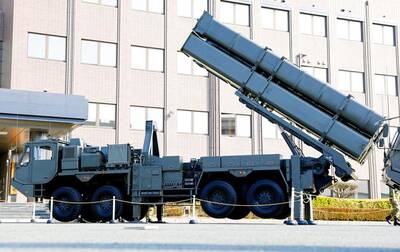
Japan has deployed long-range missiles in a southwestern region near China, the Japanese defense minister said yesterday, at a time when ties with Beijing are at their lowest in recent years. The missiles were installed in Kumamoto in the southern region of Kyushu, as Japan is attempting to shore up its military capacity as China steps up naval activity in the East China Sea. “Standoff defense capabilities enable us to counter the threat of enemy forces attempting to invade our country ... while ensuring the safety of our personnel,” Japanese Minister of Defense Shinjiro Koizumi said. “This is an extremely important initiative for

MORE POPULAR: Taiwan Pass sales increased by 59 percent during the first quarter compared with the same period last year, the Tourism Administration said The Tourism Administration yesterday said that it has streamlined the Taiwan Pass, with two versions available for purchase beginning today. The tourism agency has made the pass available to international tourists since 2024, allowing them to access the high-speed rail, Taiwan Railway Corp services, four MRT systems and four Taiwan Tourist Shuttles. Previously, five types of Taiwan Pass were available, but some tourists have said that the offerings were too complicated. The agency said only two types of Taiwan Pass would be available, starting from a three-day pass with the high-speed rail and a three-day pass with Taiwan Railway Corp. The former costs NT$2,800
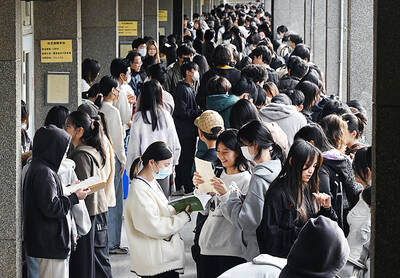
A global survey showed that 60 percent of Taiwanese had attained higher education, second only to Canada, the Ministry of the Interior said. Taiwan easily surpassed the global average of 43 percent and ranked ahead of major economies, including Japan, South Korea and the US, data from the Organisation for Economic Co-operation and Development (OECD) for 2024 showed. Taiwan has a high literacy rate, data released by the ministry showed. As of the end of last year, Taiwan had 20.617 million people aged 15 or older, accounting for 88.5 percent of the total population, with a literacy rate of 99.4 percent, the data

NEW LOW: The council in 2024 based predictions on a pessimistic estimate for the nation’s total fertility rate of 0.84, but last year that rate was 0.69, 17 percent lower An expected National Development Council (NDC) report expects the nation’s population to drop below 12 million by 2065, with the old-age dependency ratio to top 100 percent sooner than 2070, sources said yesterday. The council is slated to release its latest population projections in August, using an ultra-low fertility model, the sources said. The previous report projected that Taiwan’s population would fall to 14.37 million by 2070, but based on a new estimate of the total fertility rate (TFR) — the average number of children born to a woman over her lifetime — the population is expected to reach 12 million by


 RSS
RSS