


The Taipei District Court yesterday acquitted Wang Ping-chung (王炳忠), two fellow New Party members and a Chinese student, Zhou Hongxu (周泓旭), on all charges in an espionage case, although prosecutors said that they would appeal the first ruling.
After three years of investigation and hearings, the judges said that there was insufficient evidence to show that Wang, Wang’s father, Wang Chin-pu (王進步), Zhou, New Party Taipei City Councilor Ho Han-ting (侯漢廷) and New Party executive Lin Ming-cheng (林明正) were developing a spy network for China, and “their activities did not pose a danger to national security or social stability.”
Wang Chin-pu was indicted as an alleged accessory to espionage and other illegal activity.
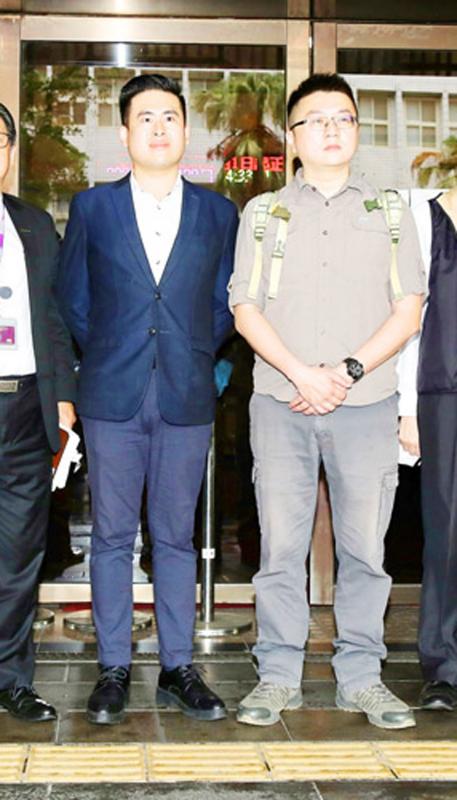
Photo: CNA
The five were indicted in June 2018 over alleged breaches of the National Security Act (國家安全法) after they were accused of receiving funding from office units controlled by the Chinese People’s Liberation Army, money that prosecutors said Wang and his associates used to set up propaganda Web sites.
They sought to infiltrate political and military circles, and recruit people to spy for China, prosecutors said.
Wang Ping-chung and other New Party members, as well as Zhou, established a Web site called Fire News, and launched the Association of New Chinese Sons and Daughters (新中華兒女學會) and the Chinese Culture Rejuvenation Association (大中華復興社) to attract students and young people, prosecutors said.
Documents showed that Wang Ping-chung had written: I will “work under the guidance and assistance of the Chinese Communist Party to unite and integrate the forces working to achieve unification across the Taiwan Strait,” prosecutors said.
“We were adamant from the start that we advocate Taiwan’s unification with China,” Wang Ping-chung told reporters after the ruling. “How is that breaking the law?”
“The case was wrong from the onset,” he said.
“There should never have been an investigation or an indictment, and naturally, we were acquitted,” he said, adding that the judges had “withstood the pressure from prosecutors to find us guilty and impose a severe punishment.”
“I hope our belief in peaceful unification with China will not be persecuted by Taiwan’s authorities, and I ask that the judges lift the travel restrictions on us to go abroad,” he said.
The New Party in a statement lauded the judges’ decision, saying that they had “refused to bow under pressure, but had upheld justice.”
Prosecutors had “unfairly targeted Wang Ping-chung and the others using deceit and entrapment,” the party said.
“They had no evidence to show that classified materials were stolen or national security was endangered,” it said. “Fortunately, the judges have cleared them of all charges.”
“Although Wang Ping-chung, Zhou and the other defendants set up the operations, evidence is lacking that they worked on behalf of China to develop the networks,” the judges said. “The interactions were normal activities between friends, and did not pose danger to national security or social stability.”
During the trial, Wang Ping-chung told the court that “it was us who recruited Zhou, not Zhou who recruited us.”
The funding was “legitimate income from legal business earnings in China,” he said.
Ho said that the activities they were accused over were regular cross-strait cultural interactions, and there was no intention to harm national security.
Zhou, a graduate student attending university in Taiwan, in 2017 was convicted of spying for China in a separate case, with his 14-month sentence upheld by the High Court in April 2018 and the Supreme Court in March last year.
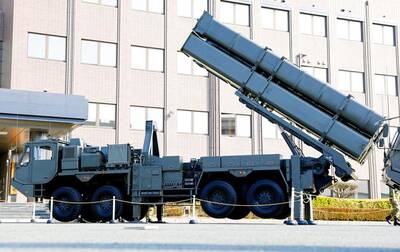
Japan has deployed long-range missiles in a southwestern region near China, the Japanese defense minister said yesterday, at a time when ties with Beijing are at their lowest in recent years. The missiles were installed in Kumamoto in the southern region of Kyushu, as Japan is attempting to shore up its military capacity as China steps up naval activity in the East China Sea. “Standoff defense capabilities enable us to counter the threat of enemy forces attempting to invade our country ... while ensuring the safety of our personnel,” Japanese Minister of Defense Shinjiro Koizumi said. “This is an extremely important initiative for
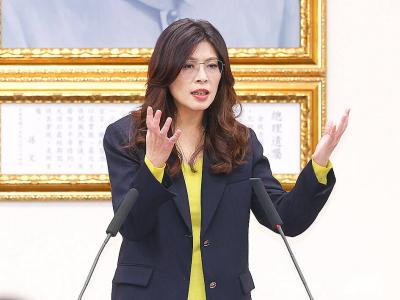
Chinese Nationalist Party (KMT) Chairwoman Cheng Li-wun (鄭麗文) today accepted an invitation from Chinese President Xi Jinping (習近平) to lead a delegation to China next month, saying she hopes to promote the peaceful development of cross-strait relations and bring stability to the Taiwan Strait. “I am grateful and happy to accept this invitation,” Cheng said in a statement from the KMT chairperson’s office. Cheng said she hopes both sides can work together to promote the peaceful development of cross-strait relations, enhance exchange and cooperation, bring stability to the Taiwan Strait and improve people’s livelihoods. At today's news conference, Cheng said any efforts to
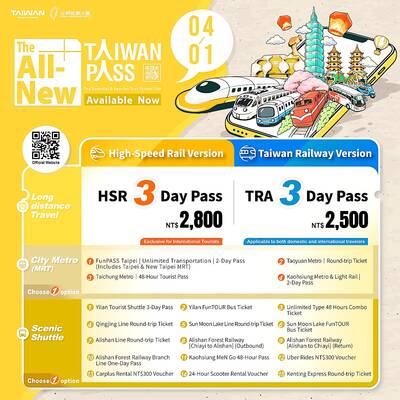
MORE POPULAR: Taiwan Pass sales increased by 59 percent during the first quarter compared with the same period last year, the Tourism Administration said The Tourism Administration yesterday said that it has streamlined the Taiwan Pass, with two versions available for purchase beginning today. The tourism agency has made the pass available to international tourists since 2024, allowing them to access the high-speed rail, Taiwan Railway Corp services, four MRT systems and four Taiwan Tourist Shuttles. Previously, five types of Taiwan Pass were available, but some tourists have said that the offerings were too complicated. The agency said only two types of Taiwan Pass would be available, starting from a three-day pass with the high-speed rail and a three-day pass with Taiwan Railway Corp. The former costs NT$2,800

The nation’s fastest supercomputer, Nano 4 (晶創26), is scheduled to be launched in the third quarter, and would be used to train large language models in finance and national defense sectors, the National Center for High-Performance Computing (NCHC) said. The supercomputer, which would operate at about 86.05 petaflops, is being tested at a new cloud computing center in the Southern Taiwan Science Park in Tainan. The exterior of the server cabinet features chip circuitry patterns overlaid with a map of Taiwan, highlighting the nation’s central position in the semiconductor industry. The center also houses Taiwania 2, Taiwania 3, Forerunner 1 and


 RSS
RSS