


The Executive Yuan is to build a NT$12.8 billion (US$447.52 million) national-level children’s recreational facility in New Taipei City to foster interest in science and technology, Premier Su Tseng-chang (蘇貞昌) said yesterday.
Su made the remarks in a speech after inspecting the site for the planned facility with New Taipei City Mayor Hou You-yi (侯友宜), ahead of Children’s Day on Sunday next week.
The National Children’s Future Plaza project is to be built on a 3.3-hectare plot of land worth NT$30 billion in Banciao District (板橋), Su said.
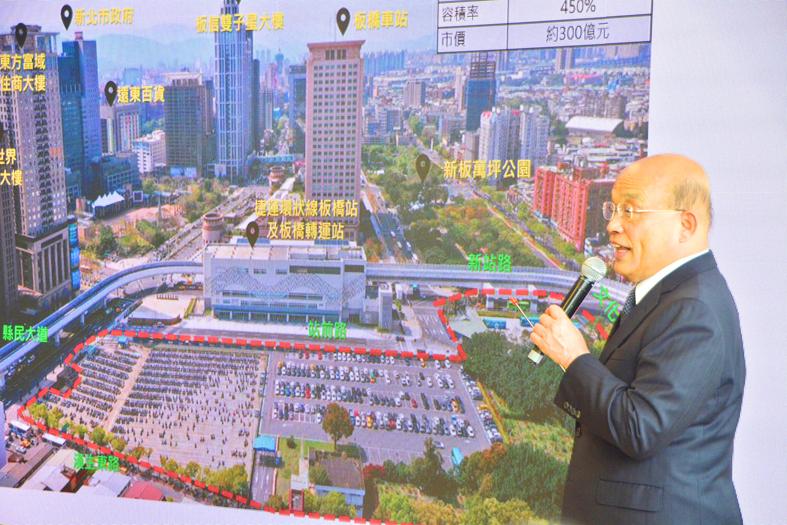
Photo: CNA
The project, which would be fully funded by the government, came about after a series of talks between himself and Hou, who as mayors of the special municipality had both thought of using the land for children, he said.
The plaza would emphasize science, technology and cultural education through play, he said.
It has the potential to become a landmark and an international tourism destination, as domestic and international visitors would use the adjacent Taiwan High-Speed Rail and Taoyuan Airport MRT, he said.
Hong Shih-fang (洪世芳), who heads the Ministry of Culture’s Cultural Resources Department, said that the plaza would have cultural activities, digital art and technology exhibitions, and a children’s theater.
The planners would study the Boston Children’s Museum, the Kids Plaza Osaka in Japan and the Digital Art Museum in Berlin as models for the plaza, Hong said.
Over the past two decades, the city has tried and failed to develop the land due to local opposition to build-operate-transfer schemes that relied heavily on private-sector contractors, he said.

LEVERAGE: China did not ‘need to fire a shot’ to deny Taiwan airspace over Africa when it owns ‘half the continent’s debt,’ a US official said, calling it economic warfare The EU has raised concerns about overflight rights following the delay of President William Lai’s (賴清德) planned state visit to the Kingdom of Eswatini after three African nations denied overflight clearance for his charter at the last minute. Taiwanese allies Paraguay and Saint Kitts and Nevis, as well as several US lawmakers and the Inter-Parliamentary Alliance on China (IPAC) condemned China for allegedly pressuring the countries. Lai was scheduled to fly directly to Taiwan’s only African ally from yesterday to Sunday to celebrate the 40th anniversary of King Mswati III’s accession and his 58th birthday, but Seychelles, Mauritius and Madagascar suddenly revoked
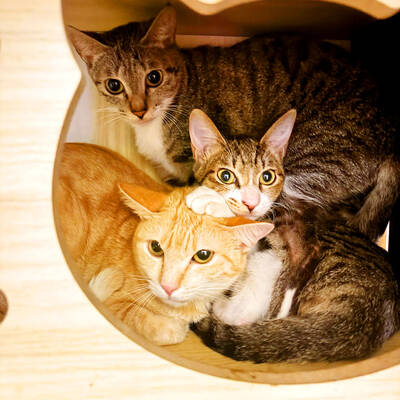
The number of pet cats in Taiwan surpassed that of pet dogs for the first time last year, reaching 1,742,033, a 32.8 percent increase from 2023, the Ministry of Agriculture said yesterday, citing a survey. By contrast, the number of pet dogs declined slightly by 1.2 percent over the same period to 1,462,528, the ministry said. Despite the shift, households with dogs still slightly outnumber those with cats by 1.2 percent. However, while the number of households with multiple dogs has remained relatively stable, households keeping more than two cats have increased, contributing to the overall rise in the feline population. The trend
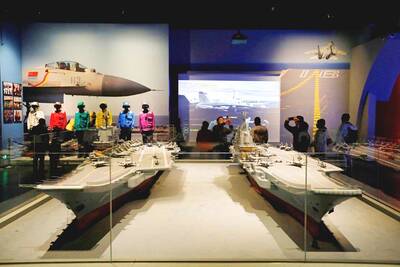
China on Wednesday teased in a video an aircraft carrier that could be its fourth, and the first using nuclear power, while making an allusion to Taiwan and vowing to further build up its islands, as it looks to boost maritime power, secure resources and bolster territorial claims. The video, issued on the eve of the 77th founding anniversary of the Chinese People’s Liberation Army Navy, featured fictional officers with names that are homophones of three commissioned aircraft carriers, the Liaoning (遼寧), Shandong (山東) and Fujian (福建). Titled Into the Deep, it showed a 19-year-old named “Hejian” (何劍) joining the group, sparking
BIG YEAR: The company said it would also release its A12 chip the same year to keep a ‘reliable stream of new silicon technologies’ flowing to its customers Taiwan Semiconductor Manufacturing Co (TSMC, 台積電) yesterday said its newest A13 chip is to enter volume production in 2029 as the chipmaker seeks to hold onto its tech leadership and demand for next-generation chips used in artificial intelligence (AI), high-performance-computing (HPC) and mobile applications. TSMC, the world’s biggest contract chipmaker, also unveiled its A12 chip at its annual technology symposium in Santa Clara, California. The A12 chip, which features TSMC’s super-power-rail technology to provide backside power delivery for AI and HPC applications, is also to enter volume production in 2029, a year after the scheduled release of the A14 chip. The technology moves


 RSS
RSS