


Athletes who have qualified to compete in the Tokyo Olympics yesterday started receiving their first dose of the AstraZeneca COVID-19 vaccine, the Central Epidemic Command Center (CECC) said.
The nation started its vaccination program on Monday, with frontline healthcare workers at designated hospitals receiving the first jabs.
Tokyo Olympics qualifiers have also been given first priority for vaccination, Centers for Disease Control (CDC) Deputy Director-General and CECC spokesman Chuang Jen-hsiang (莊人祥) said.
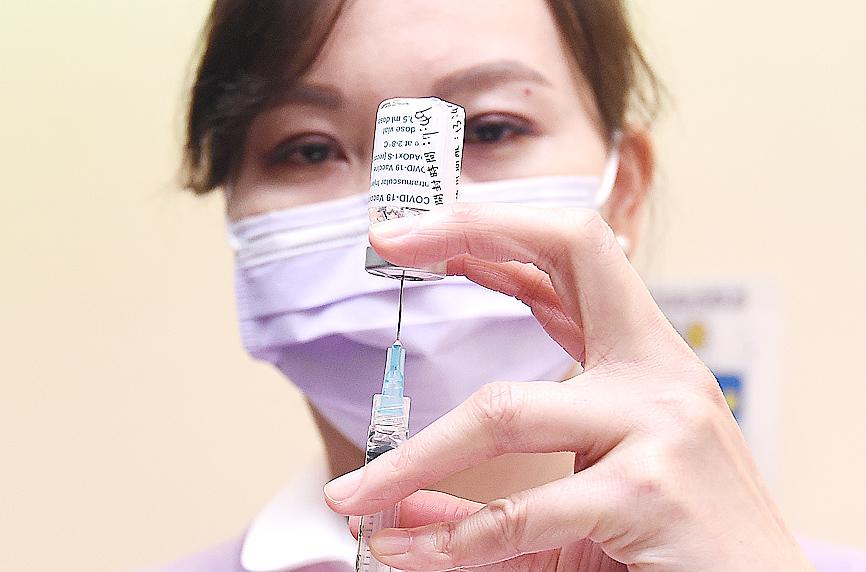
Photo: Liao Chen-huei, Taipei Times
The Tokyo Olympics are scheduled to open on July 23.
The CECC hopes that athletes and national team staff members can complete the two doses before heading to the competition, he said.
As of noon yesterday, a total of 1,578 people had received the vaccine, Chuang said, adding that the number was relatively low on the first day because it is a new vaccine in Taiwan, and hospitals need some time to test their standard procedures.
Healthcare workers took turns getting the jab to avoid a staff shortage in case some were to experience side effects, such as a fever, after being inoculated, he said.
One non-severe adverse reaction was reported — a healthcare worker in northern Taiwan who developed a fever and felt tired after being vaccinated, he said.
The legal definition of a severe adverse event includes situations such as death, life-threatening conditions, permanent disability, congenital anomaly, hospitalization or prolonged hospitalization, and other conditions that might result in permanent injuries, CDC physician Lin Yung-ching (林詠青) said.
A non-severe adverse event is defined as having the common side effects of vaccination, such as a fever, swelling or pain at the injection site, tiredness and a headache, he said.
People should not worry about developing a fever after vaccination, as it is likely the result of the immune system being activated, he said.
The CECC reported one imported case of COVID-19 yesterday — a Dutch man in his 20s.
The man arrived from the Netherlands on Feb. 8, and tested negative in a paid test on Feb. 23, but another test taken on Sunday came back positive, Chuang said.
The man’s test result implied a low viral load, with the latest test on Monday coming back negative, Chuang said.
His antibody test came back negative for immunoglobulin M antibodies and positive for immunoglobulin G antibodies — implying a past infection, Chuang said.
The man might have contracted the disease abroad some time ago and has a lower risk of infecting others, the CECC said.
In other news, the CDC reported the first imported case of Chikungunya fever this year — an Indonesian man in his 20s who on Tuesday last week arrived in Taiwan for work.
The man was tested for dengue fever at the airport as he had a fever when he arrived, and was later tested for COVID-19 and Chikungunya fever at a hospital, CDC Epidemic Intelligence Center Director Guo Hung-wei (郭宏偉) said.
The man has been hospitalized for treatment, Guo said, adding that two people who arrived in Taiwan with him have not developed any symptoms.
Additional reporting by Wu Po-hsuan
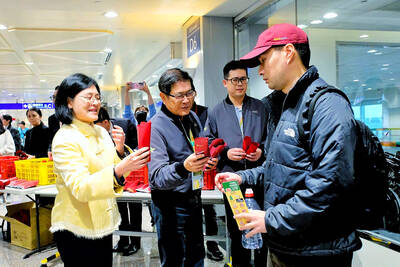
An Emirates flight from Dubai arrived at Taiwan Taoyuan International Airport yesterday afternoon, the first service of the airline since the US and Israel launched strikes against Iran on Saturday. Flight EK366 took off from the United Arab Emirates (UAE) at 3:51am yesterday and landed at 4:02pm before taxiing to the airport’s D6 gate at Terminal 2 at 4:08pm, data from the airport and FlightAware, a global flight tracking site, showed. Of the 501 passengers on the flight, 275 were Taiwanese, including 96 group tour travelers, the data showed. Tourism Administration Deputy Director-General Huang He-ting (黃荷婷) greeted Taiwanese passengers at the airport and

POSSIBILITIES EMERGE: With Taiwan’s victory and Japan’s narrow win over Australia, Taiwan now have a chance to advance if South Korea also beat the Aussies Taiwan has high hopes that the national baseball team would advance to the World Baseball Classic (WBC) quarter-finals after clinching a crucial 5-4 victory over South Korea in a nail-biting extra-inning game at the Tokyo Dome yesterday. Boosted by three home runs — two solo shots by Yu Chang (張育成) and Cheng Tsung-che (鄭宗哲) and a two-run homer by Stuart Fairchild — the triumph gave Taiwan a much-needed second victory in the five-team Pool C, where only the top two finishers would advance to the knockout stage in Miami, Florida. Entering extra innings with the game tied at four apiece, Taiwan scored
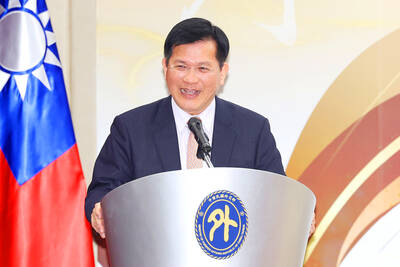
MISSION OF PEACE: The foreign minister urged Beijing to respect Taiwan’s existence as an independent nation, and work together to ensure peace and stability in the region Minister of Foreign Affairs Lin Chia-lung (林佳龍) yesterday rejected Chinese Minister of Foreign Affairs Wang Yi’s (王毅) comments about Taiwan, criticizing China as a “troublemaker” in the international community and a disruptor of cross-strait peace. Speaking at a news conference on the sidelines of the Chinese National People’s Congress, Wang said that Taiwan has always been a territory of China and that it would be impossible for it to become its own country. The “return” of Taiwan to China was the natural outcome of the Chinese people’s resistance against Japan in World War II, and that any pursuit of independence was “doomed
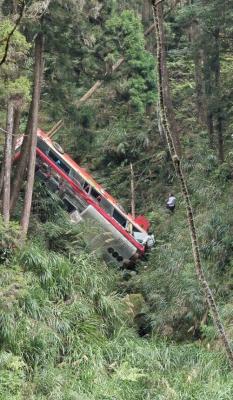
One person was killed and another seven injured today when a tourist shuttle bus plunged 30m to 40m down a ravine in Nantou County, the Tourism Administration said. The bus is suspected to have suddenly accelerated out of control near the flower center of the Sun-Link-Sea Forest Recreation Area, a popular attraction during cherry blossom season. Of the eight onboard, a 66-year-old man was killed, four were seriously injured and three sustained minor injuries, including the driver. The Nantou County Police Department said it received a report of the incident at 12:15pm and dispatched seven teams to assist. All surviving passengers have been transferred


 RSS
RSS