


The Ministry of Foreign Affairs yesterday thanked Washington for promising to involve Taiwan in a planned democracy summit.
US Secretary of State Antony Blinken on Wednesday said that he is committed to having US President Joe Biden’s administration begin talks on a free-trade agreement between the two nations, and invite Taiwan to the Summit for Democracy, which the US plans to host later this year.
During a US House of Representatives Committee on Foreign Affairs hearing on Wednesday, US Representative Young Kim said that for decades, Taiwan has been an invaluable security and global health partner of the US, and that Taiwan deserves to be included in the WHO.
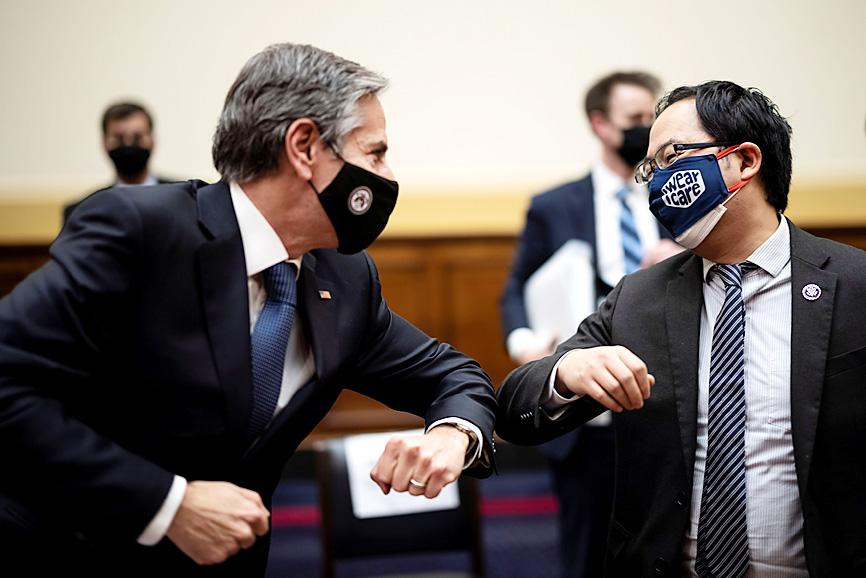
Photo: Reuters
Kim also urged the Biden administration to include Taiwan in the Summit for Democracy and to begin bilateral negotiations for a free-trade agreement.
Blinken told the hearing that he is “absolutely committed to working on it.”
“Taiwan is a strong democracy, a very strong technological power and a country that can contribute to the world” in areas such as combating the COVID-19 pandemic, Blinken added.
At a news briefing in Taipei, ministry spokeswoman Joanne Ou (歐江安) thanked Blinken for reiterating the US’ steadfast support for Taiwan.
The government would continue to work closely with the Biden administration to defend democracy, address global health challenges and tackle trade issues, Ou added.
Meanwhile, the ministry said that Taiwan and the US would stay in contact regarding a meeting of top US and China diplomats in Anchorage, Alaska, on Thursday next week.
The White House on Wednesday announced that Blinken and US National Security Adviser Jake Sullivan would meet with Chinese Central Foreign Affairs Commission Director Yang Jiechi (楊潔篪) and Chinese Minister of Foreign Affairs Wang Yi (王毅).
The ministry has had discussions with Washington and hopes the US administration would brief Taipei after the meeting with China, Ou said.
Yesterday, Minister of Foreign Affairs Joseph Wu (吳釗燮) and American Institute in Taiwan Director Brent Christensen issued a joint statement on advancing a bilateral partnership on high availability disaster recovery (HADR).
The statement followed a workshop on building resilience to disasters under the Global Cooperation and Training Framework, which was opened by Wu, Christensen, Japanese Representative to Taiwan Hiroyasu Izumi and British Representative to Taiwan John Dennis.
The US and Taiwan are embarking on a six-month series of activities, from yesterday — the 10th anniversary of the earthquake and tsunami that resulted in the Fukushima Dai-ichi nuclear power plant disaster in Japan — to Sept. 21 — the 22nd anniversary of the 921 Earthquake in Taiwan, the statement said.
“These activities will expand our already robust cooperation in the HADR space, raise public and international awareness about Taiwan’s outsized role in HADR efforts and support activities that foster personal resilience within Taiwan’s communities,” the statement read, adding that Japan and the UK would also be collaborating.
Additional reporting by CNA

‘NO SECURITY RISK’: The Railway Bureau reassured the public that the technicians’ activities were limited to technical guidance and did not involve sensitive systems The Railway Bureau yesterday said it had invited eight Chinese technicians to assist with an airport MRT construction project. The bureau issued the confirmation after an Internet user said Chinese nationals had entered the construction zone of Taiwan Taoyuan International Airport’s Terminal 3 project. They asked why “individuals from an enemy state” were allowed access to such a major national infrastructure project, which raised serious concerns over Taiwan’s industrial safety, sensitive systems and information security. The bureau’s Northern Region Engineering Branch Office said subcontractor Taiwan Handle Industrial Co (台灣手把工業) of the Taoyuan airport MRT’s “Contract No. CU05 Project A14 Station Civil, MEP &

The National Chungshan Institute of Science and Technology yesterday showcased its locally developed variants of the Vision 60 robotic patrol dog, which it plans to deploy on the nation’s outlying territories in the South China Sea. The variants were produced under the Joint Lab project — created by the institute and domestic companies — and assembled with domestically produced motors, lenses and artificial intelligence (AI) systems alongside licensed tech from the US, Missile and Rocket Systems Research Division deputy director Jen Kuo-kang (任國光) told the media event at a military base in Taipei’s Dazhi (大直) area. Taiwan has built up its strengths

TIT-FOR-TAT: The US allegedly revoked the visa of a Chinese national working at Xinhua News Agency in the US in response to Beijing’s expulsion of Vivian Wang The Presidential Office yesterday condemned China for expelling a New York Times correspondent from Beijing following the newspaper’s interview with President William Lai (賴清德), saying the move highlighted Beijing’s suppression of press freedom and its threat to international news media. Taiwan has noted a series of recent incidents in which Beijing used similar tactics to “threaten and pressure international media outlets and journalists,” Presidential Office spokeswoman Karen Kuo (郭雅慧) said in a statement. “This concerns not only press freedom and freedom of expression, but also the safety of journalists, and Taiwan and relevant partners are paying close attention to the situation,” she

NOT IMMEDIATE: Taiwan has a chance to appeal the proposed 10 percent tariff before it starts, while other countries face a 12.5 percent tariff from the trade office Taiwan is among 60 economies determined by the US to have failed to impose or enforce a ban on the importation of goods produced with forced labor, according to a notice released on Tuesday by the Office of the US Trade Representative (USTR), which proposed imposing an additional 10 percent or more tariff on them. The USTR in a statement said that following an investigation, it had determined under Section 301 of the Trade Act of 1974 that the failure of the 60 economies to impose and effectively enforce a prohibition on the importation of goods produced with forced labor is


 RSS
RSS