


President Tsai Ing-wen (蔡英文) yesterday in her New Year’s Day speech praised Taiwan’s successful response to the COVID-19 pandemic and made the case for the nation’s growing importance on the international stage.
In her speech, delivered from the Presidential Office, Tsai said that for many around the world, last year was a year of disrupted routines, economic hardship and steadily rising deaths caused by COVID-19.
Taiwan, by contrast, was fortunate to have responded early and was thus able to “defeat” the virus through a shared commitment to professionalism, mutual trust and social cohesion, she said.
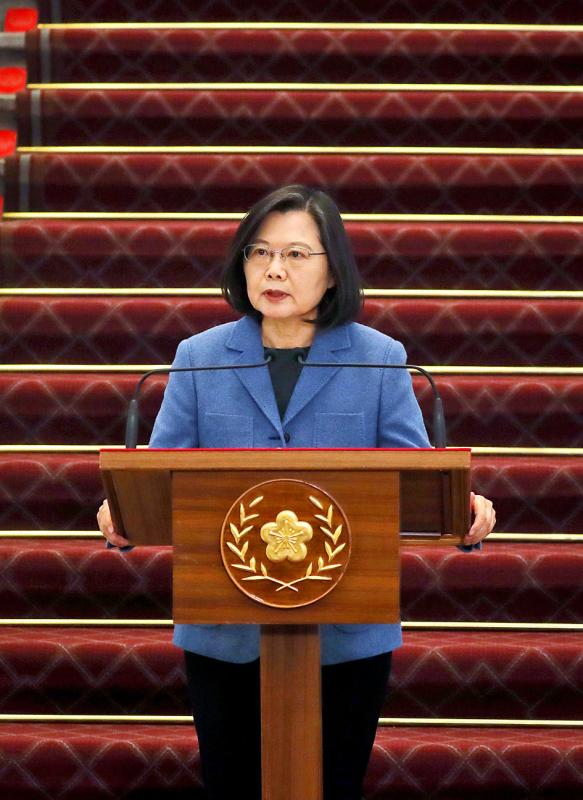
Photo: CNA
Taiwan has faced many challenges over the past year, but it also has good reasons to be optimistic, including the strong performance of local businesses, stable employment numbers and government investment in emerging technologies, Tsai said.
“Over the past year, Taiwan has achieved what the whole world is longing for — a normal lifestyle. That is quite an accomplishment,” she said, adding that ensuring people can lead a normal life and working toward a global economic recovery would be her top priorities this year.
“From a global standpoint, Taiwan is more important than ever,” she said, adding that stabilizing relations across the Taiwan Strait is no longer an issue solely for Taiwan and China, but “a concern for the whole Indo-Pacific region” and “a focus of international attention.”
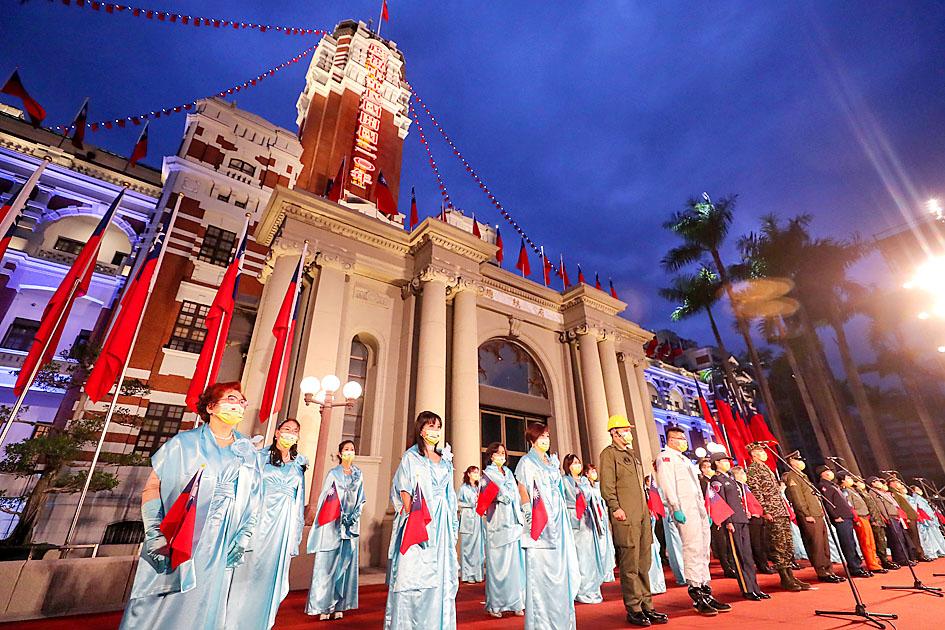
Photo: CNA
Tsai said that China had “undermined” its relations with Taiwan through its constant military activity around the nation, but she reaffirmed that her administration would not “act rashly” in response.
“We are willing to facilitate meaningful dialogue under the principles of parity and dignity, as long as the Beijing authorities sincerely want to resolve differences and improve cross-strait relations,” she said.
When the pandemic is over, Taiwan looks forward to the gradual return of people-to-people exchanges across the Strait to improve mutual understanding, Tsai added.
For the first time in a New Year’s Day addresses, Tsai spoke in English, directing a portion of her remarks to an international audience.
She said that Taiwan was proud to have worked alongside the international community to confront the challenges posed by COVID-19 and to have shown the world that “Taiwan can help.”
“As a force for good in the world, we will continue to be an indispensable member of the international community, both now and into the future,” she said.
Tsai also expressed gratitude for the international backing Taiwan has received amid the regional and global challenges it faces.
“Our democracy is stronger because of your support,” she said.
Tsai said that she was honored to have overcome, together with Taiwanese, the many challenges of last year and called for the nation to “continue to pull together” in the new year.
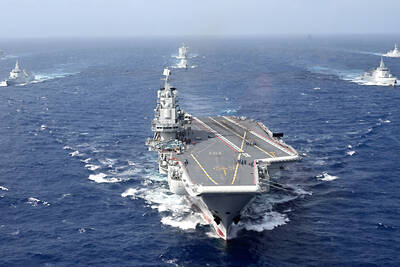
PROVOCATIVE: Chinese Deputy Ambassador to the UN Sun Lei accused Japan of sending military vessels to deliberately provoke tensions in the Taiwan Strait China denounced remarks by Japan and the EU about the South China Sea at a UN Security Council meeting on Monday, and accused Tokyo of provocative behavior in the Taiwan Strait and planning military expansion. Ayano Kunimitsu, a Japanese vice foreign minister, told the Council meeting on maritime security that Tokyo was seriously concerned about the situation in the East China and South China seas, and reiterated Japan’s opposition to any attempt to change the “status quo” by force, and obstruction of freedom of navigation and overflight. Stavros Lambrinidis, head of the EU delegation to the UN, also highlighted South China Sea
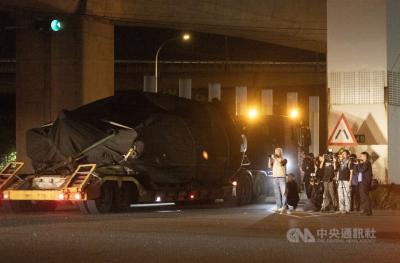
The final batch of 28 M1A2T Abrams tanks purchased from the US arrived at Taipei Port last night and were transported to the Armor Training Command in Hsinchu County’s Hukou Township (湖口), completing the military’s multi-year procurement of 108 of the tanks. Starting at 12:10am today, reporters observed more than a dozen civilian flatbed trailers departing from Taipei Port, each carrying an M1A2T tank covered with black waterproof tarps. Escorted by military vehicles, the convoy traveled via the West Coast Expressway to the Armor Training Command, with police implementing traffic control. The army operates about 1,000 tanks, including CM-11 Brave Tiger
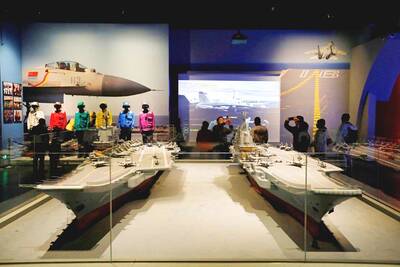
China on Wednesday teased in a video an aircraft carrier that could be its fourth, and the first using nuclear power, while making an allusion to Taiwan and vowing to further build up its islands, as it looks to boost maritime power, secure resources and bolster territorial claims. The video, issued on the eve of the 77th founding anniversary of the Chinese People’s Liberation Army Navy, featured fictional officers with names that are homophones of three commissioned aircraft carriers, the Liaoning (遼寧), Shandong (山東) and Fujian (福建). Titled Into the Deep, it showed a 19-year-old named “Hejian” (何劍) joining the group, sparking
Taiwan Semiconductor Manufacturing Co (TSMC, 台積電), the world’s largest contract chipmaker, said it expects its 2-nanometer (2nm) chip capacity to grow at a compound annual rate of 70 percent from this year to 2028. The projection comes as five fabs begin volume production of 2-nanometer chips this year — two in Hsinchu and three in Kaohsiung — TSMC senior vice president and deputy cochief operating officer Cliff Hou (侯永清) said at the company’s annual technology symposium in Silicon Valley, California, last week. Output in the first year of 2-nanometer production, which began in the fourth quarter of last year, is expected to


 RSS
RSS