


About 300 of the nation’s biggest corporate users of electricity will be required to boost their use of renewable energy from today, the Ministry of Economic Affairs said yesterday.
The threshold for defining a large user is an electricity account that has a 5,000 kilowatt capacity contract with Taiwan Power Co (台電), the ministry said, adding that 500 accounts belonging to about 300 companies fit the criteria.
Large users are required to boost their use of renewable energy to 10 percent within five years, it said.
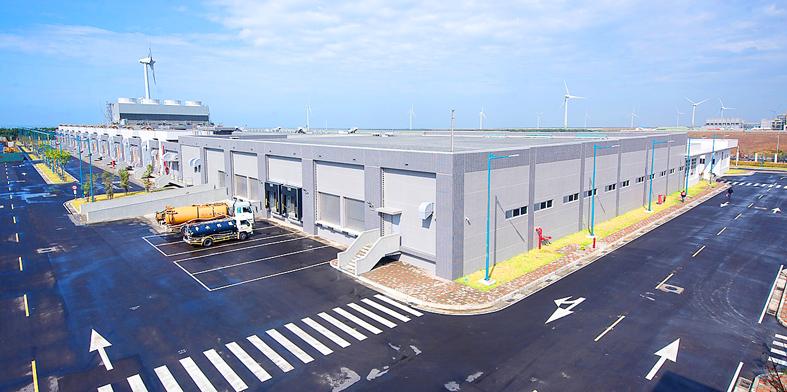
Photo courtesy of Google
The Regulations Governing the Chartered Capacity on Electricity Consumption Agreements Which the Users Shall Install Renewable Energy Facilities for Exceeding a Certain Capacity (一定契約容量以上之電力用戶應設置再生能源發電設備管理辦法) were originally due to take effect in November 2019, but were delayed, first due to a corporate backlash and then the COVID-19 pandemic.
Last-minute negotiations led to a concession for large users already producing renewable energy. Their pre-existing renewable energy production would count toward up to 20 percent of their requirement, Bureau of Energy Deputy Director-General Lee Chun-li (李君禮) said.
“Companies argued that they should be rewarded for already complying with the policy, but at least 80 percent of the requirement would still have to come from new builds,” Lee said.
Another way companies can reduce the requirement is by fulfilling it ahead of time, he said.
“Early birds” who fulfill the requirement within three years would receive a 20 percent requirement reduction, while those fulfilling it within 10 years would receive a 10 percent reduction, he added.
In addition to building their own renewable energy generation facilities, large users can comply with the requirements by purchasing “green” energy certificates, installing energy storage solutions or by paying an additional fee, Lee said.
“Paying a fee is going to be the most expensive option for companies. We want to encourage them to participate in renewable energy production,” he said.
Although the regulations have been criticized for being watered-down and affecting only a small number of users, Lee said the impact on overall use of renewable energy would be substantial.
“The 300 users make up 49 percent of the nation’s electricity use,” he said. “Lowering the threshold would affect a lot more users without having much of an impact.”
The regulations are to be reviewed in two years to see if the criteria for being a large user should be lowered or the percentage of renewable energy increased, Lee said.
Most large users are companies in the semiconductor, steel and petroleum sectors, and many have already committed to using more renewable energy than the regulations require due to supply chain demands, he said.
“We used to have to chase up companies to get them to use more renewable energy, now they are asking us where they can buy more,” Lee said.
Apple Inc, Microsoft Corp, Google, Facebook Inc and Walmart Inc are among the companies who have taken an “RE100” pledge — to transition to using 100 percent renewable energy.
The world’s largest contract chipmaker, Taiwan Semiconductor Manufacturing Co (台積電), took the RE100 pledge in July last year.
Chung-Hua Institution for Economic Research (中華經濟研究院) RE100 representative Alisha Lee (李承歡) said that while she welcomed the new requirements for large users, the regulations would exacerbate the problem of the high cost of renewable energy in Taiwan.
“While we hope to see more users transition to renewable energy, it is also important to drive down the cost of renewable energy, especially so that small and medium-sized enterprises can compete with large users,” Alisha Lee said. “I think there is high corporate demand and interest in renewable energy, but prohibitive cost is a major barrier.”
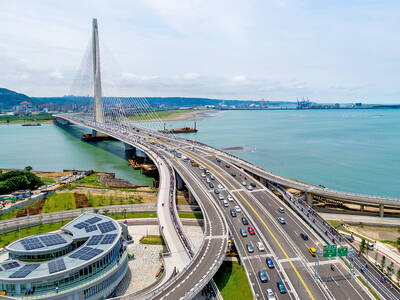
The Ministry of Transportation and Communications yesterday inaugurated the Danjiang Bridge across the Tamsui River in New Taipei City, saying that the structure would be an architectural icon and traffic artery for Taiwan. Feted as a major engineering achievement, the Danjiang Bridge is 920m long, 211m tall at the top of its pylon, and is the longest single-pylon asymmetric cable-stayed bridge in the world, the government’s Web site for the structure said. It was designed by late Iraqi-British architect Zaha Hadid. The structure, with a maximum deck of 70m, accommodates road and light rail traffic, and affords a 200m navigation channel for boats,
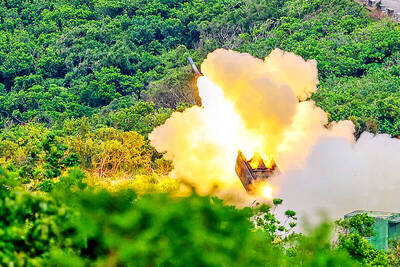
PRECISION STRIKES: The most significant reason to deploy HIMARS to outlying islands is to establish a ‘dead zone’ that the PLA would not dare enter, a source said A High Mobility Artillery Rocket System (HIMARS) would be deployed to Penghu County and Dongyin Island (東引) in Lienchiang County (Matsu) to force the Chinese military to retreat at least 100km from the coastline, a military source said yesterday. Taiwan has been procuring HIMARS and Army Tactical Missile Systems (ATACMS) from the US in batches. Once all batches have been delivered, Taiwan would possess 111 HIMARS units and 504 ATACMS, which have a range of 300km. Considering that “offense is the best defense,” the military plans to forward-deploy the systems to outlying islands such as Penghu and Dongyin so that
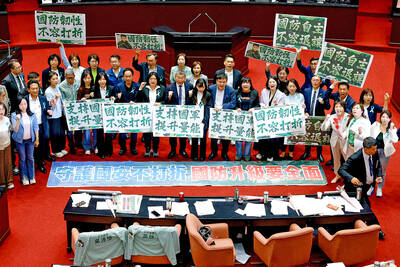
WHAT WAS ALL THAT FOR? Jaw Shaw-kong said that Cheng Li-wen had pushed for more drastic cuts and attacked him, just for the outcome to be nearly identical to his bill The legislature yesterday passed a supplementary budget bill to fund the purchase of separate packages of US military equipment, with the combined amount of spending capped at NT$780 billion (US$24.8 billion). The Chinese Nationalist Party (KMT) and Taiwan People’s Party (TPP) used their legislative majority to pass the bill, which runs until 2033 and has two main funding provisions. One was for NT$300 billion of arms sales already approved by the US for Taiwan on Dec. 17 last year, the other was for NT$480 billion for another arms package expected to be announced by Washington. The bill, which fell short of the NT$1.25

‘CLEAR MESSAGE’: The bill would set up an interagency ‘tiger team’ to review sanctions tools and other economic options to help deter any Chinese aggression toward Taiwan US Representative Young Kim has introduced a bill to deter Chinese aggression against Taiwan, calling for an interagency “tiger team” to preplan coordinated sanctions and economic measures in response to possible Chinese military or political action against Taiwan. “[Chinese President] Xi Jinping [習近平] has directed the People’s Liberation Army to be ready to invade Taiwan by 2027. China has a plan. America should have one too,” Kim said in a news release on Thursday last week. She introduced the “Deter PRC [People’s Republic of China] aggression against Taiwan act” to “ensure the US has a coordinated sanctions strategy ready should


 RSS
RSS