


Local governments yesterday announced updated disease prevention measures for tomorrow’s New Year’s Eve celebrations, with restrictions on crowd sizes, after the nation last week reported its first domestic case of COVID-19 in more than eight months.
Officials encouraged would-be attendees to eat ahead of time, as eating and drinking — aside from sips of water — would not be allowed at the venues, and masks would be mandatory, adding that last-minute changes to requirements are possible.
Checkpoints would be established for taking body temperatures, providing hand sanitation and registering contact information.
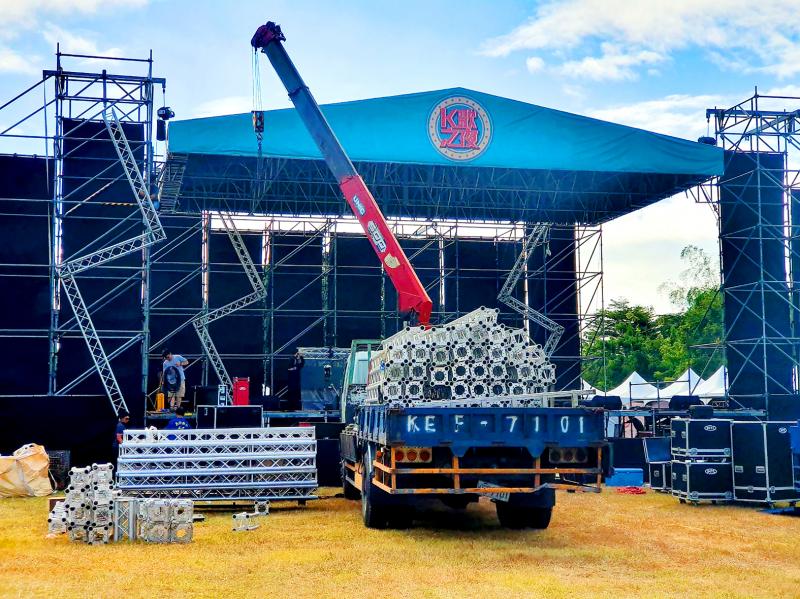
Photo courtesy of the Pingtung County Government via CNA
Taipei Deputy Mayor Vivian Huang (黃珊珊) said that the capital’s festivities would proceed as usual, but the number of attendees would be sharply reduced.
Taipei City Hall Plaza is to open at 3pm and no more than 80,000 people would be admitted, she said, warning that the number could be cut to 40,000 if necessary.
The plaza can hold about 110,000 people, but entrances to the plaza would be closed once the ceiling number is reached, she said.
Asked when the limit might be reached, Huang said experience showed that most people arrive between 6pm and 7pm, but people should not to line up before the gates open, as no one would be admitted before 3pm.
People could provide their contact information ahead of time through the TaipeiPASS (台北通) or myCode app, the Taipei Department of Information and Tourism said, adding that a QR code from one of the apps or a personal identification card must be presented at the entrance in case contact tracing becomes necessary.
Checkpoints would be erected on Songgao Road, Songshou Road and in front of the Taipei City Council, it added.
Anyone under quarantine or self-health management orders who attempts to enter would be flagged at registration, she said, adding that anyone with COVID-19 symptoms would be escorted to a hospital through a dedicated passageway.
The Taichung Information Bureau said that a maximum of 40,000 people would be allowed in Taichung Central Park, while up to 10,000 would be allowed into Renhua Park in Dali District (大里).
Attendees would also have to provide contact details either by filling out an online form ahead of time or at the entrance, or providing an identification card for scanning, bureau Director Huang Kuo-wei (黃國瑋) said.
Keelung’s New Year’s Eve event is to proceed as usual in the parking lot next to the West Passenger Terminal, although registration would be required at the venue’s single entrance, Keelung Department of Tourism and City Marketing Director-General Tseng Tzu-wen (曾姿雯) told reporters.
However, the annual flag-raising ceremony at Cheng Kung Elementary School scheduled for Friday morning has been scaled down and performances canceled, Keelung Department of Social Affairs Director Wu Ting-feng (吳挺鋒) said.
The public would still be able to attend the ceremony as long as they register and wear a mask, Wu said.
In Pingtung County, the government has recommended that New Year’s Eve revelers at the Millennium Park celebrations, where performances are to begin at 7:30pm, keep their cellphones on at all times in case of emergency.
A market in the park would open at 2pm, and food products would be sold, but they would have to remain in their packaging, the Pingtung County Cultural Affairs Bureau said.

The Tourism Administration yesterday announced that it would reward repeat international visitors with incentives of up to NT$8,000 to boost inbound tourism. The incentives are available to all international tourists, it said, adding that repeat visitors would be rewarded with NT$5,000 and would receive an additional NT$3,000 if they bring travel companions. The nation received 2,990,657 inbound visitors during the first quarter, marking a 3.8 percent increase from the same period last year, agency data showed. Japanese nationals are among groups visiting Taiwan the most. About 1.48 million Japanese tourists arrived last year, a year-on-year increase of more than 12
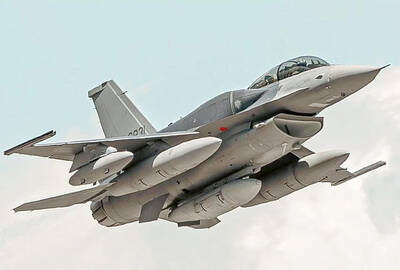
66 FIGHTER JETS: The aircraft is likely undergoing preparations for its transfer to Taiwan — a significant step forward in the nation’s modernization program, a lawmaker said The first of Taiwan’s order of F-16V Block 70 aircraft has been sighted in Texas ahead of delivery, Democratic Progressive Party (DPP) Legislator Wang Ting-yu (王定宇) said. Taiwan’s first F-16V Block 70 two-seat aircraft, tail number 6831, was seen flying from Lockheed Martin’s production facility in Greenville, South Carolina, to Naval Air Station Joint Reserve Base Fort Worth in Texas, Wang wrote on Facebook yesterday. The plane is likely undergoing preparations for its transfer to Taiwan, marking a significant step forward in the Republic of China Air Force’s modernization program, Wang said, citing military analysts. The F-16V Block 70 is a new-build version
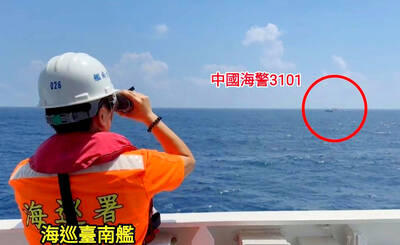
‘BRAZEN’: The holiday did not stop China from activities that infringe on Taiwan’s maritime jurisdiction, but the CGA is ready to defend the nation, Kuan Bi-ling said Beijing is intensifying maritime pressure on Taiwan, but the nation will never yield, Ocean Affairs Council Deputy Minister Sung Chen-en (宋承恩) said. The Coast Guard Administration (CGA) has adopted a “shadowing and monitoring” approach to avoid falling into a Chinese trap to escalate tensions and deepen the conflict, Sung said in an interview published yesterday in the Chinese-language Liberty Times (the Taipei Times’ sister newspaper). China Coast Guard formations patrolling waters east of Taiwan, as well as official Chinese vessels entering areas around Itu Aba Island (Taiping Island, 太平島) and Pratas Islands (Dongsha Islands, 東沙群島) show Beijing’s attempts to significantly step up
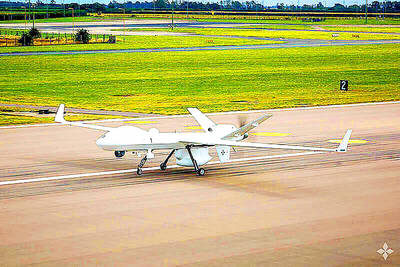
BOOST: By operating the same advanced systems as the US military, Taiwan would be better positioned to share and integrate intelligence with partners, an expert said The first batch of MQ-9B SkyGuardian drones has arrived in Taiwan, and is being assembled and tested by drone manufacturer General Atomics and the military ahead of flight trials as part of the air force’s acquisition to bolster its aerial surveillance capabilities, a source said yesterday. The air force allocated a budget of NT$21.7 billion (US$687 million) from 2022 to 2029 to procure four MQ-9B uncrewed aerial vehicles (UAVs) manufactured by General Atomics along with associated equipment such as ground control stations. The US has agreed to deliver the four MQ-9Bs to Taiwan in two batches this year and next


 RSS
RSS