


EVA Airways Corp (長榮航空) yesterday dismissed a New Zealand pilot — national COVID-19 infection case No. 765 — as he failed to comply with the airline’s anti-virus measures and did not fully report his contact and activity history, it said in a statement.
EVA Air said that yesterday, its discipline committee teleconferenced with the man, who is in his 60s and hospitalized for treatment.
On Friday last week, the airline asked the pilot whether he had complied with its anti-virus measures, such as wearing a mask during a Dec. 12 flight to the US, after a Taiwanese in her 30s, a copilot on the flight, said that she had contracted COVID-19 and that the pilot had not worn a mask.
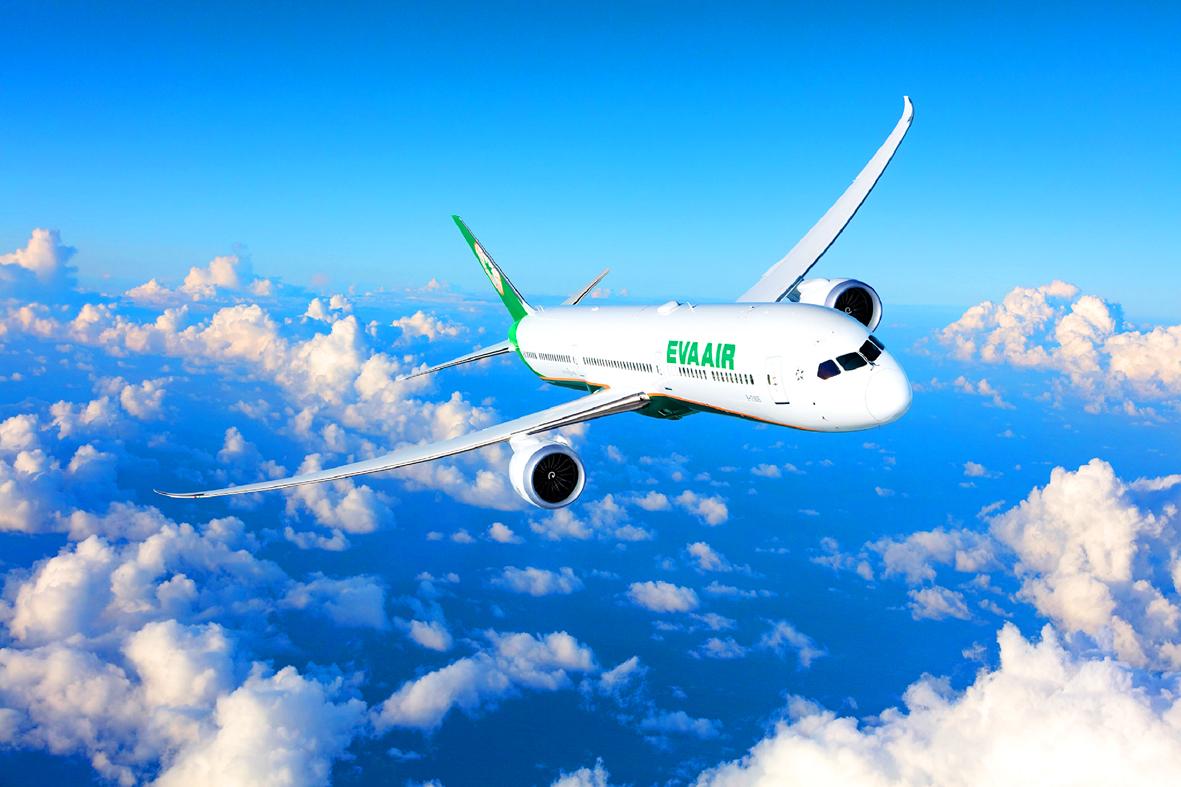
Photo courtesy of EVA Airways Corp
The man at the time refuted the accusation, EVA Air said.
However, a Japanese copilot on the flight, who also contracted the disease, later told the airline that the female pilot had reminded the New Zealander to wear a mask during the flight, EVA Air said.
As the evidence indicates that the pilot breached the Communicable Disease Control Act (傳染病防治法) and the Labor Standards Act (勞基法), EVA Air said that it immediately terminated his contract.
The pilot seriously damaged the airline’s reputation and negatively affected its operations, while the government is planning to tighten regulations for airlines and punish those with employees who poorly comply with COVID-19 measures, it added.
“While it might be understandable that people sometimes forget to wear a mask, the pilot kept lying, which reduced our trust in him,” an EVA official said by telephone.
Before the incident, it fired four flight attendants and two pilots due to their failure to comply with ant-virus measures, but such employees are in the minority, EVA Air said.
EVA Airways shares yesterday fell 0.76 percent to NT$13.05 in Taipei trading.
The New Zealander said that he was unable to recall where he had been during his rest days from Dec. 8 to Dec. 12, but a police investigation found that case No. 771 had close contact with him during that period, so she was tested on Monday and confirmed positive yesterday, the Central Epidemic Command Center (CECC) said on Tuesday.
The New Zealander had visited Shin Kong Mitsukoshi Department Store’s Tianmu (天母) branch in Taipei between 11:30am and 12:30pm on Dec. 8, Far Eastern SOGO Department Store’s Tianmu branch between 6:30pm and 7:30pm on Dec. 10, and Costco Wholesale Store’s Nankan (南崁) branch in Taoyuan between 11am and 12pm on Dec. 11, the center said.
As the New Zealander failed to honestly report his contact and activity history, including not even mentioning having close contact with case No. 771, which is a breach of the Communicable Disease Control Act (傳染病防治法), he could be fined NT$60,000 to NT$300,000, the center said.

A signaling system malfunction disrupted high-speed rail (HSR) services beginning at 8am today, with trains temporarily reduced to three northbound and three southbound trains per hour as authorities conduct inspections. The malfunction occurred on a section of track in Miaoli County during pre-operation checks early this morning, forcing northbound and southbound trains to use a single track, the HSR operator said. The regular schedule has been replaced with three hourly trains offering only nonreserved seating in each direction, stopping at every station, it said, adding that business class cars would still have reserved seating. Departures from terminal stations are scheduled at the top

Taiwan is still in the process of assessing the possibility of recruiting workers from Eswatini, the Ministry of Foreign Affairs said yesterday, adding that its goal is to help Eswatini upgrade its vocational training centers. If there are plans to recruit workers from Eswatini, safeguarding national security, protecting public health and ensuring the employment rights of Taiwanese would be prerequisites, Department of West Asian and African Affairs Director-General Yen Chia-liang (顏嘉良) told a news conference. Key considerations would also include filling labor shortages in specific industries, and fostering bilateral professional and technical exchanges, he said. Yen was asked about the progress of labor

A US uncrewed surface vessel (USV) encountered multiple Chinese warships during an autonomous transit of the Taiwan Strait, US defense company Seasats said in a statement on Wednesday. Seasats announced that a Lightfish USV had completed the first autonomous transit of the Taiwan Strait. Over five days, the USV traversed the entire length of the Strait while constantly monitoring surface vessel traffic, the company said. The Lightfish encountered multiple Chinese warships, one of which was a Chinese People’s Liberation Army Navy (PLAN) Type 056 corvette, it said. The Chinese vessels were operating “well within Taiwan’s exclusive economic zone without transmitting their identity via the

VERBOSE VESSELS: A CGA cutter and a China Coast Guard exchanged verbal barbs for more than a day in Taiwanese-controlled waters before the Chinese vessel left The Taiwanese and Chinese coast guards had a standoff near the strategically located Pratas Islands (Dongsha Islands, 東沙群島) in the north of the South China Sea, the Coast Guard Administration (CGA) said yesterday. The two sides engaged in intense radio exchanges over sovereignty claims during the 33-hour standoff. China Coast Guard vessel 3501 eventually left the restricted waters, 26.6 nautical miles (49.2km) west of the Pratas Islands, at 5pm yesterday, the CGA said. Lying approximately between southern Taiwan and Hong Kong, the Taiwan-controlled Pratas are seen by some security experts as vulnerable to Chinese attack due to their distance — more than


 RSS
RSS