


A plan to change the numbering system for Alien Resident Certificates (ARC) and Alien Permanent Resident Certificates (APRC) — so they have the same format as Republic of China national identification cards — was yesterday praised by foreign chamber representatives, who said it would make their lives in Taiwan more convenient.
“The policy makes more people feel that Taiwan is their home,” AmCham Taipei president Leo Seewald told the National Immigration Agency’s promotional event.
Starting on Jan. 2, the numbers on ARC and APRC cards, which are now two letters and eight digits, would be changed to one letter and nine digits.
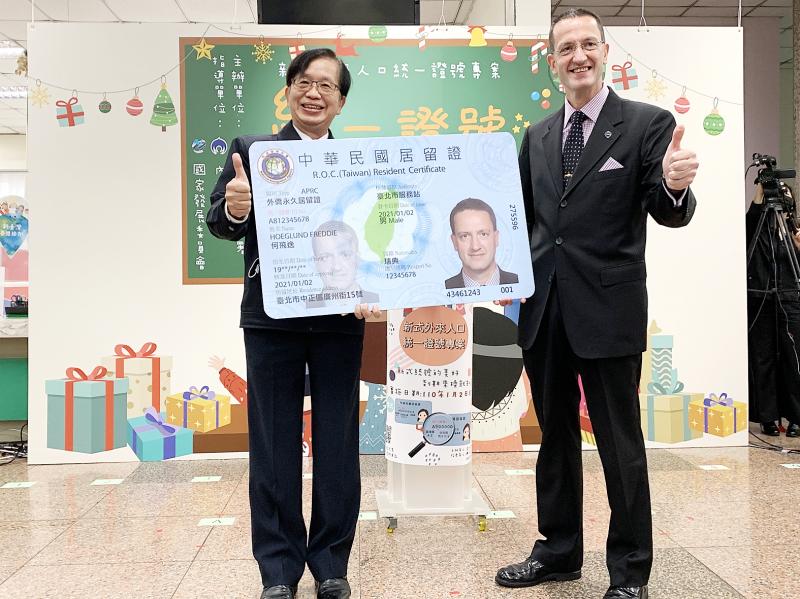
Photo: CNA
The new measure would enable foreign residents in Taiwan to make online purchases, book tickets, and register online, all of which can be challenging due to the current numbering differences.
Calling the inconsistent card numbering an issue of “sustainability and prosperity,” Seewald said the problem has been continuously raised by its members in the chamber’s annual business climate survey.
The European Chamber of Commerce Taiwan has been studying the issue since 2010, chief executive Freddie Hoeglund said, adding that he is happy to see it resolved.
“It will provide us easier access to e-commerce platforms,” Hoeglund said.
However, some time would be needed to ensure that the program is running well, Hoeglund added.
While redesigned information systems of government agencies are likely ready to go, the private sector might need more time to adapt to the changes, he said.
The change would affect about 871,006 ARC holders and 20,408 APRC holders, National Immigration Agency statistics showed.

South Korea has adjusted its electronic arrival card system to no longer list Taiwan as a part of China, a move that the Ministry of Foreign Affairs said would help facilitate exchanges between the two sides. South Korea previously listed “Taiwan” as “Taiwan (China)” in the drop-down menus of its online arrival card system, where people had to fill out where they came from and their next destination. The ministry had requested South Korea make a revision and said it would change South Korea’s name on Taiwan’s online immigration system from “Republic of Korea” to “Korea (South),” should the issue not be

Tainan, Taipei and New Taipei City recorded the highest fines nationwide for illegal accommodations in the first quarter of this year, with fines issued in the three cities each exceeding NT$7 million (US$220,639), Tourism Administration data showed. Among them, Taipei had the highest number of illegal short-term rental units, with 410. There were 3,280 legally registered hotels nationwide in the first quarter, down by 14 properties, or 0.43 percent, from a year earlier, likely indicating operators exiting the market, the agency said. However, the number of unregistered properties rose to 1,174, including 314 illegal hotels and 860 illegal short-term rental

Both sides of the Taiwan Strait share a political foundation based on the “1992 consensus” and opposition to Taiwanese independence, Chinese Nationalist Party (KMT) Chairwoman Cheng Li-wun (鄭麗文) today said during her meeting with Chinese President Xi Jinping (習近平). Both sides of the Strait should plan and build institutionalized and sustainable mechanisms for dialogue and cooperation based on that foundation to make peaceful development across the Strait irreversible, she said. Peace is a shared moral value across the Strait, and both sides should move beyond political confrontation to seek institutionalized solutions to prevent war, she said. Mutually beneficial cross-strait relations are what the
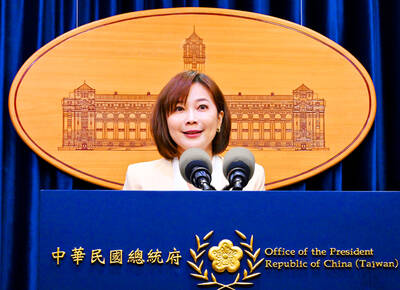
ECONOMIC COERCION: Such actions are often inconsistently applied, sometimes resumed, and sometimes just halted, the Presidential Office spokeswoman said The government backs healthy and orderly cross-strait exchanges, but such arrangements should not be made with political conditions attached and never be used as leverage for political maneuvering or partisan agendas, Presidential Office spokeswoman Karen Kuo (郭雅慧) said yesterday. Kuo made the remarks after China earlier in the day announced 10 new “incentive measures” for Taiwan, following a landmark meeting between Chinese President Xi Jinping (習近平) and Chinese Nationalist Party (KMT) Chairwoman Cheng Li-wun (鄭麗文) in Beijing on Friday. The measures, unveiled by China’s Xinhua news agency, include plans to resume individual travel by residents of Shanghai and China’s Fujian


 RSS
RSS