

Taipei Zoo officials were overjoyed yesterday after a mother anteater that had escaped more than three months ago was found on Sunday by two hikers near a mountain trail in New Taipei City’s Shenkeng District (深坑).
The mother anteater, called “Hsiao Hung” (小紅, “little red”), arrived in Taiwan in August 2018 and was housed in the zoo’s Tropical Rainforest section. She gave birth to a pup in May.
Zoo spokesman Eric Tsao (曹先紹) said that when an electronic scan identified that it was indeed Hsiao Hung, some of the staff were teary and overcome with emotions, as they were afraid she would not have been able to survive in the wild.
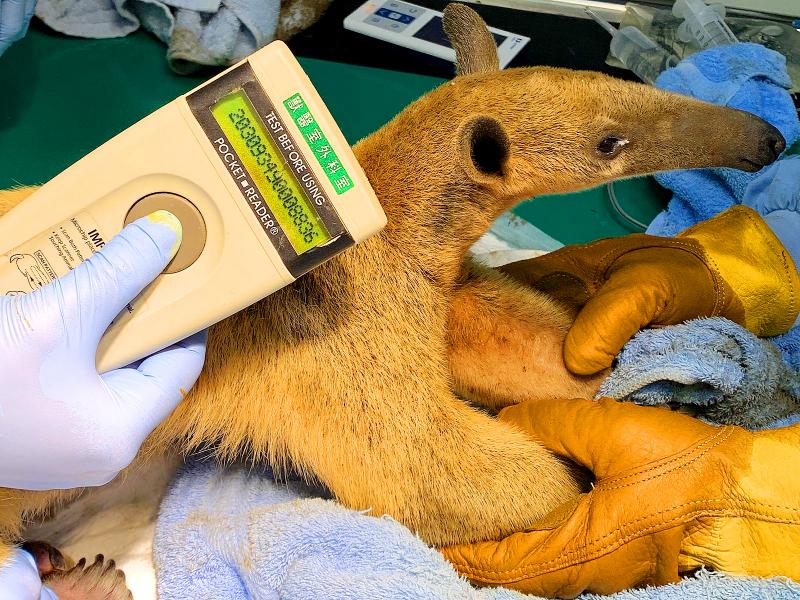
Photo courtesy of Taipei Zoo
Tsao joked that the zoo might have to change her name to “Rambo,” as she was found about 3km to 4km from the zoo in a forest with ravines, gullies and steep slopes, but still managed to find food and avoid being attacked by feral dogs and other predators.
After escaping from her enclosure on Sept. 1, the zoo had mounted searches for Hsiao Hung, including setting cage traps with food to lure her back, and posting notices and pictures on social media in a public appeal for help to find her.
After three months with no news of Hsiao Hung, zoo staffers thought there was little chance she would have survived.
When asked about Hsiao Hung during a question-and-answer session at the Taipei City Council last week to discuss the zoo’s budget, Tsao said: “This species of anteater is not indigenous to Taiwan, and the weather is turning cold. She needs a place with warm temperatures. She might also be exposed to attacks by wild predators, so we believe she might not be able to survive in the wild.”
However, on Sunday afternoon, two hikers, surnamed Chiang (江) and Hsu (許), saw a strange animal and took photographs of it, which were passed on to the zoo.
Officials immediately gathered a rescue team of 36, including zoo staff, animal rescue specialists and local residents familiar with the mountain trails.
After searching for more than an hour, they found Hsiao Hung sleeping inside the hollow of a tree.
The mother anteater was in pretty good shape, although she had scratches and other minor wounds, and showed signs of dehydration and malnutrition, having lost about 1kg since September, Tsao said.
Her wounds are being treated, and she is being fed her favorite food to hasten her recovery, he said.
It would take at least a month of recuperation and a health assessment before the public can see her again at the zoo, Tsao added.
The zoo has had other animals that had escaped in the past, mostly Formosan serows, gibbons and chimpanzees, he said.
Gibbons and chimpanzees have sometimes escaped by swinging from overgrown trees, but the simians are social animals and family-oriented, so they soon climb back to join their group, he said.

SOFT TENNIS: Yu Kai-wen and Huang Shih-yuan narrowly defeated their Japanese rivals to capture Taiwan’s first gold at the Asian Games in Nagoya Yu Kai-wen (余凱文) and Huang Shih-yuan (黃詩媛) won Taiwan’s first gold of this year’s Asian Games, defeating a Japanese duo in a nail-biter in the soft tennis mixed doubles final in Nagoya, Japan, while Johnny Sun (孫家閎) won silver in wushu and Shih Cheng-chung (石政中) won bronze in men’s kumite. Yu and Huang narrowly defeated Japan’s Toshiki Uematsu and Rena Temma 5-4 (2-4, 5-3, 4-2, 1-4, 1-4, 4-0, 1-4, 4-1, 7-5) to give Taiwan its first gold in soft tennis mixed doubles at an Asian Games since 2018. Sun secured Taiwan’s first wushu medal at this year’s game, with a combined score

UNITY: Lai thanked the nations who spoke up for Taiwan, saying that democracies must stand together to face global authoritarian expansion Taiwan yesterday thanked eight European and Indo-Pacific countries for opposing unilateral changes to the “status quo” in the Taiwan Strait in a joint statement earlier this week, as well as three of Taiwan’s allies for speaking up for the nation’s participation in the UN at the body’s General Assembly in New York. Minister of Foreign Affairs Lin Chia-lung (林佳龍) welcomed the support and expressed his appreciation for the countries’ stance, the Ministry of Foreign Affairs said in a statement. Foreign ministers and senior representatives of Australia, France, Germany, Japan, New Zealand, Poland, South Korea and the UK issued a statement on Tuesday

PLEA: How the UN addresses Taiwan’s security issue would be a test of its strength and relevance, Marshall Islands President Hilda Heine told the UN General Assembly Only Taiwan’s elected government can represent the people of Taiwan, Marshall Islands President Hilda Heine said on Friday at the UN General Assembly, calling for the nation’s inclusion in the UN. Taiwan and its 23 million people are a reality, and only its democratically elected government can represent it, Heine said when addressing the 81st session of the UN General Assembly General Debate. Appropriate ways must be found for Taiwan’s substantive participation in UN meetings if the UN is to be truly inclusive and effective in years to come, she said. UN member states would experience pressure to accept a
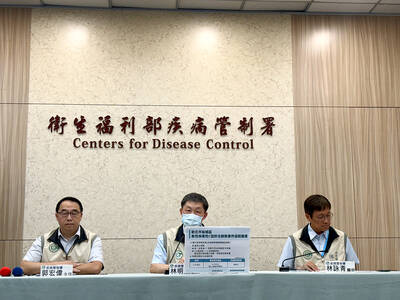
AT-RISK GROUPS: Of the accumulated 1,586 severe cases and 304 related deaths in this flu season, 65.8% were older people and 83.2% had chronic diseases, an official said The Centers for Disease Control (CDC) yesterday said that 165 severe flu cases and 30 flu-related deaths were reported last week, the highest weekly numbers in this flu season, and that cases might continue to increase, urging people to take precautions. Medical visits for flu-like illnesses increased by 1.4 percent to 141,374 last week, with 11.8 percent being emergency visits, showing that the seasonal flu is still in its epidemic period, CDC Epidemic Intelligence Center Director Guo Hung-wei (郭宏偉) said. From Tuesday last week to Monday, 165 severe flu cases and 30 flu-related deaths were confirmed, the highest weekly numbers


 RSS
RSS