


Joshua Wong (黃之鋒), 24, one of Hong Kong’s most prominent democracy advocates, was jailed yesterday for more than 13 months over an unlawful anti-government rally last year, the toughest and most high-profile sentence for an opposition figure this year.
Wong’s sentence comes as critics say the Hong Kong government is intensifying a crackdown on the opposition and chipping away at wide-ranging freedoms guaranteed after the former British colony returned to Chinese rule in 1997, a charge authorities in Beijing and Hong Kong reject.
Reacting to the court ruling, British Secretary of State for Foreign, Commonwealth and Development Affairs Dominic Raab urged Hong Kong and Beijing to stop their campaigns to stifle the opposition.
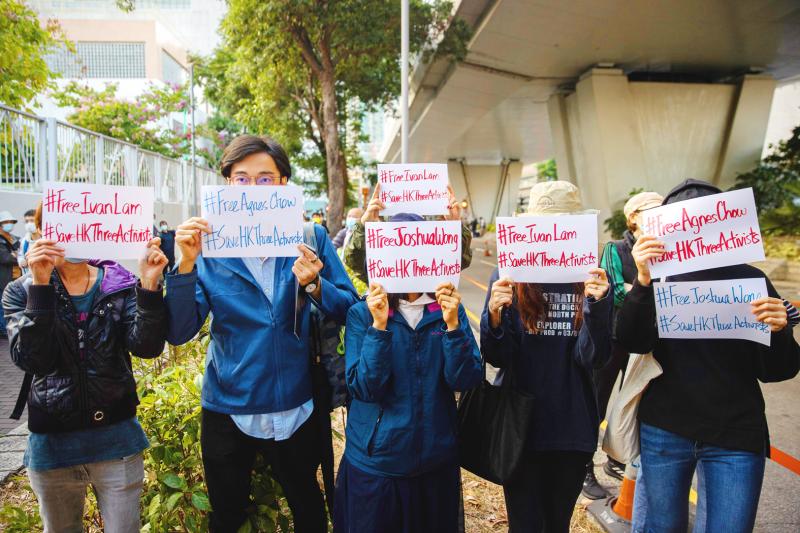
Photo: EPA-EFE
Wong had pleaded guilty to organizing and inciting an unlawful assembly near police headquarters during the height of the sometimes violent demonstrations in June last year. He faced a maximum of three years in jail.
About 100 supporters gathered quietly inside the court ahead of the sentence, while a small group of pro-Beijing protesters rallied outside, calling for a hefty prison sentence.
“I know the coming days will be tougher. We will hang in there,” Wong, wearing a black sweater and mask, shouted after the sentence was read out.
“It’s not the end of the fight,” Wong said later through his lawyers. “Ahead of us is another challenging battleground. We’re now joining the battle in prison along with many brave protesters, less visible yet essential in the fight for democracy and freedom for Hong Kong.”
Wong’s colleagues — Agnes Chow (周庭), 23, and Ivan Lam (林朗彥), 26 — were jailed for 10 and seven months respectively, on charges linked to the same demonstration when thousands of protesters surrounded the police headquarters on June 21 to demand the government withdraw a now-shelved extradition bill.
Chow, who cried inside court on hearing her sentence, had pleaded guilty to incitement and participation in an unlawful protest, while Lam pleaded guilty to incitement.
A familiar face at democracy protests since he was a teenager, Wong was less than one year old when Hong Kong returned to Beijing 23 years ago with a guarantee of freedoms not enjoyed on the mainland, including freedom of speech and assembly.
Ahead of sentencing, the district court judge read a letter from Wong’s mother to the court in which she said her son was “a young person who cares about society and is persistent in his ideals.”
US Senator Marsha Blackburn accused China of destroying “any semblance of autonomy in Hong Kong.”
“Keep the faith, Joshua, you are truly an inspiration to freedom fighters everywhere,” Blackburn said in a statement.
Rights groups were swift to condemn the rulings.
“By targeting well-known activists from Hong Kong’s largely leaderless protest movement, authorities are sending a warning to anyone who dares openly criticize the government that they could be next,” Amnesty International Asia-Pacific regional director Yamini Mishra said.

‘NO SECURITY RISK’: The Railway Bureau reassured the public that the technicians’ activities were limited to technical guidance and did not involve sensitive systems The Railway Bureau yesterday said it had invited eight Chinese technicians to assist with an airport MRT construction project. The bureau issued the confirmation after an Internet user said Chinese nationals had entered the construction zone of Taiwan Taoyuan International Airport’s Terminal 3 project. They asked why “individuals from an enemy state” were allowed access to such a major national infrastructure project, which raised serious concerns over Taiwan’s industrial safety, sensitive systems and information security. The bureau’s Northern Region Engineering Branch Office said subcontractor Taiwan Handle Industrial Co (台灣手把工業) of the Taoyuan airport MRT’s “Contract No. CU05 Project A14 Station Civil, MEP &

A US uncrewed surface vessel (USV) encountered multiple Chinese warships during an autonomous transit of the Taiwan Strait, US defense company Seasats said in a statement on Wednesday. Seasats announced that a Lightfish USV had completed the first autonomous transit of the Taiwan Strait. Over five days, the USV traversed the entire length of the Strait while constantly monitoring surface vessel traffic, the company said. The Lightfish encountered multiple Chinese warships, one of which was a Chinese People’s Liberation Army Navy (PLAN) Type 056 corvette, it said. The Chinese vessels were operating “well within Taiwan’s exclusive economic zone without transmitting their identity via the
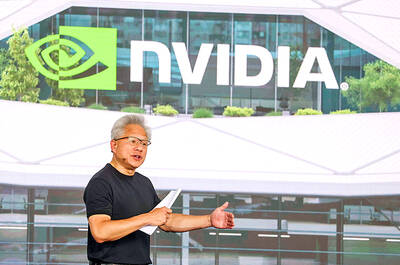
‘BOOMING’: ’ The number of partners we have here is incredible. You can see from their stock prices. They’re doing so well, they’re so happy,’ Jensen Huang said Nvidia Corp’s spending in Taiwan has ballooned to about US$150 billion a year, 10 times the US$10 billion to US$15 billion the company spent five years ago, Nvidia chief executive officer Jensen Huang (黃仁勳) said yesterday, suggesting Taiwan’s strategic importance in the global artificial intelligence (AI) supply chain. “Taiwan is the epicenter of the AI revolution. This is where the chips come, packaging comes. This is where the systems are made. This is where AI supercomputers were created,” Huang said at a meeting for the company’s employees in Beitou-Shilin Technology Park (北投士林科技園區) in Taipei, the planned site of Nvidia’s Taipei headquarters. “Taiwan
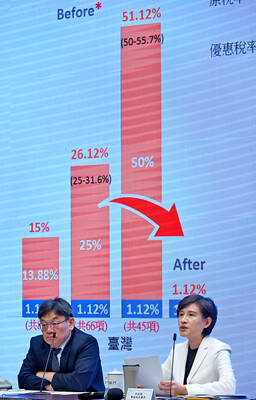
GREATER REACH? Auto parts and wood products would face tariffs of up to 15%, matching those targeting the EU, Japan and South Korea, Vice Premier said The US has announced that preferential tariff treatment for Taiwan’s non-semiconductor Section 232 goods would take effect retroactively from May 1, the Executive Yuan said yesterday. The US government yesterday posted a notice on the Federal Register’s public inspection Web site previewing tariff concessions for Taiwan under a memorandum of understanding (MOU) on Taiwan-US investment after two months of negotiations. The MOU signed on Jan. 15 stipulated three major preferential tariff arrangements: a 15 percent “reciprocal” tariff rate for Taiwan without stacking most-favored nation (MFN) rates; preferential Section 232 treatment for semiconductors and related products; and preferential Section 232 treatment for non-semiconductor


 RSS
RSS